
–submitted by Kevin Hoffman; photo by Jeff Smith
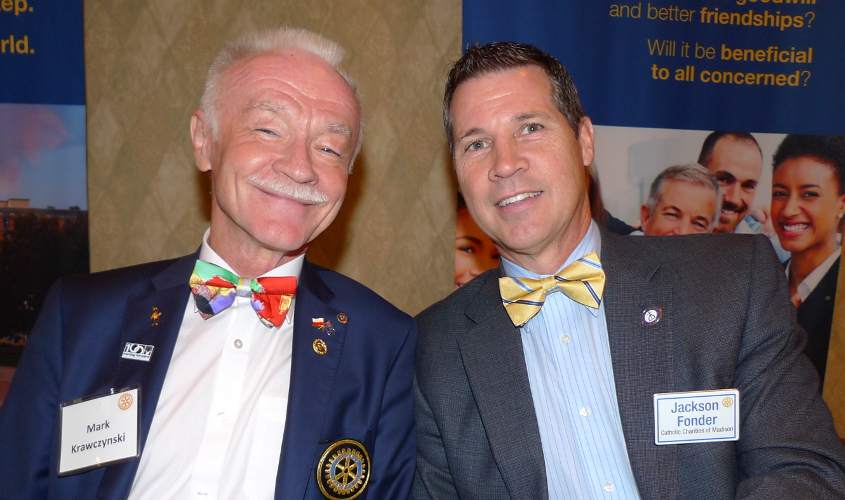
Mark Krawczynski (left) pictured here with our Rotary club member Jackson Fonder
Fellow Rotarian Mark Krawczynski is originally from Warsaw, Poland, but has spent most of his life in Australia as a Chartered Architect working on many large scale public and private projects, including the reconstruction of the iconic Sydney Opera House.
He is now taking his nearly 50 years of experience as an architect to promote and advocate for using known renewable energy technologies to change the way buildings are thought of and constructed. Thinking of future generations, Mark explained that the earth has reached the point where the use of traditional single-use energy technologies (oil, wood and coal), the growth of human population, and accelerating economic development have placed an unsustainable pollution load on the environment. Fossil fuels, in particular, have caused many cities and regions to become polluted to the point where one can no longer see the sky, clean water is threatened and increasingly scarce, and pollution-induced illnesses have claimed more lives than polio.
From this gloomy premise he proceeded to propose that solutions are available but that the time to start is now and the transition will take a long time – probably 40 to 50 years.
Mark proposed that one of the first things to change would be how we view the purpose of buildings. He described the construction of buildings in the past was from a “defensive” purpose. That is, buildings were primarily to keep out natural elements such as water, wind and sun and, therefore, wasted. Current buildings throw away these natural and renewable resources by repelling and sheltering us from them.
An updated consideration of buildings would look for ways to combine several clean, renewable energy technologies that would work in concert to provide for the energy needs of the building and spin off enough surplus energy to be used elsewhere in the community. Mark envisioned that buildings built in this fashion would need to combine several technologies to be feasible but would work better than traditional energy methods.
Buildings designed using the harmony of several clean energy technologies would need to incorporate the technologies into their shape and structure, as well as the surrounding environment and natural resources of the site (wind, sun, geo-thermal, water, etc.).
Mark concluded by showing a short video that described a prototype building called an Elemental Flow Tower. It was designed to use natural light, water, sun, geo-thermal, rain and wind to create a total system of self-contained energy production, as well as serve the functions of a building for shelter and comfort.
CLICK to view the video of this presentation on our club’s YouTube Channel.
 Rotary Club of Madison, Wisconsin