
submitted by Mary Borland; photo by Mike Engelberger

Fellow Rotarian Bradley Hutter, “The Accidental Shark Diver”, gave an illustrated talk (lots of pictures and video!) about his unique experiences while scuba diving with sharks, including Tigers, Bulls, Hammerheads and Great Whites.
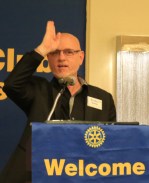 Brad got into swimming with sharks “by accident” — he was scuba diving in Stuart Cove, Nassau, Bahamas, and was asked to be a safety diver by the staff of the Discovery Channel who were there filming sharks in the area.
Brad shared that sharks are typically shy and avoid humans. Sharks are in the fish family and half the species are under 39” long; some sharks can rotate their eyes backwards but they cannot swim backwards – so if they are coming towards you, just guide them along past you; some sharks have up to 30,000 teeth in a lifetime; and some deep cold water species can live to be 1,000 years old! Sharks are apex predators and are very important to sea life balance.
He gave the audience some “tourist based shark rules” to follow if we ever find ourselves in the water with a shark nearby:
- Don’t swim away, in fact, lean forward, even just a little bit.
- Put your hands up in a blocking mode.
- Look the shark in the eye! If you avert your eyes you become vulnerable; Respect sharks.
- Swivel your head while keeping your eyes on the shark’s eyes.
- Don’t swim in cloudy water – you may be mistaken for something sharks actually like to eat, like a seal.
- Avoid dolphins as sharks may be in the area and about to feed on them.
Brad shared that on average, 10 people per year are killed by sharks (because the shark mistook the person as food they eat or the person got in the way of sharks feeding) and by comparison, 725,000 people per year are killed by mosquitos and 25,000 are killed by dogs. Humans kill ~100,000 sharks per year and some species are down to 5% left.
Mismanaged plastic waste is a big concern for our oceans with China being the biggest polluter. Work needs to be done to stop countries like China from putting plastics in the ocean and laws are needed to outlaw fishing for fins.
Brad has enjoyed learning about sharks over the past seven years as he’s worked with experts seen regularly on Discovery Channel’s “Shark Week”, National Geographic, and Animal Planet. It’s a family affair as Brad’s daughters are now avid shark divers themselves.
Brad has a saying – “Live every week like it’s shark week.”
If you missed our meeting this week, you can watch the video here.

 We are living in the information generation – constantly bombarded by new information and larger and larger amounts of data. In fact, the world is changing so rapidly that the future has become a complete unknown. That unknown is creating anxiety and interrupting everyone’s ability to live happy lives. Through his pursuit of the science of happiness, Dr. Niraj Nijhawan has uncovered specific root causes of unhappiness and developed steps that people can take to reprogram their brains and escape this crisis.

 Rotary Club of Madison, Wisconsin