Category Archives: 2. Meetings

What is the Value of a Liberal Arts Education?

–submitted by Andrea Kaminski; photo by Stacy Nemeth
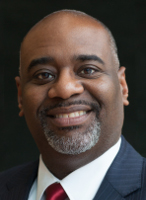
Scholz KarlIn a lively presentation, UW-Madison College of Letters & Science Dean John Karl Scholz made the case for a liberal arts education, especially when it comes from UW-Madison. However, he stressed that the University needs the input of employers and alumni to make it happen.

According to the Bureau of Labor Statistics, the average weekly earnings of people with less than a four-year degree dropped between 1979 and 2014, while those of people with a bachelor’s degree or higher rose 14.1 percent. Scholz was proud to report that the median student graduating from UW-Madison has no student debt. The almost 50 percent who do have student loans graduate with an average of $27,000 in debt. While that can be a significant factor in a new graduate’s life for several years, Scholz (an economist) compared it to an average return on investment of $500,000 to $1 million in additional earnings over a lifetime.

There are 35 departments in the College of Arts & Letters, encompassing the physical sciences, social sciences and humanities. The College offers nearly 60 percent of all credit hours at UW-Madison, according to Scholz. He noted that employers are looking for the skills and qualities that students gain in the College: a broad knowledge base, problem-solving skills, communication skills, especially writing, and critical thinking.

A recent survey of alumni who are one year out of college, or eight to ten years out, found that in general they have been successful in getting jobs. Their earnings are good, and 90 percent said they use their liberal arts education in their professional work. Scholz highlighted two recent graduates who have excelled: one becoming a Rhodes Scholar and the other a Marshall Scholar.

Outstanding research in Letters & Science includes the discovery of a new species of humans in our evolutionary history, and research projects examining the origins of the universe and international humanities. Scholz also noted that the UW Geology Museum is a gem which is visited by more than 50,000 school children per year.

Metrics for student success are good, including an average time-to-degree completion rate of 4.13 years and a 95.8 percent retention of freshmen. UW-Madison is rated ninth in the nation for best value for students.

But academic triumph has to be matched with cultivation of job and life skills in order to make students successful in their careers, particularly for first generation college students. That is why the College has launched the Letters & Science Career Initiative, which applies dedicated faculty and staff to work with alumni, employers and students. A new course for sophomores will help them reflect on their skills, define their aspirations and build on their strengths. Students will learn how to write a top-notch resume and build a professional network.

Another program, Career Kickstart, will create an immersive, residential learning community for 600 sophomores, with onsite academic advising and mentoring.

Scholz noted that no one is in a better position to help students build their professional network and succeed in a career than past graduates of UW-Madison who have done just that.  Alumni will be active in mentoring, doing informational interviews and offering internships. Scholz envisions that, through outreach and partnerships with employers, there will be more opportunities for students. UW Letters & Sciences seeks to be a “go-to place” for talent in the job marketplace.

Scholz was asked what we, as Rotarians, can do to help, and he asked us to help project the University’s success story throughout the state and beyond. He noted that state legislators will take note if they hear positive news about the university from “unexpected sources,” i.e., not university administrators.

CLICK to watch the video on our YouTube channel.
Is Your Business Ready for the X’ers?

–submitted by Donna Hurd; photo by John Bonsett-Veal

Seeger Debbie

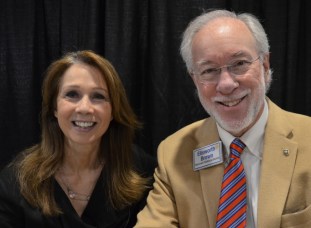
Debbie Seeger, (pictured here with club president Ellsworth Brown) in her presentation entitled “Shift Happens,” provided a futuristic view of the incoming workforce, the ensuing competition to attract and retain talent, and how to prepare for the inevitable.

By the numbers: Baby Boomers represent one of the largest generations in history (78 million) and we are aging.  The succeeding generation, Gen X, represents just over half of the baby boomer population.  Clearly, the laws of supply and demand indicate the supply of available workers will not sufficiently meet the potential demand of employers.  The repercussions of poor planning or absence of planning will prove detrimental to a business’s viability.  Defining the gaps in knowledge with the loss of boomers will be an integral part of assessing the needs of the business in its attempt to successfully move from one generation of workers to the next.

Technologically astute, this up and coming generation knows what they want and are not afraid to ask for it.  Unlike their predecessors, X’ers will continue to seek employment opportunities that align with the way they want to work and value their contributions.  Blind loyalty will not be afforded to businesses that have not done their homework.  Understanding what motivates this group is integral to drawing, engaging and retaining this talent.  Enticing this limited resource with money only will prove to be a losing strategy.  Emotional compensation (the feeling of being valued) has to be part of the package.  Determining the right blend of financial and emotional compensation will be a recipe for success for both employer and employee.

Aligning their mission, vision, and values with their recruitment, development and retention strategies businesses are sure to have an advantage over those that do not.  Trust is the foundation that will support the shifting paradigm in order to engender loyalty from the incoming talent pool.

CLICK to watch the video on our club’s YouTube channel.

Brandon on Madison’s Business Climate

–submitted by Rick Kiley; photo by Mike Engelberger

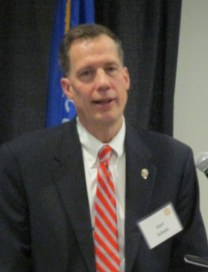
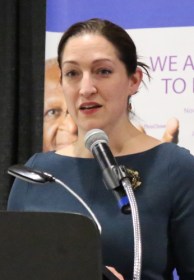
Brandon ZachZach Brandon, President of the Greater Madison Chamber of Commerce, addressed our Club regarding “Madison’s Business Climate,” citing four trends to explain where we are headed.
The first trend is “sector density,” the types of jobs and industry we have.  These include growing industries such as biomedicine and bioscience, health tech and information technology.  Three-fourths of local jobs created are diverse sources in the private sector, not just Epic Systems; recent hiring is by Google, Amazon, Zen Desk and Microsoft.

One reason for this job creation is jobs in technology and engineering are easily filled with local employees and do not pay relatively high salaries.

The second trend is our development of talent.  We are a large market for software creation.  State-wide software development is nearly as large an employer as manufacturing.

We have a significant in-migration of “millennial” workers, born in the late 1970s.  Unlike most cities, in Madison this group tends to buy homes and settle.

The third trend cited is our area’s reputation.  We have a lot to boast.

Recently, Forbes magazine listed us fifth among cities “winning the battle” for info-tech jobs; the Millken Institute ranks us eleventh among cities for high-tech job growth; per capita, we rank fourteenth for raising venture capital to fund early-stage companies.

In addition, we rank #1 among cities for successful aging.  What underlies these encouraging rankings?  Proximity to education, Mr. Brandon says.  However, we are nearly the most income-segregated city, a troubling situation that requires the attention of the entire community.

The fourth trend is wealth creation.  “Madison is the epitome of how to win the coming jobs war”, he says.

Concluding, Mr. Brandon sees the Madison area as “on the upswing,” but we “need to learn how to brag” to communicate our strengths, that “we are the next big thing;” “we solve the world’s problems;” and “we export solutions.”

CLICK to watch the video on our club’s YouTube Channel.

Sarah Marty on the State of Community Theatre in Madison

–submitted by Mary Borland; photo by Mike Engelberger

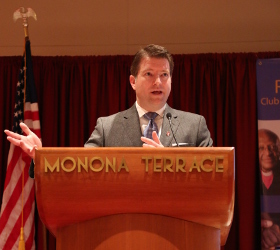
Sarah MartySarah Marty, the Director of Arts programs at UW-Madison Continuing Studies, spoke to Rotarians about the vibrant arts program in the Madison and surrounding areas and the challenges they are facing. Sarah opened her remarks by sharing the lyrics to “No Business Like Show Business” and stating there is “no people like show people.”  She proceeded to demonstrate how this is true by sharing information about the vibrant arts programs in Madison.  Community theatre is made by, with and for the community and deploys local talent onstage and backstage and is responsive to the community in which it exists. Did you know:
  • There are over 35 art companies in the area
  • Madison is punching way above its weight in the arts and is 48th in the nation in spending $0.14/capita compared to our neighbors in Minnesota who spend $6.26/capita on the arts
  • Many local talents have gone on to national careers in the arts and some of them have come home to Madison to share and grow the next round of talent
  • Changing economic realities create challenges as companies in the area compete for limited resources, talent, volunteers, etc.
  • Change is required to be a sustainable arts program
    • Local companies are talking and planning with one another to help create many opportunities for many people to participate
  • Ticket sales now have to accommodate for 60% of funding with another 20% coming from foundations and another 20% coming from individual and business donations.
  • Examples of ways the local community arts programs are adapting include:
    • Joint auditions are happening across the community to cast two shows at once
    • Similar sets are shared between shows when feasible
    • Shared box offices
    • Shared rehearsal spaces
    • Shared pool of carpenters

Sarah closed stating there are 3 Big Questions each arts company needs to be asking themselves:

  1. Who are we?
  2. What do we do?
  3. Why do we matter?

The art companies need the community’s help with these questions and finding new ways to work together and truly move to an “ours vs mine” approach. She left us with noting that we should support the arts because they are important to peoples’ lives – the arts affect our spirits, our hearts and connect us to our fellow human beings.

For more on Sarah’s background, visit www.littlebrownnotebook.com.

CLICK to watch the video of Sarah Marty’s presentation.

Aaron Olver Shares Future of University Research Park

–submitted by Valerie Johnson; photo by Mike Engelberger

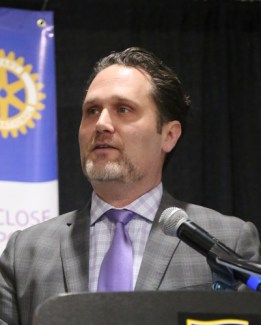
Olver AaronBAaron Olver previewed the future of University Research Park with Rotarians Wednesday, January 13.
Olver is the Managing Director of the University Research Park. Established in 1984, University Research Park, a UW-Madison affiliate, is an internationally recognized research and technology park that supports early-stage and growth-oriented businesses in a range of sectors including engineering, computational and life sciences.

Olver shared the strategy underpinning the park’s direction.  It has three purposes: support UW-Madison via real estate; commercialize UW research; and make technology transfer more fruitful.

Originally the park wanted to attract employers, Olver said.  Rather they had more success attracting small entreprenerus.  We accidentally become a real estate developer, unique nationally, he added. He answered the question of the biggest challenge being transportation, since so many professionals live off mass transit lines.

He closed by outlining the park’s agenda:

  • Reposition @1403, a building next to Wisconsin Institute of Discovery (WID) on University Ave, as a campus-focused entrepreneurial hub
  • Add density through development of large tenants such as Exact Science
  • Expand food cart program
  • Attract/Develop amenities such as coffee, fitness
  • Invest in programming/events and community making
  • Make green spaces more usable
  • Conceptual master plan for URP 2, second research park
  • Attract development partners for areas not core to URPs mission

Olver previously served as Director of Economic Development for the City of Madison. Prior to joining the City, Olver spearheaded Wisconsin’s economic development efforts as Secretary of Commerce under Governor Jim Doyle.

Olver earned an undergraduate degree in Economics from UW-Madison and a graduate degree in Philosophy, Politics, and Economics from Oxford University, Oxford, UK, where he was a Rhodes Scholar.

For more, visit www.universityresearchpark.org

CLICK to watch the video of this presentation on our club’s YouTube Channel.

2016 Mentor Scholar Winter Mixer Highlights

–submitted by Janet Piraino; photos by Mike Engelberger

IMG_3483

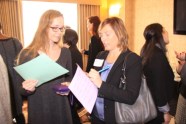
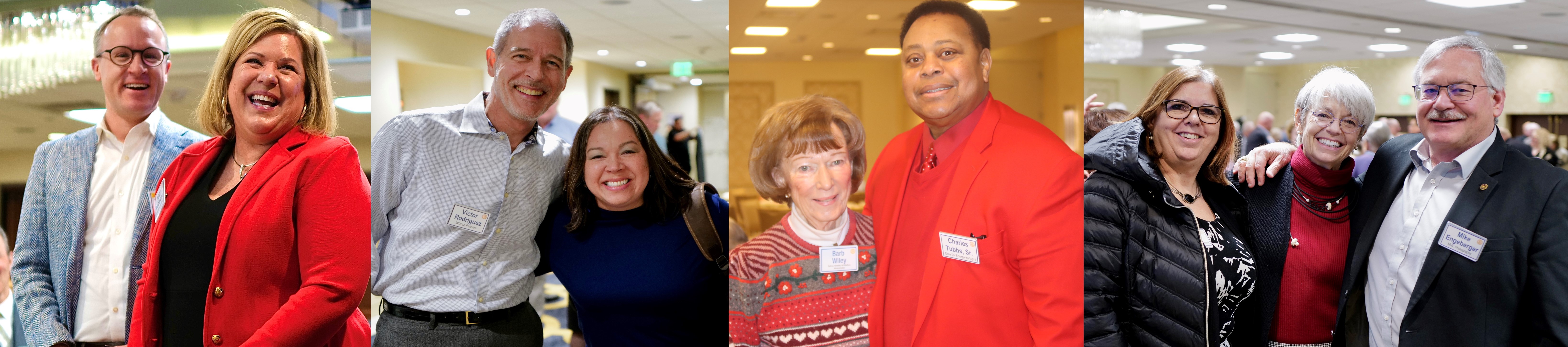
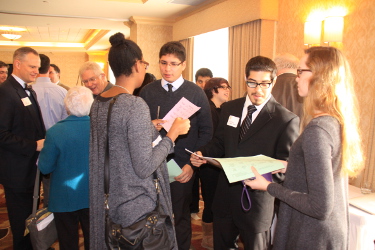
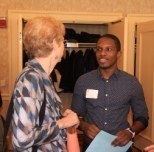
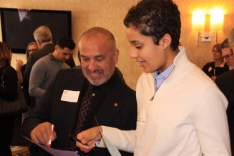
Rotary scholars and their mentors got to enjoy some fun and games at the Mentor-Scholar Mixer at the Hilton before our noon lunch on January 6.  We were prompted to get to know each other a little better by finding people in the room who matched the descriptions on our Mentor-Scholar Bingo sheet.  As a result, we now know who helped their scholar find a job and who likes Caesar salad!

IMG_3511  IMG_3477  IMG_3474

Jacqui Sakowski shared the importance of offering internships to our scholars, to ensure they have the opportunity to put the their education to use.  We heard a moving story from one of our senior scholars whose internship is helping launch a career in women’s health.  Ellie Schatz handed out applications for the new Kay Family Scholarship Fund  designed to help students who need financial help beyond eight semesters to finish their degrees.

IMG_3564  IMG_3536  IMG_3479

It was incredibly inspiring to be in a room filled with the next generation of leaders…and the people who are willing to do whatever it takes to help them overcome their challenges and reach their goals.  It made me proud to be a Downtown Rotarian!