Category Archives: 2. Meetings

Fred Mohs Tells His Father’s Story

–submitted by Rich Leffler; photo by Loretta Himmelsbach
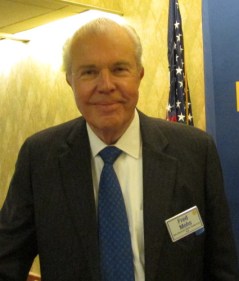
Fred MohsA 11 18 15As a three-time beneficiary of the Mohs surgical procedure at the Mohs Clinic of UW Hospital, this reporter was especially interested to hear Fred Mohs talk about his father, Dr. Frederic Mohs, Sr. Born in 1910, Dr. Mohs was a medical pioneer. Although he intended to be a radio engineer when radio was the popular technological rage, he got a college job at Birge Hall at the UW. A prominent cancer researcher introduced Dr. Mohs to the work being done in the 1930s on cancer: what exactly was it and how could it be treated? His mentor changed the trajectory of young Fred’s career. He went to medical school.

Dr. Mohs was an admirer of Thomas A. Edison, and he used Edison’s technique of intensive experimentation until he found that zinc chloride in a paste could kill cancer cells while still preserving cellular structure. Much of Dr. Mohs’s work was funded by WARF’s first research grants. He applied this compound to tumors of the skin to kill the cancer, while allowing a pathologist to determine whether the cells on the periphery were cancerous or normal. Very large and invasive tumors, which other surgeons were unable to excise, were now susceptible to treatment.

Dr. Mohs early-on learned the difficulty of communicating medical science to the general public. An interview with the Wisconsin State Journal about his technique resulted in a headline: “Cancer Cure Discovered.” Colleagues were outraged. His license to practice medicine was threatened. Eventually, especially after Dr. Mohs successfully treated a prominent Madison physician for a very large neck tumor, the value of the Mohs procedure was generally recognized.

Today, the Mohs procedure is widely used. In combination with an onsite pathologist, and working closely with plastic surgeons when needed, Mohs clinics allow surgeons to remove skin cancer with a minimally invasive and disfiguring procedure. Thank you Dr. Mohs, and thanks to Fred for telling us the story.

Did you miss our meeting this week?  CLICK to watch the video.

Dawn Crim Receives Rotary Club of Madison Community Service Award

Presented by Carol Toussaint on November 18, 2015; photo by Loretta Himmeslbach

Crim AwardA

From left: Carol Toussaint, Dawn Crim & Club President Ellsworth Brown

I am here as a member of our Club’s Member Recognition Committee.  This is a committee established by our board to annually make recommendations to recognize members for their efforts on behalf of our Rotary Club.  The recognition is in one Rotary’s Five Avenues of Service which are club, community, international, new generations and vocational.

The board receives the recommendations and presents the award.  My job today is to introduce a member who is receiving a community service award on behalf of our Rotary Club.  Dawn Crim.

Dawn is an Associate Dean for External Relations for the UW School of Education.  She is a well organized and busy, busy person.  In addition to her role at the UW, Dawn is involved in many projects and organizations within our community.  In addition to her professional work, family and community service activities, Dawn has devoted a great deal of time to Rotary over her eight years of membership.

She joined our Rotary Club in 2007 and immediately got involved in committees.  Dawn has worked with the Rotaract Club on the UW campus.  She serves as a mentor to one of our Rotary scholars and has served on our Program Advisory Committee.  In addition, Dawn has for six years been an active member on our club’s Community Grants Committee. This is not a small commitment.  She has interviewed grant applicants and attended numerous meetings with other Community Grants Committee members as they develop recommendations for the funding projects each year.  You’ll also have seen newsletter photos of Dawn as part of our Hiking/Skiing Fellowship Group.  Dawn finds time for Rotary and for her continuing dedication to our Rotary Club, we are awarding our 2015 Rotary Club of Madison Community Service Award to Dawn Crim.

The Club has made a $200 gift in her name to The Rotary Foundation of Rotary International, and President Ellsworth presented Dawn with a special certificate and a pin to recognize the community service award.

Congratulations, Dawn.


Michael Edmonds: Bold (Not to Say Crazy)

–submitted by Valerie Johnson; photo by Karl Wellensiek

Edmonds Michael

History is not only made by celebrities, it’s made by each of us and the choices we make every day.  That’s the lesson Michael Edmonds says we should take away from the 43,000 documents and images compiled by the Wisconsin Historical Society on the civil rights movement.

Edmonds brought to life the 1964 Mississippi Freedom Summer Project with some of the stories behind the people collecting these historical documents for Rotary members Feb 11.  This was the summer when volunteers arrived in the Deep South to register voters and teach nonviolence, and more than 60,000 black Mississippians risked everything to overturn a system that brutally exploited them.

Wisconsin has one of the richest civil rights collections anywhere, and the largest American history collection anywhere, according to Edwards.

Edmonds is Deputy Director of the Library–Archives at the Wisconsin Historical Society and curator of its online collection of more than 25,000 pages documenting Freedom Summer. A 1976 graduate of Harvard University, he earned an MS degree at Simmons College in 1979 and taught part-time at the University of Wisconsin–Madison.

These vivid primary sources shared by Edmonds, collected by the Wisconsin Historical Society, provided both firsthand accounts of this astounding grassroots struggle as well as a broader understanding of the civil rights movement and the work to collect them.

Edmonds closed by saying, “Remember, an archive is not a dusty old place, it’s an engine to remember our place in the world quite differently. For example, your grandmothers didn’t know they had to be so brave.”

For information on Edmond’s book Risking Everything: a Freedom Summer Reader click www.wisconsinhistory.org.  To view 43,000 pages of historical civil rights documents click: www.Wisconsinhistory.org/freedomsummer.

Mattoon Addresses Rotary on 2015 Economic Outlook

–submitted by Rick Kiley; photo by Karl Wellensiek

Mattoon Rick

Our guest speaker this week was Rick Mattoon, Senior Economist and Economic Advisor for the Federal Reserve Bank of Chicago.  Mr. Mattoon’s talk, “U.S. and Wisconsin Economic Outlook for 2015”, reviewed the current state of our national and local economy as it emerges from the Great Recession of 2008-2009.

The past year has seen the strongest GDP growth since the recession, with second and third quarter growth of 4.6% and 5%; however, this growth is weaker than the recoveries following the recessions of 1981-1982 and 1974-1975.  This slow recovery reflects a variety of conflicting trends.  For example the oil price collapse of approximately 50% has generated a $550 annual household benefit, but wage gains are modest; employment has reached prerecession levels, but increases in wealth are the result of stock market gains, so household wealth increases are unevenly shared.

There are a variety of factors to watch in 2015 that will influence the near future.  Examples include a number of states increasing minimum wages, the prospect of continued growth of construction spending after several years of below average investment.

With regard to Wisconsin, the southern part of the state is closely tied to the economy of the Chicago area, which has underperformed national growth.  And, while personal income in the state has recovered well, only half the jobs lost in the recession have returned.  The business climate in the state is generally positive, about the middle of the pack among the states.

Mr. Mattoon concluded saying the U.S. economy has good momentum and should have GDP growth in the coming year approaching 3%.  Wisconsin, however, has made slower progress since the recession.  Our biggest challenge as a nation will be weak international markets as a result of their slower growth and the strength of the dollar.

Rotarians Called to Action on Hiring People of Color

–submitted by Paul Fanlund; photo by Jeff Smith

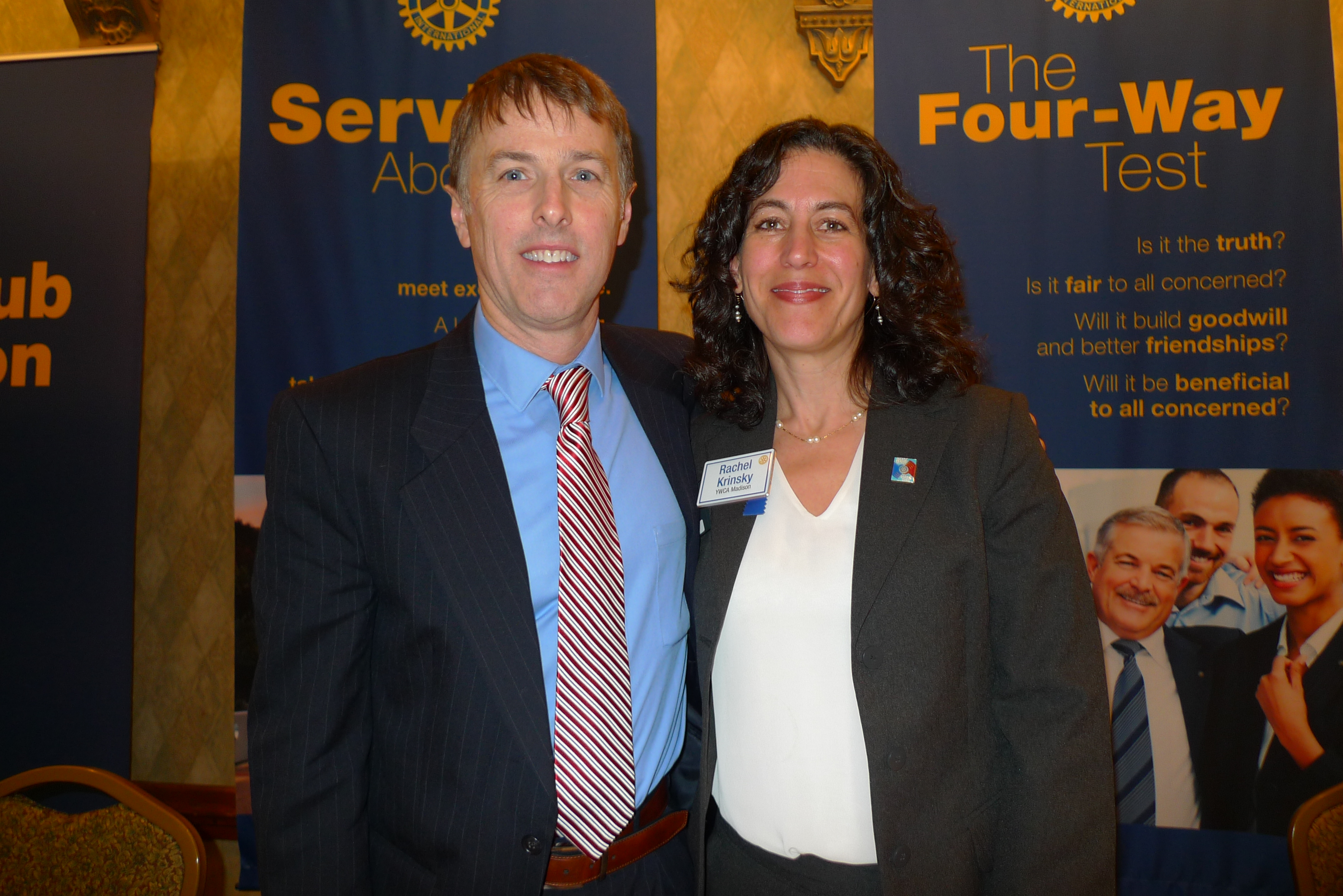
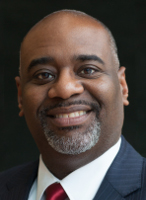
Taylor Krinsky

Downtown Rotary is filled with civic and business leaders who influence hiring decisions as well as the culture within their organizations, Wednesday’s speakers said.

And so businesspeople in Rotary should help accomplish a community goal of increasing the employment and earnings of at least 1,500 currently unemployed or underemployed African-American parents by 2020.

That goal was set out in a joint presentation by Ken Taylor, executive director of the Wisconsin Council on Children and Families, and Rachel Krinsky, CEO of YWCA Madison.

The two said progress will require a special level of effort by business leaders; it will not occur naturally. Leaders must be flexible and creative, Krinsky told the gathering: “Just being fair,” which Rotarians have no doubt been, “has not gotten us to where we want to be.”

Taylor told the group that while pursuing diversity is the right thing to do, it is also an imperative because a more diverse, younger generation will drive business growth in coming years.

The two listed what will be required for success:

  • A commitment by corporate, public, nonprofit, health and higher education employers to significantly increase the diversity of their workforces;
  • Outreach to connect with targeted families;
  • An increase in the number of jobs that pay family-supporting wages;
  • Additional public and private investment in the agencies that provide job training and placement;
  • On-the-job supports to encourage retention and advancement of targeted new entrants to the workforce.

The two also focused on what business leaders should emphasize: leadership, skill building and hiring practices.

Under leadership, they pointed to a personal and organizational commitment, communication, strategic planning, tenacity and accountability.

For Rotarians to develop skills and get educated, they suggested reading, training and workshops, talking with credible peers who have expertise and using consultants.

And employers should review hiring practices, network, review position descriptions and explore the question of “fit.”

 If you would like a copy of the PowerPoint presentation used by this week’s speakers, contact the Rotary office at rotaryoffice@rotarymadison.org, and they will email you a copy of it.

Imagining to Remember

–submitted by Donna Hurd; photo by Jeff Smith

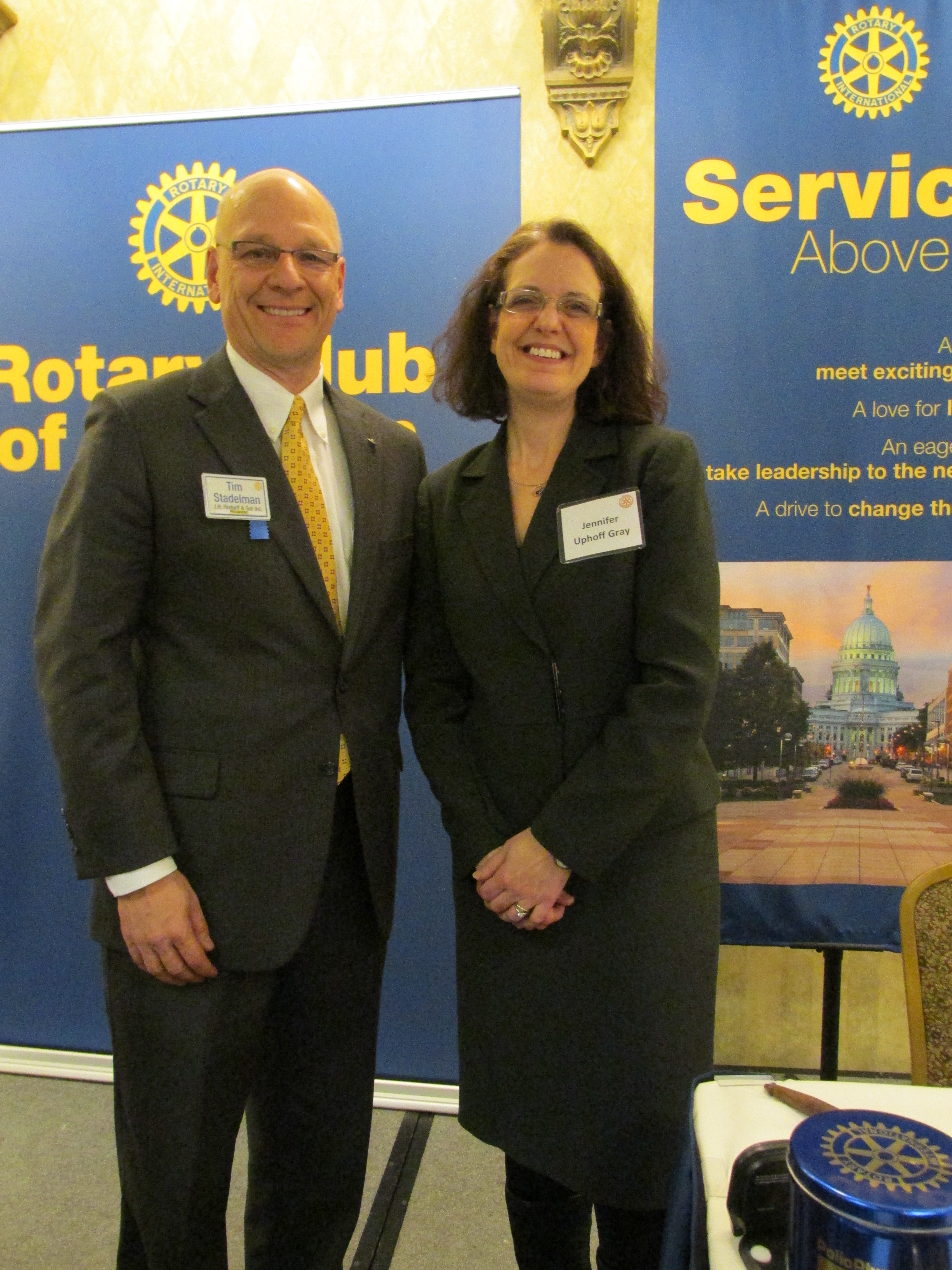
President Tim Stadelman and Jennifer Uphoff Gray

President Tim Stadelman and Jennifer Uphoff Gray

An enthusiastic, Jennifer Uphoff Gray, Artistic Director of Forward Theater Company presented a side of the artistic community that few know existed…its commitment to the community by educating, entertaining and connecting the community.  In its 5th season, the Company strives to connect the work they do as artists to the community.  Its latest endeavor tackles the subject of dementia, in general, and Alzheimer’s (the most common form of dementia) in particular.  Through its partnership with the University of Wisconsin Hospitals and Alzheimer’s & Dementia Alliance of Wisconsin, the theater is taking on an integral part in the understanding, communication and ultimately addressing alternative treatments for this debilitating disease.

Example after example was presented to highlight the profound role the Arts play in Alzheimer’s treatment.  Clinicians and researchers alike are touting the benefits realized through music, art and story-telling therapy for patients and caregivers.

The Theater’s mission of connecting the work they do as artists to the community will begin on stage January 15 – February 2 with the presentation of “The Other Place,” an off-Broadway show about a research scientist on the cusp of the development of a new dementia drug as she struggles with personal hardships. Extending social conversations beyond the stage, the company offers talk backs (post-show discussions), pre-show lectures and the “Play Club” (in-depth discussions with the theater professionals) providing theater goers an opportunity to engage in thoughtful discussion about the subject matter at hand.

The culmination of this collaboration, will take place on Sunday, February 15, 2015, at Promega Corporation, 5445 E. Cheryl Parkway in Fitchburg from 1:00pm – 4:00pm.  “Imagining to Remember”  will be an interactive program for the general public, as well as caregivers, professionals, and others who work with people living with Alzheimer’s and dementia. This interactive event features Professor Anne Basting, Director of the UW-Milwaukee Center on Age & Community and Founder of TimeSlips Creative Storytelling. TimeSlips is a method of engaging with those with memory loss using imagination and storytelling. Attendees will have the opportunity to experience specific creative engagement practices including Poetry, Visual Art, Movement and Music. A moderated Q&A panel will follow, featuring Anne Basting and other leaders of this innovative approach to connecting to those with Alzheimer’s and dementia.

We applaud the efforts of Forward Theater Company in addressing the social concerns of our community through the arts!