Category Archives: Rotary Club of Madison Guest Speaker

August 9: New McKenzie Center: Educating Young People in the Skilled Trades

–submitted by Joy Cardin

From left: Michael Johnson, Alan Branch, Club President Charles McLimans and John McKenzie

Rotarians heard from the key leaders in the Boys and Girls Club of Dane County’s new McKenzie Regional Workforce Development Center that just celebrated its grand opening on July 15.  The center was created to address the labor shortage in the skilled trades industry.  John McKenzie, owner of the McKenzie Apartment Company and donor to the project, approached BGCDC president and CEO Michael Johnson when he realized the only way to meet the demand was to diversify the workforce – which is largely male, white, and aging.  McKenzie says the center will be good for the economy, business, and the social fabric of the community.   Johnson says the $30-million project is the largest workforce training center in Boys and Girls Club history and has spurred similar efforts in 20 other communities.  Alan Branch, the vice president of workforce development for BGCDC, says it is important to interest children between the ages of 9 and 13 in the skilled trades before they eliminate them as a career choice. The McKenzie Center will offer some participants an alternative to college and a path directly from high school to a job.  There will also be opportunities for apprenticeships, education about wealth management, entrepreneurship, and post-secondary education.   

If you missed last week’s program you can watch it here:  https://www.youtube.com/watch?v=9sBXA3PkCo0&t=1574s.
August 2: Science Behind a Smile

–submitted by Joy Cardin

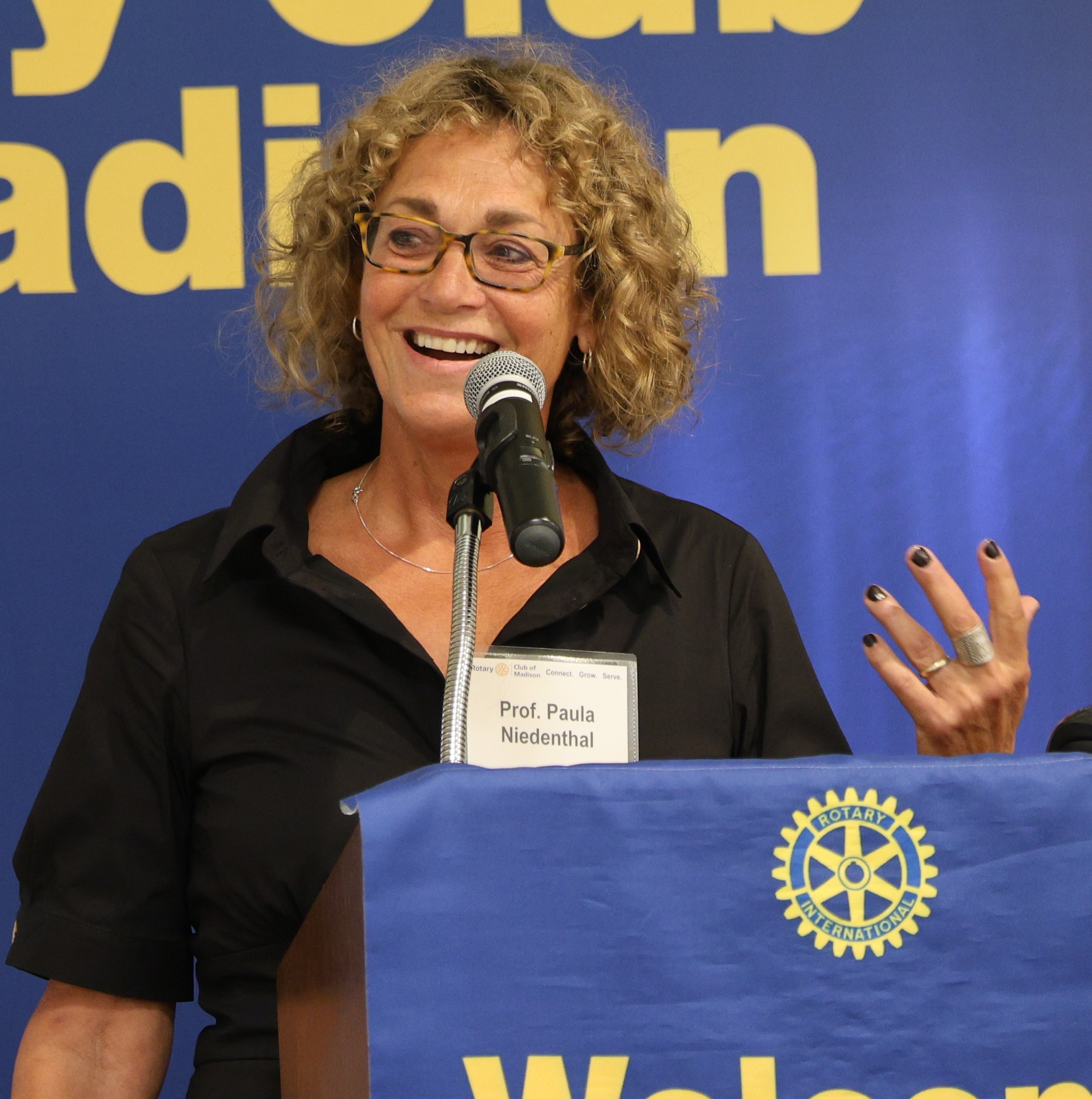
Why do we smile?  Why do people smile more in some countries than others?  And how are our smiles perceived?  UW-Madison Psychology Professor Paula Niedenthal shared some of the answers to these questions in her presentation before the Rotary Club of Madison. Neidenthal, who researches smiling around the world, has found countries like the U.S. that are more ancestrally diverse, smile more than others.  She theorizes this is because people from different cultures and countries who spoke different languages (and who emigrated to the United States) would use smiles and facial displays of emotion to better communicate and build trust.  On the other hand, in European countries with less ancestral diversity where only one language is spoken, don’t smile as much and perceive the North American smile as “fake” and intended to “sell you something”

Neidenthal was smiling as she began her presentation because the Madison City Council the night before started the process to change an ordinance than bans keeping pigs in Madison. The proposed change would allow miniature pet pigs to live in the city.  Neidenthal is hopeful this will mean her pet pig, Rudi, the subject of numerous recent news stories, will be able to continue to delight his fans around her near westside neighborhood.  

If you missed last week’s meeting, you can watch it here:  https://www.youtube.com/watch?v=D_OhddgERD8&t=13s

July 26: Name, Image, Likeness (NIL) and WI Athletics

–submitted by Kevin Hoffman

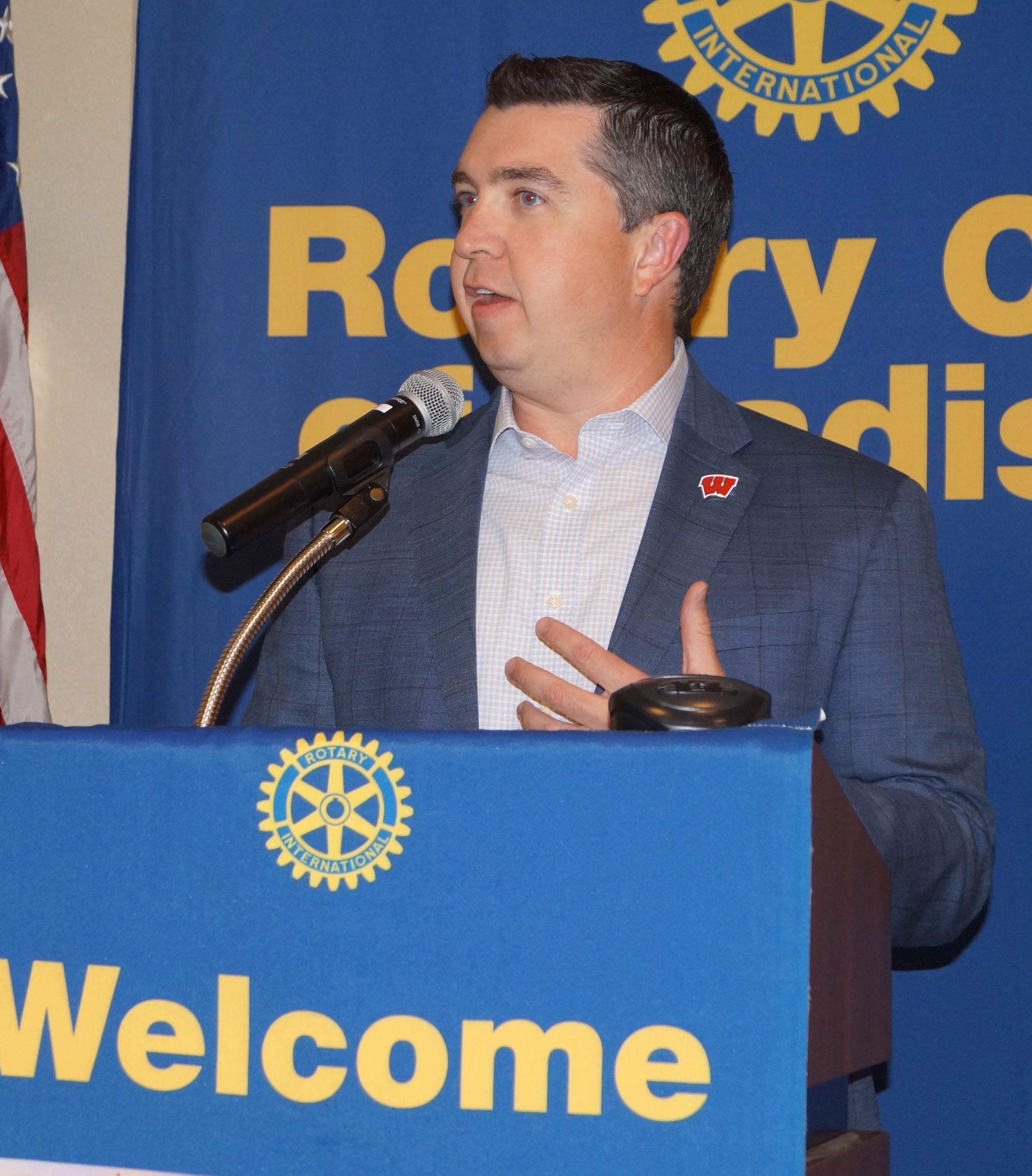
Brian Mason is the Director of Name, Image, Likeness (NIL) Strategy with the UW Athletic Department.  Under recent state legislation and Supreme Court decisions the rights of student athletes to control and use their name, image and likeness for monetary gain was established. There is also federal legislation pending with the objective of creating a level playing field for all athletes and programs instead of fifty different sets of laws to follow. He clarified that NIL cannot be used as a recruiting inducement by schools.

The NIL strategy at UW seeks to facilitate the connection between student athletes and businesses. In addition to the traditional pillars of athletic performance, academic achievement, and personal development, the impact of financial advancement is also positively guided and supported. The UW Athletic Department works toward helping the student athlete develop the business and life skills to manage NIL benefits.

If you missed our meeting last week, you can watch it here: https://www.youtube.com/watch?v=7za6kqTh-uQ&t=1918s.

July 12 Program: The Life of Jim Thorpe

–submitted by Kevin Hoffman

Bestselling author, journalist, and former Madisonian David Maraniss spoke about the subject of his latest book, Path Lit by Lightning: The Life of Jim Thorpe.  Thorpe was a gifted Native American athlete who excelled in all sports but was best known for professional football, baseball, basketball, and winning Olympic gold medals in 1912 in the decathlon and pentathlon. Despite personally enduring racism and prejudice and broader efforts by the US government to “erase” Indigenous culture and language, Maraniss felt that Thorpe transcended sports fame.  He overcame many tragedies and challenges in his life to be a lesson in perseverance for him and his people.

If you missed our meeting this week, you can watch the video here: https://youtu.be/tGk-450W0RM.

Lake Monona Waterfront Design: Connecting Downtown with the Lakefront

–submitted by Joy Cardin

The Lake Monona Waterfront Design project is a once-in-a-generation opportunity to create an inclusive, environmentally-focused, and economically-beneficial gathering space for the entire community according to our guest speakers at the Madison Rotary Club’s June 14th meeting. 

The chair of the Lake Monona ad-hoc committee Allen Arntsen and the president of Downtown Madison Inc. Jason Ilstrup explained the need, the benefits and the future of the ambitious project that will redesign a nearly two mile stretch of the Lake Monona shoreline from Olin Park to Machinery Row on Williamson Street.  

The winning master plan submitted by the Denver design firm Sakaki includes an elevated boardwalk, a waterfront restaurant, a boathouse, nature center and an expansion of the Monona Terrace Convention Center.  The plan acknowledges the Ho-Chunk Nation’s history with Lake Monona and focuses on its future environmental health.  

The ad hoc committee will continue to work with Sakaki and other community shareholders on finalizing the redesign over the next few months.  A final plan is expected to go before the Madison Common Council for a vote in October.  

If you missed our meeting this week, you can watch the video here: https://youtu.be/pDCwzjOakDs.

June 7: Welcoming New Neighbors

–submitted by Valerie Renk

New member Kai Gardner Mishlove, Executive Director, Jewish Social Services of Madison, shared a bit of the organization’s work before focusing on how JSS welcomes refugees to Madison at the June 7 meeting.

Mishlove said JSS resettles families globally regardless of ethnicity, nationality or religion, starting that work in the 1970s, as they resettled Jewish individuals fleeing antisemitism in the USSR.

Since 2016, JSS resettled 435 individuals. Democratic Republic of Congo, Afghanistan, and Syria are countries most represented today.  

“Their trip includes waiting years, before arduous vetting, and then waiting more years,” Michlove said. “We’ll never know their challenges.”  

If you missed our meeting this week, you can watch the video here: https://youtu.be/uRtBcSlnqis.