Category Archives: Rotary Club of Madison Guest Speaker

July 27 Rotary Speaker: Gary Maier – Meaning of Major Mounds at Lake Mendota

–submitted by Valerie Renk

Forensic Psychiatrist Dr. Gary Maier worked 31 years at Lake Mendota Health Institute, becoming familiar with the effigy mounds there.  Mounds and effigies (mounds shaped as animals) were created in our area at the highest rate by the Ho-Chunk between 750-1250 AD.  Golfers and the mental health community seem to be protecting them, as there are major groupings at Blackhawk County Club and Mendota. 

There were hundreds of mounds in this area.  Fortunately, many were documented; unfortunately many were grave robbed. 

Our Rotary Club is working with Maier to plan a respectful future visit to the Institute’s mounds. If you’d like to be added to the list for a tour, contact the Rotary office at 608-255-9164 or rotaryoffice@rotarymadison.org.

If you missed our meeting this week, you can watch it here: https://www.youtube.com/watch?v=N-1E97H9eYs&t=57s.

July 20: The Power of a Grand Civic Vision: Monona Terrace

–submitted by Ellsworth Brown

Who knew that 115 years ago Madisonian John Olin, believing that Madison was a special place, engaged John Nolen, a preeminent city planner from Cambridge, Massachusetts, to produce a 1911 plan for Madison that became a preeminent example of the urban landscape movement?  And who knew that John Nolen,  author of projects for well over a dozen cities, created plans as well for the Tenney Park-Yahara River Parkway, the UW, and Wisconsin’s state park system?  And especially, who knew that the track of Nolen’s plans affirmed a four-generation vision for Madison that inspired the city, county, state, non-profit organizations and private funding to give us Monona Terrace and leave its traces in a Downtown 2000 Master Plan including 1.7 miles of Lake Monona waterfront, a six-fold increase in the tiff valuation since 1995, a new State Museum, the Overture Center, hotels that will soon double room numbers within two blocks of Monona Terrace, and an affirmed self-confidence in Madison’s common future? 

George Austin knew, and he shared it with us on Wednesday, July 20.  The exceptional attendance at Wednesday’s meeting honored his 23-year career with the city, including 15 years as Planning and Development Director and leader of the Monona Terrace project; and now the Wisconsin History Center’s project manager. 

This is one of Madison’s greatest stories, told to us by the successor to the visions that preceded him.

If you missed our meeting last week, you can watch it here: https://www.youtube.com/watch?v=YOPR2u7dYRQ&t=874s.

July 13: Joe Loehnis & Dr. Bill Banfield: Artistic Citizenry: What Does It Mean to be a Contemporary Artist Today?

–submitted by Jessika Kasten

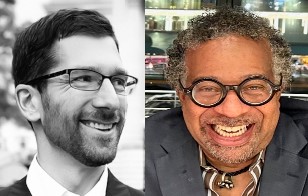
On July 13, Joe Loehnis and Dr. Bill Banfield spoke to the Club on the topic of Artistic Citizenry: What does it mean to be a contemporary artist today? Dr. Banfield is an award-winning composer who is currently serving a three-year Composer in Residence program with the Wisconsin Chamber Orchestra. Dr. Banfield spoke about the important role the arts play in bridging communities by bringing people together and building community. He also previewed the evenings’ Concerts on the Square piece: Testimony of Tone, Tune and Time that was created as a reflection on liberty and inspired by Frederick Douglass.

If you missed our meeting this week, you can watch the video here: https://www.youtube.com/watch?v=fYm3I6Bc640&t=5s

June 15: Russia’s Invasion of Ukraine

–submitted by Ellsworth Brown

UW Professor Yoshiko Herrera’s subject was one that grips us all:  Ukraine, Russia and a war of punishment and increasing brutality.  Superimposed on the United States, Ukraine ranges from New York City to beyond Chicago.  There are three focal questions:  who, how, or why did it begin; how might it end; and what can we do about it?

Succinctly, Professor Herrera provided answers:  Putin is responsible for the war, stoking Russian citizens’ fears—of NATO for example—as motivation and enforcing it with highly controlled information and brutal internal suppression of opposition.  Similar confrontations in Chechnya, Georgia, Crimea, and Syria drew little attention, and an isolated Putin perceived a weak NATO and a divided United States would be little concerned about Ukraine.  His miscalculation was massive.

Herrera forecast that “Putin will continue until someone forces him to stop.”  A united Ukrainian defense will probably prevail, though at great cost, and then join NATO—it is a country large enough to avoid a takeover, and Russia’s historic tactics have been to punish and destroy, not conquer.  Meanwhile, sanctions have begun to work within a context that will damage Russia and remove trust of it for decades.

And what can we do?  We can talk to friends and acquaintances, support local protests on behalf of Ukraine, make donations to humanitarian aid for Ukraine, and write to our senators and representatives.

We all hope . . . .

If you missed our meeting this week, you can watch it here: https://www.youtube.com/watch?v=GAgiZ3n_dKQ&t=161s

June 8: A Wisconsin for All – Department of Safety and Professional Services (DSPS)

–submitted by Kevin Hoffman

Our own Rotary Club of Madison member Dawn Crim, the Wisconsin Secretary of the DSPS, spoke to the membership about the important role the DSPS plays in the conduct of our everyday lives.  This important agency touches everyone, directly or indirectly, by ensuring that industry (such as construction and other commercial businesses with safety responsibilities), licensed professionals (such as healthcare and legal practitioners), and public policies are operating in the public interests of safety and economic development.  She cited a few of the many programs from health care to prescription opioid control to clean energy to military veteran transition to equity and inclusion that support and protect citizens and businesses. 

If you missed our meeting this week, you can watch the video here: https://youtu.be/fs0jpPYUuDg.

May 25: Reshaping The Future of South Madison

–submitted by Janet Piraino

On May 25th, Madison’s Director of Planning and Community and Economic Development Matt Wachter talked about the great redevelopment plans for Madison’s South Side. South Siders told the City they wanted new gathering places, affordable child care, better parks, improved bike and pedestrian infrastructure, increased transit service and better connectivity across Park Street.  Most importantly, they wanted to avoid gentrification of, and displacement from, their neighborhoods.  The City is focusing on The Village on Park, the Thorstad property and the Perry/Ann Street corridor. Common elements of the plans include transforming giant parking lots into buildings/programs that foster affordable housing, create job opportunities, support small business and improve amenities.

If you missed our meeting this week, you can watch the video here: https://www.youtube.com/watch?v=j1n8Hl72np0&t=1317s.