
November 17, 2021 Rotary Guest Speaker
–submitted by Ellsworth Brown

Justice Castaneda a man on a mission, delivered a distillation of his academic work with the passion and intensity of a community advocate. He cares deeply about Madison, a city in which he was raised and moved many times before concluding his teenage years. Castaneda knows intimately the challenges that caused and perpetuate the strictures of redlining, covenants and zoning. He concluded his presentation with a summary that gives this complex subject a frame:
- Contemporary housing patterns are limited by historical and contemporary land use policies and practices that contribute significantly to housing volatility, absence of strong community ties, and family cohesiveness.
- Volatility in housing tenure—sometimes 50% turnover a year—is an undercurrent in pathological associations with concentrated poverty. For example, affordability of land available for development in Madison is limited to former redline sections that are depressed and underserved, formerly redline sections of the city. Purchase of this lower-priced land for economic development often removes the availability of affordable housing.
- Impediments in access to democratic processes and institutions are detrimental to collective efficacy.
- The structure of local governments, their deliberate pace extending through two or three administrations, limits the use of long-term mitigation strategies.
Castaneda added that the absence in Madison of viable, efficient transportation routes between neighborhoods, services and sources of employment in historically redlined, covenant restricted areas continues to contribute to ongoing volatility of housing.



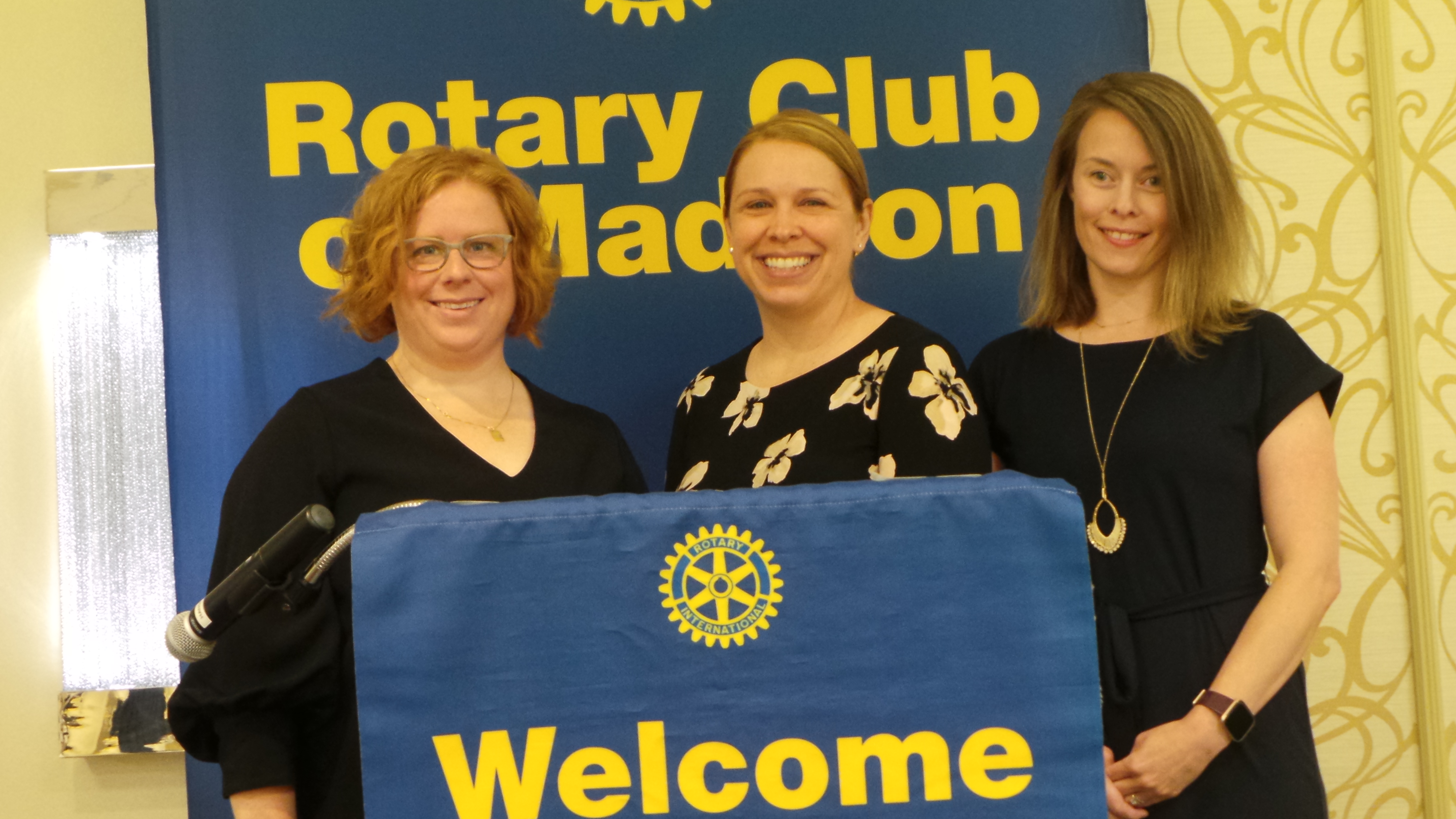 Rachel Sattler, Kim Curran, and Kate Walsh comprised a panel supplying a fast-moving presentation about the largely unaddressed scope of problems and possible solutions to sexual assault of UW-Madison women.
Statistics are startling: 26% of UW-Madison undergraduate women have experienced unwanted contact, 20% have been assaulted, and 6.8% have suffered violent attacks. The use of alcohol by men and women plays a large role in these abuses.
The consequences are several and can have life-long symptoms: rape victims often experience PTSD, depression, and substance abuse disorders. School dropouts occur.
The panel agreed that responses to sexual assault are unsatisfactory because a highly functioning, systemic, coordinated, multi-agency source of physical and medical, psychological, and legal services does not exist.
This problem is magnified by most victims’ lack of knowledge about these services, their sources and their unknown and disparate locations, the absence of transportation, and the lack of an advocate who could knit all of these together, provide a single point for reporting, and accompany a victim to the services.
One result of the absence of coordinated services is that only 2% of the victims report an assault to the University, and very few are reported to police.
The panel is deeply involved in ways to address the shortcomings described above. A U.S. Department of Justice grant has been awarded to hire a campus advocate who can begin to connect services, provide continuous and establish an example that can encourage the hiring of more advocates.
A multi-agency virtual portal is also being developed for reporting and coordination of services, to help with the connection not only between agencies but also among survivors.
At the close of the presentation, President Jorge asked what we as Rotarians can do to help. The answer: contact foundations you know for financial support of advocates or mental health programs or make personal contributions to these initiatives.
Our thanks to Kim Curran, Rachel Sattler and Kate Walsh for their presentation this week and to Ellsworth Brown for preparing this review article.
If you missed our meeting this week, you can watch it here:
Rachel Sattler, Kim Curran, and Kate Walsh comprised a panel supplying a fast-moving presentation about the largely unaddressed scope of problems and possible solutions to sexual assault of UW-Madison women.
Statistics are startling: 26% of UW-Madison undergraduate women have experienced unwanted contact, 20% have been assaulted, and 6.8% have suffered violent attacks. The use of alcohol by men and women plays a large role in these abuses.
The consequences are several and can have life-long symptoms: rape victims often experience PTSD, depression, and substance abuse disorders. School dropouts occur.
The panel agreed that responses to sexual assault are unsatisfactory because a highly functioning, systemic, coordinated, multi-agency source of physical and medical, psychological, and legal services does not exist.
This problem is magnified by most victims’ lack of knowledge about these services, their sources and their unknown and disparate locations, the absence of transportation, and the lack of an advocate who could knit all of these together, provide a single point for reporting, and accompany a victim to the services.
One result of the absence of coordinated services is that only 2% of the victims report an assault to the University, and very few are reported to police.
The panel is deeply involved in ways to address the shortcomings described above. A U.S. Department of Justice grant has been awarded to hire a campus advocate who can begin to connect services, provide continuous and establish an example that can encourage the hiring of more advocates.
A multi-agency virtual portal is also being developed for reporting and coordination of services, to help with the connection not only between agencies but also among survivors.
At the close of the presentation, President Jorge asked what we as Rotarians can do to help. The answer: contact foundations you know for financial support of advocates or mental health programs or make personal contributions to these initiatives.
Our thanks to Kim Curran, Rachel Sattler and Kate Walsh for their presentation this week and to Ellsworth Brown for preparing this review article.
If you missed our meeting this week, you can watch it here: 
 Rotary Club of Madison, Wisconsin