
–submitted by Valerie Renk

Joe & Tina Ruskey
After a standing ovation, Rotary District Governor Joe Ruskey shared the difference Rotarians make when we work together.
In the past 10 years, he said, we have gained 1.2 million members. Also in the past 10 years, we have lost 1.2 million members. Why? They report their membership wasn’t relevant. “We know this isn’t true,” he says. “That means those who quit in the first three years simply don’t know what we really are.”
“So my goal,” Joe says, “is to tell the clubs, 3,000 members in this district, what an amazing organization of which they are part. I want to shift their understanding of what a Rotarian is.”
Joe reported we have 34,000 clubs making an impact in 200 countries. Members are bringing peace to conflict regions. They meet with leaders when government officials are not allowed. Rotary teaches members about principals to prepare expatriates to return to their countries better prepared to help them.
Rotarians are making a huge impact on health, such as the major headway we are making eradicating polio, only the second disease in the world that might be eradicated. There have been only 11 cases year to date globally.
Rotary International’s Foundation is ranked three or five in the nation, depending on the ranking, with 94 percent of gifts going to programs. This is possibly due to our volunteer structure, ability to leverage other donors, and generous Rotarians. Our model is all gifts are invested for three years before spending back with clubs, such as our club’s $125,000 Ghana project funded in part by the Rotary International Foundation.
Joe closed by telling about global Rotary development projects for clean water and menstrual product donations and hearing how they transformed the lives of young women. This is when he really felt the huge transformational power of Rotary for people around the globe.
If you missed our meeting this week, you can watch the video here.


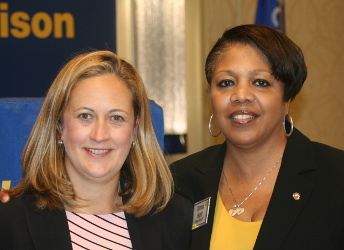 Wednesday’s speaker, Katherine Magnuson (pictured here with club President Donna Hurd) of the University of Wisconsin-Madison Institute for Research on Poverty, ended her speech with this question. She had already provided insight into helping her Rotary audience understand just what is needed to focus on the early years in every child’s life.
 When The Capital Times was founded, the US had just entered World War I. Committed to “reporting the unvarnished truth,” The Capital Times evolved over the years, tackling important social issues and adapting to new technology. Founded by William Evjue (whom only Bob LaFollette got away with calling “my dear Billy”), the paper became known for progressive opinions and being part of the fabric of our Madison community. An advocate for women’s rights and workers’ rights, a ferocious enemy of the Ku Klux Klan at a time when the hate group was more or less mainstream, a bitter foe of McCarthyism and an opponent of the Vietnam War, Evjue defined the character of The Capital Times and, through his foundation, made a real and lasting difference in the lives of many of our citizens.
 Rotary Club of Madison, Wisconsin