Category Archives: Rotary Club of Madison

September 21: Report on South Madison Renaissance

–submitted by Ellsworth Brown

Ruben Anthony, Alex Gee, and Karen Menendez Coller presented a well-coordinated report on Madison’s dynamic South Madison Renaissance in a series of five-minute presentations and sequenced responses to queries by Past President Teresa Holmes. 

The South Park Street development, totaling $150 million dollars and with construction well underway, will change the face of South Park Street, a key freeway entrance to Madison, a central street through the community and bring dramatic affirmation to the area’s residents and businesses. 

Karen emphasized especially Centro Hispano’s greatly expanded new quarters at Cypress and Hughes Place, its affirmative effect on a fast-growing population and a heightened level of community collaboration. 

Alex noted that the initiatives complement combined leadership, a sentiment mentioned by all three panelists and an emphasis on a reaffirmed Black culture of great depth as an offset to increasing area gentrification. 

Rubin spoke about the Black Business Hub now being erected, combining new offices for established organizations with parallel training facilities for the workforce and for new initiatives. 

As one panelist said, “Madison deserves this.”  A standing ovation by a roomful of Rotarians signaled agreement!

If you missed our meeting this week, you can watch it here: https://www.youtube.com/watch?v=js2dmPxNHEk.
September 14: A Lesson on Beethoven’s 9th

–submitted by Ellsworth Brown

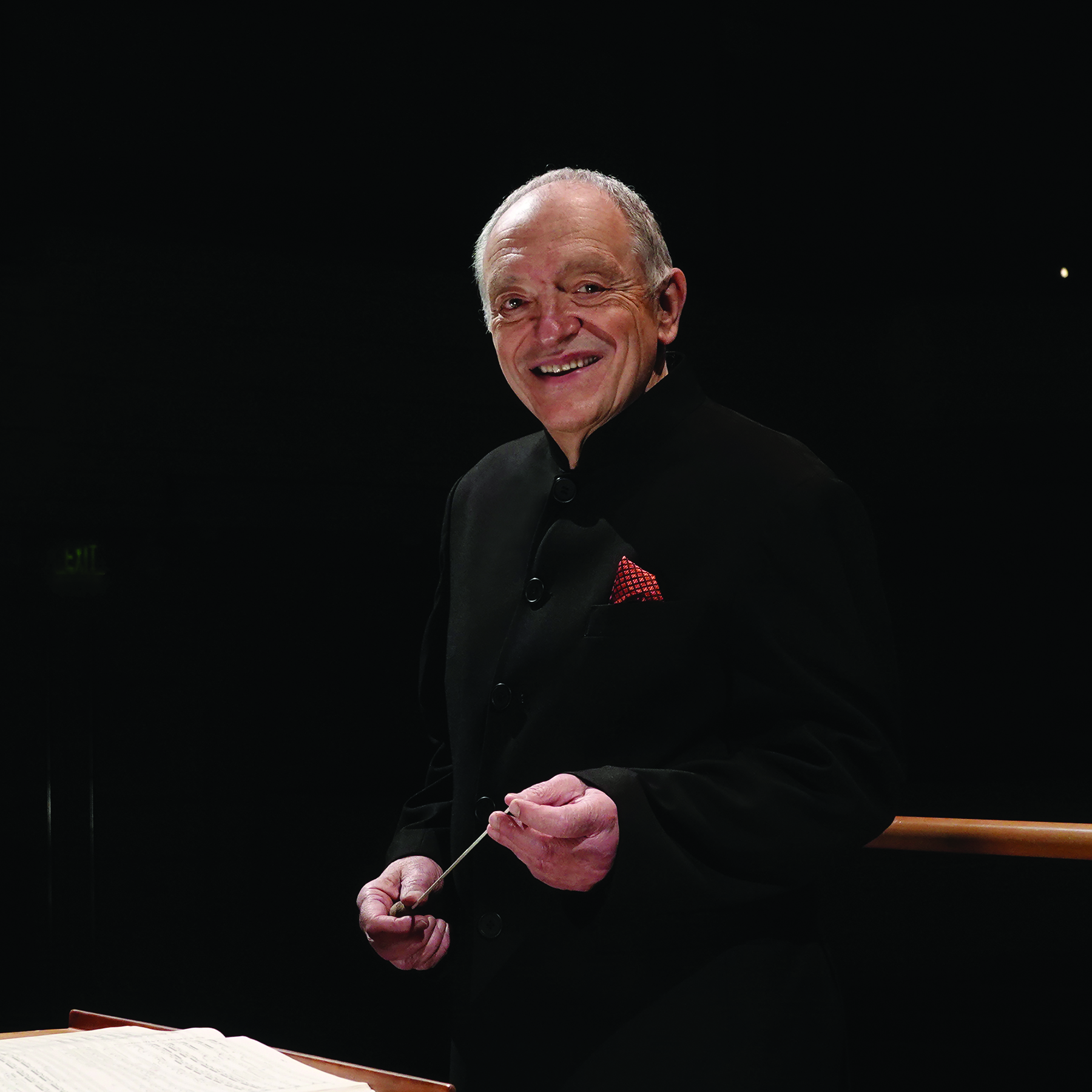
A Rotary program like none we’ve experienced before, presented with words and at keyboard by Maestro John DeMain with violin, clarinet, and bass—

Identifying revolutionary combinations of symphonic themes, new compositional approaches, and an unforgettably powerful last movement, the work of a deaf composer—

Discussing the Beethoven’s veiled human agenda on behalf of freedom, expressed not only in music, but also in word.

DeMain, renowned Madison Symphony Musical Director of 28 years, and a miniature orchestra explained and illustrated the four movements of Ludwig van Beethoven’s 9th Symphony:

  • The first, of longing and musical disputes
  • The second, a “farce” (so labeled by Beethoven), motor-driven in rhythm by three, then two opening notes, then a return to three
  • The third movement, a strong, slow melody of “excessive tenderness”
  • The fourth, unforgettable “Ode to Joy” with chorus to provide words calling for freedom, using as its anchor Friedrich Schiller’s poem of that name when music alone would not suffice

The program closed with the entire Rotary audience, using the language of “la, la, la”, singing the tune all seemed to know, accompanied by the four instruments.

For further information, please use this link about the symphony and the poem by Schiller:  https://en.wikipedia.org/wiki/Ode_to_Joy.

August 31: Getting to Know the Inter-Workings of the Madison Fire Department

–submitted by Rich Leffler

binary comment

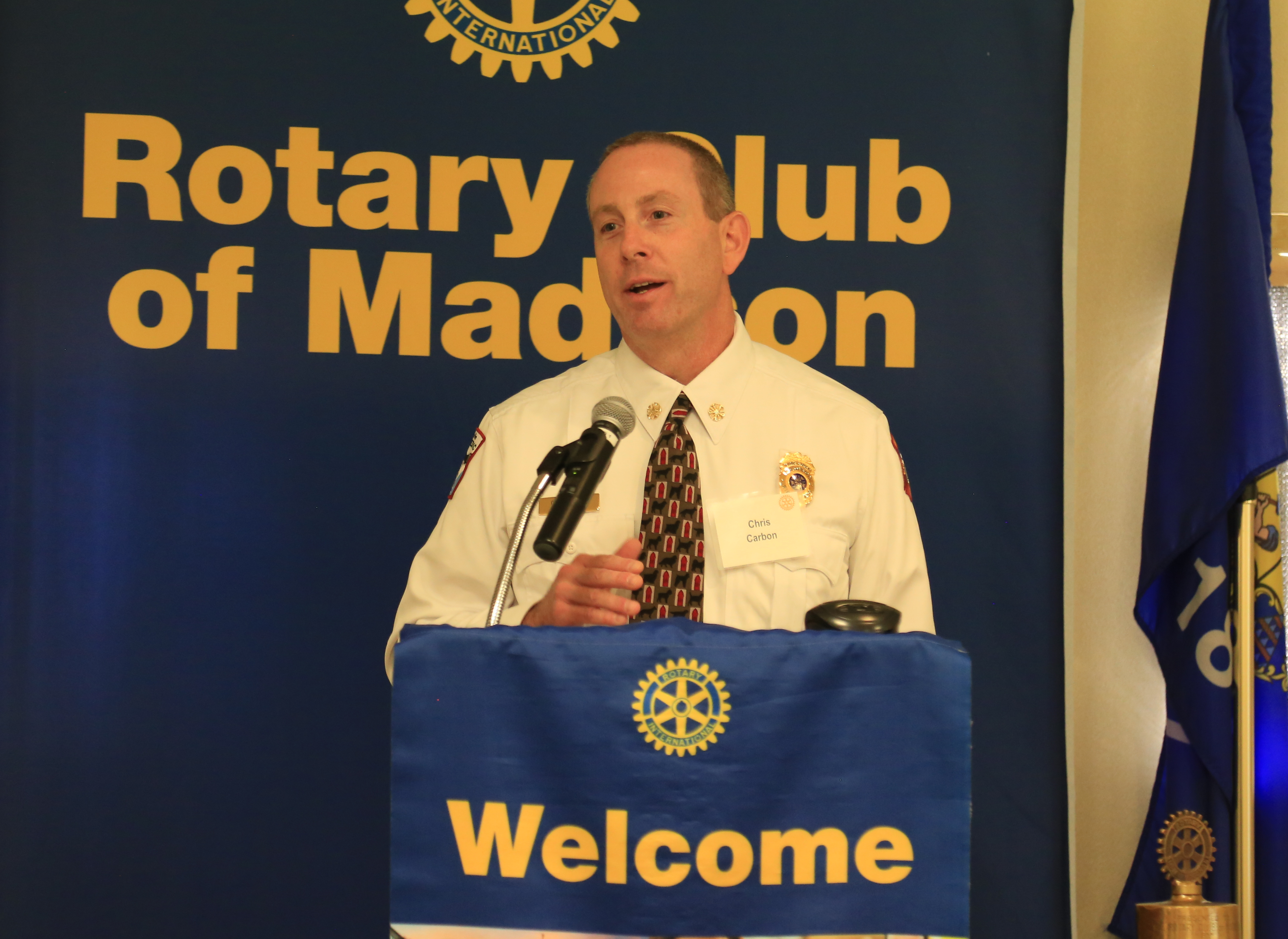
Our speaker on August 31 was Chief of the Madison Fire Department Chris Carbon. (His grandfather, Max Carbon, was, for many years, a member of our club.) He offered a general overview of the Department, noting that there are 35,000 requests for service every year; the vast majority of which are not to put out fires. The department has many special-service teams to handle the different kinds of service people require. He emphasized two. The Community Paramedic Program aims to identify peoples’ needs and to build relationships with the public. There is a partnership with UW Health and Meriter. One of the primary goals is to reduce return visits to the ER and enable greater independence of patients. 

The CARE program is a collaboration with the police to deal with mental-health crises. In non-violent situations, mental health professionals and paramedics try to resolve the situation. Calls for this service have increased since its inception; there have been 900 calls so far. An analysis is going on to determine how well the program is working. 

This fall, the department will begin a recruitment process. One hope is to improve the diversity of the department: the goal is to recruit people who are compassionate and understand the complexity of the Madison community. In response to a question about how to inspire Latinx and other minority people to become fire fighters, Chief Carbon said that the recruiting team will seek to establish partnerships with community groups to help in the effort, and he invited the questioner to meet with him to talk further. 

The Chief had to leave at 12:45pm, and Assistant Chief Ché Stedman continued answering questions. He said that response teams of health professionals and paramedics were key to dealing with people suffering from dementia; to resolve a critical situation; and to know how to find additional help. The most challenging calls were those involving children in distress. He explained that fire fighters work two consecutive twenty-four-hour shifts per week, which leaves time for family and also for socializing with the families of their colleagues. He explained that when a crisis involves an armed person, that becomes a matter for the police to handle. But of the 900 calls for the CARE program, only two percent of the cases required police action. 

This was a terrifically informative and encouraging program. Not only did the Chiefs explain the department, but they also gave evidence that they and their colleagues were public servants truly dedicated to serving the people of Madison.

NOTE: This week’s Rotary meeting was not videotaped.

August 10: At the 50-Year Mark, the Dane County Farmers’ Market is Still Going Strong!

–submitted by Sharyn Alden

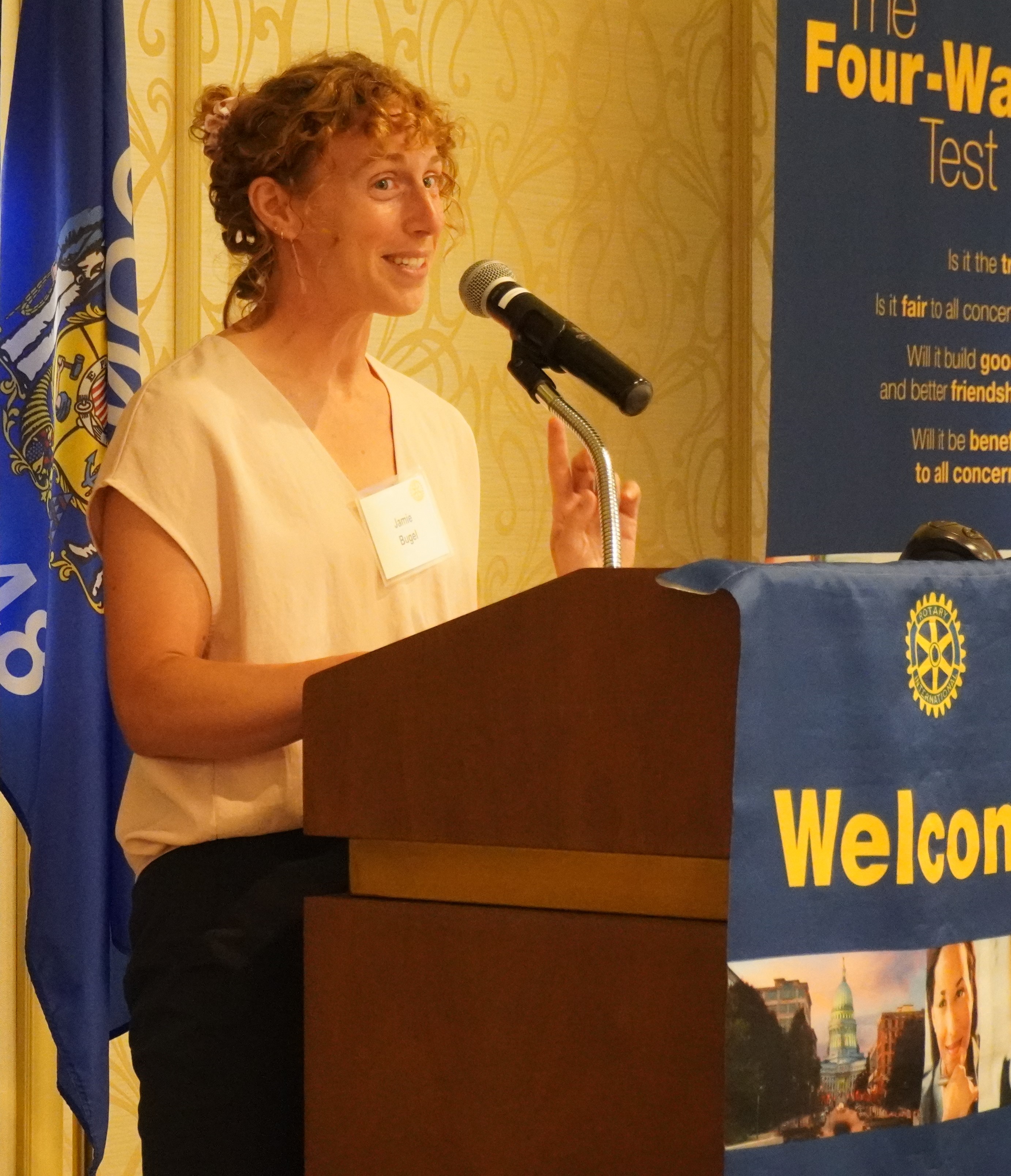
During the August 10 Rotary meeting, Market Manager Jamie Bugel provided an interesting history and updates about the iconic market on the Capitol Square.

When Jamie Bugel talked about the ‘Dane County Farmers’ Market, a fixture on the Capitol Square since 1972, she knew her stats.

“Fifty years ago the market started with 11 farmers, but by the next weekend 85 farmers showed up,” she said.

It didn’t take long for one of Madison’s best-kept secrets to start growing exponentially. Bugel pointed out last week there’s a major difference in how and where vendors are located on the Square compared to when the market first opened.

In its early years, vendors just showed up and took the best spots around the Square they could find. “Sometimes they would arrive at 4 in the morning and sleep on the Square to save a spot and secure the best foot traffic.”

Since 1991, though, that method of ‘finders keepers’ went away. The model since the early 90s the location is based on how many years a vendor has been part of the market.

Bugel said there are currently 230 members (farmers/vendors) of the Dane County Farmers’ Market, yet her staff is “just two and a half’ associates. On an average Saturday on the Square there are about 100 vendors offering products.”  When asked how a business can become a Farmers’ Market vendor she said, “You don’t have to milk the cows that supply milk for your cheese, but you do have to be the owner of the business you represent, and you must be active in the production of the food or goods you sell.”

As the number of vendors has grown, today’s Dane County Farmer’s Market is a unique repository of food and other products that are grown and made locally. Sometimes they are new to shoppers on the Square.

Bugel gave an example of some of the market’s unusual products. “Black currants, which are more common in Europe are now one of the products you might find when you’re at the market,” she said.

If you missed our meeting last week, you can watched it here: https://www.youtube.com/watch?v=Pds1WBDnjMY&t=3s.

Laura Peck Receives 2022 Rotary Club of Madison Community Service Award

–presented by Joyce Bromley on August 10, 2022

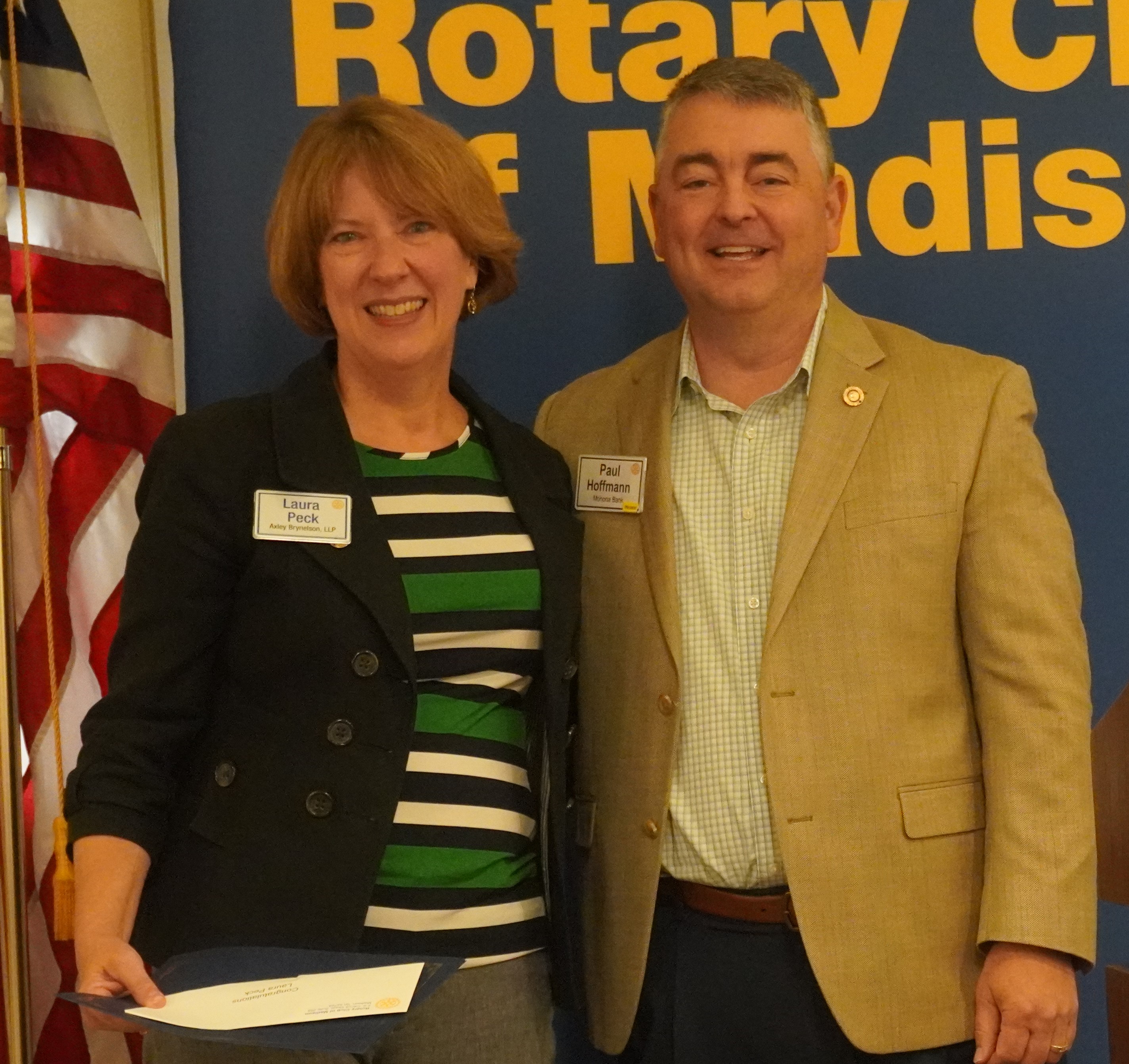
Laura Peck pictured here with Club President Paul Hoffmann

Each year, our club recognizes up to six members for their service to our Club in one of Rotary’s five avenues of service.  This is the third week we have recognized members of our Club for their service.   Oscar Mireles received the Youth Service award, and Lynne Sexten our Club’s Service award.  Today, it is my pleasure to introduce you to the Rotary Club of Madison 2022 Community Service Award recipient.

Laura Peck, a partner with Axley Brynelson Law Firm has been a member of our Rotary Club since 2002.  She has served in a number of roles in our club over the past 20 years, including on our club’s board of directors and as president of our Madison Rotary Foundation. 

Today, Laura is being recognized for her extensive service on our Scholarship Committee for the past six years, including Chair of that committee for the past three years. 

The commitment to the Scholarship Committee is intense for 3-months in the spring that includes meetings with high school counselors, reviewing student applications, conducting 2 full days of interviews, preparing the annual presentation of the scholars to our club, and many follow-up arrangements with scholars.  And…she has served as a mentor to several Rotary scholars.

She is truly dedicated to her role and committed to helping all of our scholars succeed.  Her dedication has made a big difference in the lives of many scholars over the past six years. 

This year, Laura is using her Scholarship Committee experience to Chair an ad-hoc committee to evaluate the overall scholarship committee process.

For Laura’s outstanding service, our club’s board of directors has named Laura Peck as one of our 2022 Rotary Club of Madison Community Service Award recipients.  The Club has made a $200 gift in her name to The Rotary Foundation of Rotary International.

Congratulations, Laura, and thank you for your “service above self.”

August 3: Dr. James Skibo, WI State Archaeologist, Describes Humbling & Thrilling Discovery, Recovery, and Preservation of 1200 Year-Old Mendota Dugout Canoe

–submitted by Sharyn Alden

James Skibo, PhD. Wisconsin State Archaeologist at the Wisconsin Historical Society, easily mesmerized Rotarians at the August 3 meeting. He described the amazing find in Madison’s Lake Mendota waters, the now world-famous “Mendota Dugout Canoe” discovered underwater last year.

The canoe has been selected as one of the top ten archaeological discoveries in the world in 2021. The largest and oldest boat ever sailed in Wisconsin waters attracted media attention from around the world.

The canoe was found buried in a slope in 27 feet of water about 200 yards offshore near Shorewood Hills.

Tammy Thomson, marine archaeologist for the Wisconsin Historical Society who dives year-round, found the canoe during a pleasure dive. She first thought the 15-foot long dugout canoe looked like a buried stick. During Skibo’s program he showed an underwater photo of Thomson recording the find on her underwater notebook.

The 15 foot-long canoe probably carried two people along with a catch of fish, Fishing artifacts –‘net sinkers’ were found in the boat. Skibo said it likely took hundreds of hours to carve the canoe from the hard wood of a white oak tree. After discovery, the team had only about six weeks before winter set in to figure out to carefully extract the canoe from its resting place. Members of local tribes including the Ho-Chunk Nation, were among those consulted.

.

On a cold day last November, it took about four hours to bring the intact canoe to shore.

“There were about 100 people on shore clapping and cheering,” said Skibo.”It was a humbling, thrilling experience.”

The canoe will be undergoing preservation efforts in the next two years before eventually going on display.

If you missed our meeting last week, you can watch the video here: https://www.youtube.com/watch?v=Gb1DNPwEOQ0