
submitted by Jerry Thain
 Dr. Ankur Desai, professor of climate, people and environment at UW-Madison, addressed the first ever virtual meeting of the Club on the effect of climate change on local weather. He stated that climate is personality, and weather is mood.
Looking at weather over the years, he noted a global trend, beginning in the 1980s, of higher temperatures. This is caused by CO2 emissions which are raised by the use of fossil fuels. He said CO2 is to climate change what steroid use was to baseball. An increase in temperature up to 2 degrees Celsius has only modest impact, but above that level, it leads to significant and harmful consequences. Policy changes could mitigate the damage by “flattening the curve” much as health experts urge us to do in attacking the current pandemic. A major difference is that it will take decades to flatten the climate curve.
Turning to the influence of climate change on local weather, Dr. Desai showed the global decline of snow cover which, in itself, affects the temperature. The meeting of snow/no snow lines influence weather fronts and increases the severity of storms. Lesser snow over North America means most places get wetter and rainier–rain on frozen ground is more likely to cause storms than snow. Southern Wisconsin has seen wetter and rainier weather in recent years while northern Wisconsin has been drier. Some cold winter weather will still occur but at a much lower rate than in the past.
The problems caused by this will need to be addressed either by adaptions (such as moving homes from frequently flooded areas) or by mitigation (reducing emissions significantly). Unfortunately, there is no single “silver bullet” to solve things so all alternatives must be pursued by policymakers.
Dr. Desai cited recent research indicating, contrary to some beliefs, that climate change deniers are a very small proportion of the populace. Moreover, among people aged 18-30, climate change is either their first or second highest policy priority. It is not possible to prevent all adverse effects, but we must take actions that will have some effect or be overcome by the problems.
He ended on a hopeful note, showing the sprouting of tree plants in an Australian forest area recently consumed by wildfires. Earth will survive, but we need to help heal it for our own good.
If you missed our online meeting this week, you can watch the video here.
 Last week, I wrote about how the Rotary Four-Way Test is a wise guide that can help us limit the spread of COVID-19 while we safeguard ourselves, our loved ones and community. Here are some ways our Rotary Club of Madison members are applying this principle to serve our own Club and its members: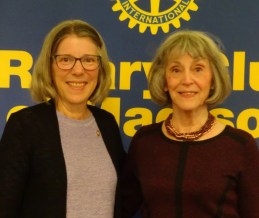
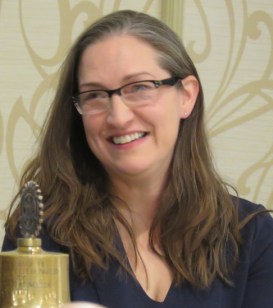 “Hamilton: The Musical is the biggest tour of a Broadway show to hit the road in years, maybe decades,” Sarah Marty, Producing Artistic Director of Four Seasons Theatre in Madison, told Rotarians on Wednesday, February 26. “Hamilton represents an entire industry, with ripple effects that go far beyond the lights of Broadway,” she said, adding that it had surpassed the reach of any other Broadway musical, including the phenomenal popularity of Oklahoma following its 1943 debut.
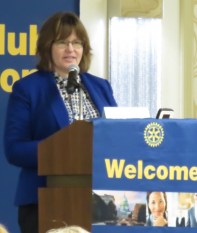 On February 19, 2020, Becky Schigiel, Sr. Partnership Specialist with the U.S. Census Bureau, spoke to Downtown Rotarians about the upcoming 2020 United States Census. Becky spoke to us about the three top reasons that the Census is so important: 1) It’s the basis of our democracy. The Constitution specifically calls out that everyone in the United States will be counted every ten years so that we can determine representation, 2) It the basis by which $675 billion dollars are distributed by the Government annually. Census data is used to determine the amount of funding for important things such as roads, school lunches, foster care, special education and much more. It’s estimated that for every person missed in Dane County, we lose about $2,000 annually for each of the next 10 years, and 3) Census data is heavily relied upon by leaders (community, faith, business) when making decisions that impact our local communities.
 Rotary Club of Madison, Wisconsin