Category Archives: Rotary Club of Madison

Brad Hutter Talks About Sharks at 4th Annual Bring Your Child/Grandchild to Rotary Day

submitted by Mary Borland; photo by Mike Engelberger
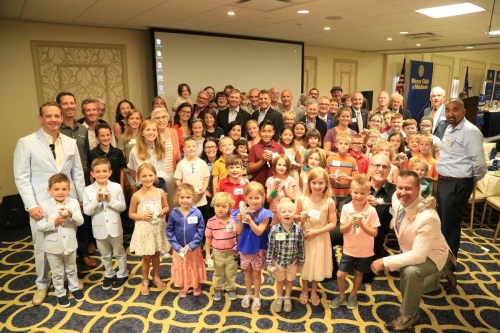
group 72419

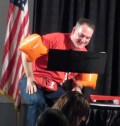
Fellow Rotarian Bradley Hutter, “The Accidental Shark Diver”, gave an illustrated talk (lots of pictures and video!) about his unique experiences while scuba diving with sharks, including Tigers, Bulls, Hammerheads and Great Whites.
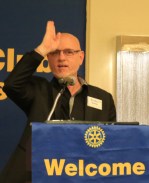
Brad Hutter 7 24 2019   Brad got into swimming with sharks “by accident” — he was scuba diving in Stuart Cove, Nassau, Bahamas, and was asked to be a safety diver by the staff of the Discovery Channel who were there filming sharks in the area.

Brad shared that sharks are typically shy and avoid humans. Sharks are in the fish family and half the species are under 39” long; some sharks can rotate their eyes backwards but they cannot swim backwards – so if they are coming towards you, just guide them along past you; some sharks have up to 30,000 teeth in a lifetime; and some deep cold water species can live to be 1,000 years old!  Sharks are apex predators and are very important to sea life balance.

He gave the audience some “tourist based shark rules” to follow if we ever find ourselves in the water with a shark nearby:

  • Don’t swim away, in fact, lean forward, even just a little bit.
  • Put your hands up in a blocking mode.
  • Look the shark in the eye! If you avert your eyes you become vulnerable; Respect sharks.
  • Swivel your head while keeping your eyes on the shark’s eyes.
  • Don’t swim in cloudy water – you may be mistaken for something sharks actually like to eat, like a seal.
  • Avoid dolphins as sharks may be in the area and about to feed on them.

Brad shared that on average, 10 people per year are killed by sharks (because the shark mistook the person as food they eat or the person got in the way of sharks feeding) and by comparison, 725,000 people per year are killed by mosquitos and 25,000 are killed by dogs.  Humans kill ~100,000 sharks per year and some species are down to 5% left.

Mismanaged plastic waste is a big concern for our oceans with China being the biggest polluter. Work needs to be done to stop countries like China from putting plastics in the ocean and laws are needed to outlaw fishing for fins.

Brad has enjoyed learning about sharks over the past seven years as he’s worked with experts seen regularly on Discovery Channel’s “Shark Week”, National Geographic, and Animal Planet. It’s a family affair as Brad’s daughters are now avid shark divers themselves.

Brad has a saying – “Live every week like it’s shark week.”

If you missed our meeting this week, you can watch the video here.

How to Make Time for What Matters…

submitted by Linda Baldwin; photo by Mike Engelberger

Zeratsky

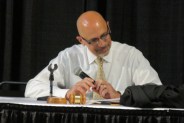
From let: Club President Andrea Kaminski, John Zeratsky and Past President Jason Beren

How many times have you thought what happened to my week?  Why didn’t I accomplish what I wanted?

John Zeratsky would say that defaults have taken over your life.  It’s not your lack of self-control or willpower.  It’s all of the electronic distractions, calendars, meetings, etc…the defaults that prevent you for making time for what matters.

Taking your guilt out of the picture, Zeratsky shares his journey from list maker- organizer extraordinaire to living a life making time for what matters.

He highlighted his personal journey from Green Lake to UW-Madison to the high-tech Google world.   He and his partner wrote a book sharing methods for getting out from under the daily milieu, “Make Time.” The book shares 87 tactics to make time everyday for what’s important.

Four Daily Steps:

  1. What’s the highlight of your day?  Write it down on a sticky note.  What’s your top focus of activity today?
  2. Create barriers to distraction.  For example, put that phone away.  Turn off or delete aps that demand your attention.
  3. Build energy to enjoy the moments and interactions that matter.
  4. One day at a time.  Each day you can choose to spend time differently.

Feeling a need to disconnect from the world of carryout, Uber and Amazon, he and his wife then embarked on a sailing adventure from SF south through the Panama Canal and then up through the Caribbean to Key West.  On this trip, they were able to disengage from their frenetic world and decided to begin again in Milwaukee…”relearning the value of belonging.”

Zeratsky ends his presentation describing his journey in “self-care” (on their voyage) to the realization that his greater need was contributing to the bigger world.  He ends with “the threads of connection can’t replace that feeling of belonging – that you are meant to be somewhere.”  In his case, Milwaukee.

If you missed our meeting this week, you can watch the video here.


How to Save the World

submitted by Jessica Giesen; photo by Mike Engelberger

Niraj Nijhawan 7 10 2019We are living in the information generation – constantly bombarded by new information and larger and larger amounts of data. In fact, the world is changing so rapidly that the future has become a complete unknown. That unknown is creating anxiety and interrupting everyone’s ability to live happy lives. Through his pursuit of the science of happiness, Dr. Niraj Nijhawan has uncovered specific root causes of unhappiness and developed steps that people can take to reprogram their brains and escape this crisis.
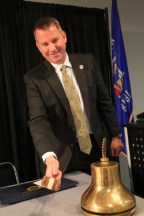
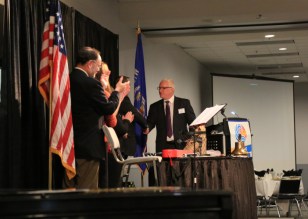
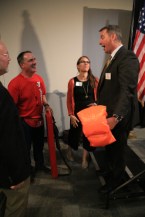
People need to allow their neural networks to thrive and to grow, which can continue to happen until the day we die. In order to support that growth, people must look to time, focus and emotion. The more feedback we allow ourselves to take in and tolerate on a daily basis, the more growth we will see.

Dr. Nijhawan spoke about our negative ties to self-esteem and the “social brainwashing” we have all undergone that tells us that we need to be X or do well in Y or choose career path Z in order to be ‘good’. We learn that status, money, power and educational degrees are the things that must be sought after and achieved in order for someone to be happy. However, according to Dr. Nijhawan, that is not the case and should not matter in life if happiness is the goal. Rather than look to external motivations – such as economic or emotional rewards or penalties, which cause stress hormones to spike and people to remain on “a roller coaster of destruction” – we must flip our mindsets to a radical growth mindset.

The solution is to become higher brain dominant, which can shift a person’s mindset within days and alleviate depression, anxiety and sleep difficulties while increasing psychological well-being and overall quality of life. The three steps Dr. Nijhawan proposes a person follow to secure their own happiness are to 1) Remove oneself from the roller coaster of destruction by realizing that self-esteem and “status” markers we are socially taught to exalt are not important, 2) Get on to the rocket ship of the higher brain and 3) Teach to others these learnings and ultimately . . . save the world.

If you missed our meeting this week, you can watch the video here.

A Roast or A Toast?

submitted by Ellie Schatz; photos by Mary Ellen O’Brien and Mike Engelberger

HO7A1947  HO7A2022  HO7A2024

President Jason Beren joined the Rotary Past President’s Club, riding out of office with respect, appreciation and fond memories of his leadership experiences. In his year in office he was impressed with the breadth of work of our club committees and endeavored to fulfill his intention of being a person of action who would help the club grow. In order to meet the challenges of the office, he noted that he exchanged 1400 emails with Pat Jenkins.

The Roast Committee paid tribute to Jason by telling his story “Otto Preminger style: as if all the world’s a stage and this one man plays a major part.” Establishing the scene as a courtroom of Rotarian lawyers and judges, Jason’s fellow Rotarians were asked to sit in judgement of his year.

The prosecution began by stating 4 violations of Rotary law made by Jason:

  1. High crimes in the gross mispronunciation of last names.
  2. Obsession with aquatic activities.
  3. Engaging in geeky mechanical engineering behaviors.
  4. Having an overt desire to be roasted.

The accused pled not guilty. The prosecution set out to prove that this person who began life as a child of promise took the road less traveled. The first witness called was Pat Jenkins (played by Heidi Frankson), who proclaimed she had to phonetically spell out most words in his weekly notes. It cost her valuable time in preparing what should have been 1-2 page documents but became 250 page tomes. When asked if by speaking nothing but the Rotarian truth he admitted to these elocution crimes, Jason refused to answer “on the grounds it might ’incinerate’ me.”  It was brought to the jury’s attention that his difficulty with pronunciation might be a by-product of his other hobby/misdemeanor: wine. Jason then named several of his favorites, attesting to the fact that he has impeccable pronunciation when it comes to wine.

IMG_1519  IMG_1431  IMG_1509  IMG_1513

Photo 1: “Jason Beren” played by Mark Westover; Photo 2: Judge Stephen Ehlke played by Judge Stephen Ehlke; Photo 3: Prosecuting Attorney Ken Kraus played by Ken Kraus; Photo 4: “Pat Jenkins” played by Heidi Frankson

Regarding his second violation, the prosecution stated that Jason was obsessed with controlling events as life “saver” at his swimming pool. One example is when he tells swimmers, “Don’t mess with the whistle!” In rebuttal, the defense avers he is simply a trained professional whose motto is: “When I guard, I guard hard.”

With geeky behaviors, such as wearing a pocket protector not to be denied, Jason proceeded to declare his desire was not to be roasted but just to be Rotary President because of his love of his fellow Rotarians. His proof: photos he’s taken of Rotarians at their weekly luncheons.

Although the defense declared the charges preposterous and thanked Jason for being an exemplary Rotarian, his peers declared him guilty. His sentence? One glass of Carlo Rossi burgundy and 50% attendance in the upcoming Rotary year.

Thank you Jason, enjoy a glass on us in appreciation of your year of outstanding Rotary leadership.

   Our thanks to Ken Kraus and new members of the Roast Committee for providing an entertaining program; to Mary Ellen O’Brien and Mike Engelberger for serving as photographers; to Brian Basken and Paul Ranola for serving as videographers  and to Ellie Schatz for preparing this review article.   Visit our club’s Facebook Page for more photos.

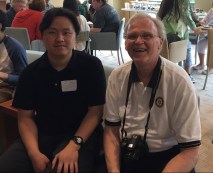
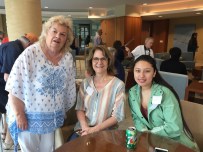
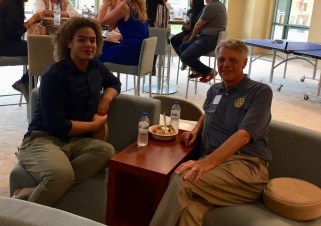
June 23 Scholar Mentor Picnic Highlights

submitted by Linda Baldwin; photos by Donna Beestman & Jim Christensen

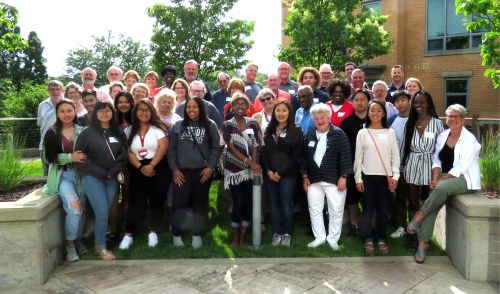
Group Photo 2019 Revised

Our annual Rotary Scholar Mentor Picnic was held on Sunday, June 23, at the home of Nancy and Ed Young.  Moving from one side of Lake Monona to the other, Nancy and Ed treated scholars and their mentors to a terrific afternoon in the Community Room at Nolan Shores condos.

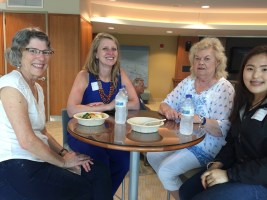
Picnic 8  Picnic 11

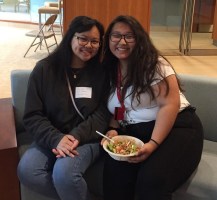
Our club has a terrific group of scholars, and I had the opportunity to talk with a few. One, Lisa Xiong, a 2016 Levy Family Scholar from East High School, a senior studying biomedical engineering, had been to four picnics, loved catching up with other mentees and enjoyed meeting new ones.

Picnic 6 picnic-4.jpg  Picnic 2

Cassidy Ferguson, a 2018 Brandenburg Scholar from La Follette High School, is studying early childhood education at UW Stevens Point.  She loves the smaller school learning experience and we chatted about One City Schools, our Rotary sponsored project.  I encouraged her to visit the school while in Madison this summer.

I also talked with Ahyun Chung, a 2019 McBeath Scholar from Middleton High School, who is studying engineering at UW-Madison.  We talked about climate change with her mentor, Karen Kendrick-Hands.  I left the event uplifted and impressed with these young people and the others I met.  I’m confident that their generation will change the path of history for the better…

picnic-9.jpg picnic-5.jpg

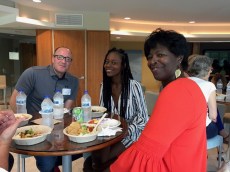
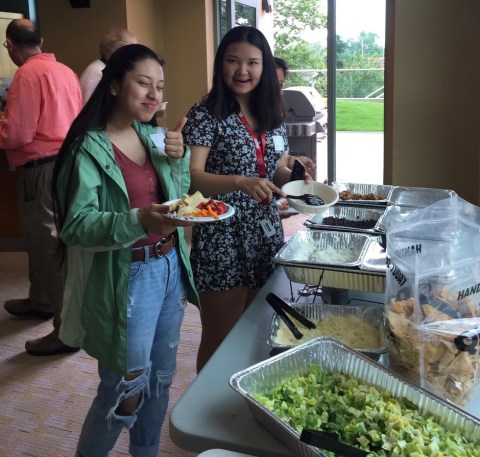
The tacos were terrific and we ate on recyclable plates with recyclable forks. Our thanks to Ed and Nancy Young for hosting our group and thanks to Rotarians who brought food and beverages.

“More Than a Store”

submitted by Carole Trone; photo by Mary Ellen O’Brien

Maldonados 6 12 2019  “More than a store. It is a gathering place,” was how Joe Maldonado summarized the special role of Luna’s Groceries in its first year of operations. Luna’s Groceries is the result of the inspiration, research and hard work of Joe and wife/business partner Mariam Maldonado, longtime residents of Madison’s Allied/Dunn’s Marsh neighborhood. As of last fall, they are owners of the only full-service grocery store in this diverse, working class neighborhood.
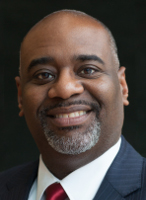
They love this neighborhood but recognized how residents have struggled to find nearby affordable and healthy food since the area’s only grocery store closed in 2009. Joe and Mariam both recounted rich childhood experiences of daily visits to the local store in their respective upbringings in Milwaukee and the Dominican Republic. Joe explained how “food deserts”—defined by the Centers for Disease Control (CDC) as the lack of convenient access to nutritious fruits, vegetables, meats and grains—hit low-income communities of color particularly hard.

Luna’s Groceries was preceded by a year of research into national, regional and local data on troubling patterns of food deserts located in low-income neighborhoods with correspondingly high numbers of chronic health problems. The Allied/Dunn’s Marsh Neighborhood was one of ten identified food deserts in Madison, further challenged by its location squeezed into a growing and massive road and highway interchange on Madison’s southwest side.

Nine months after opening, Luna’s is on target to exceed sales projections. Perhaps more importantly, Luna’s has become the answer to isolation, with an unexpected booming social media engagement, monthly cooking classes, demand for hot specialty foods, and a bi-monthly “Coffee at Luna’s” interview-format gathering on education, health and social issues that affect community members. With Luna’s Groceries, Madison residents can feed body and soul.

If you missed our meeting this week, you can watch the video here.