Category Archives: Rotary Club of Madison

What’s So Exciting About the First Folio?

–submitted by Dave Mollenhoff; photo by Mike Engelberger

calhoun-joshua-11-16-16
“It’s the book that gave us Shakespeare,” explained Joshua Calhoun in a spirited talk to the club.  “Just imagine,” continued Calhoun, an assistant professor of English at the UW Madison, “When Shakespeare died 400 years ago, only half of his 36 plays had been printed.”  Without the First Folio we would never have known the Comedy of Errors, As You Like It, the Taming of the Shrew, Julius Caesar, MacBeth, and Antony and Cleopatra.  Happily, all of these and several more were published in 1623 in one of the most famous books ever printed.  And what a book it was!  Four pounds, 900 pages, 2 inches thick and about 13 inches high and 9 inches wide.  And expensive!  In today’s dollars, it would have cost at least $250.  Only 750 were printed and about 250 survive.

This rare book is the centerpiece of an exhibit at the Chazen and will be on display until December 11.  Accompanying the book is a thoughtfully-curated exhibit entitled “The Globe’s Global in Shakespeare’s time.”  The exhibit has triggered a great surge of interest throughout Wisconsin.

Calhoun delights in getting his students to contrast today’s media and technology with Shakespeare’s.  “It’s about the power of words,” concluded Calhoun.  “It’s about what makes us human.”

Did you miss our meeting this week?  Watch the video here.

The First Folio!: The Book that Gave us Shakespeare

–submitted by Ellie Schatz; photos by Valerie Johnson
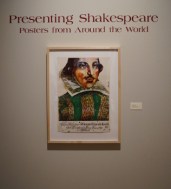
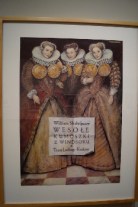
dsc00571The First Folio!: The Book that Gave us Shakespeare is on exhibit at the Chazen Museum until December 11. On Wednesday afternoon, Nov. 9, nearly 40 Rotarians of the Special Events Fellowship Group and their guests enjoyed a foray into the life of Shakespeare and the preservation of his works, followed by a social hour at the University Club.

Folio is a term for a big book, usually reserved for royal, religious or reference materials. The Shakespeare folio was published in 1623, 7 years after Shakespeare’s death, the first folio in England devoted to plays. This complicated project, containing more than 900 pages, was put together by 2 of Shakespeare’s friends and acting colleagues. Of 233 copies remaining of the 750 that are estimated to have been printed, the one here is on loan from the Folger Shakespeare Library in Washington D.C., carefully encased under glass and open to the Hamlet soliloquy, “To be or not to be.”

dsc00576   dsc00574  dsc00577

The First Folio contains 36 plays, printed one right after another; The Tempest is the first. Eighteen of the plays had not appeared in print before the First Folio was printed. So we would not have Macbeth, Julius Caesar, The Tempest, Twelfth Night, Measure for Measure, The Winter’s Tale, Antony and Cleopatra, As You Like it, The Comedy of Errors, The Taming of the Shrew, Coriolanus, Cymbeline, and several other plays were it not for this book.

Because of the way in which the First Folios were printed and have been handled over the ages, no two First Folios are alike. A finished First Folio in a calfskin binding cost about £1 in 1623, which today roughly equals between $150-$200. In 2001, a First Folio sold at Christies for just over $6.1 million. The most recent sale was in 2006, when a First Folio sold at Sotheby’s for $5.2 million.

dsc00591

It is presumed that each play was first written down by Shakespeare in his own hand. This handwritten manuscript was most likely written largely in what was known as “secretary hand,” a small script that is hard for us to read today. The author’s manuscript was sent to a scribe or scrivener who copied it over, making what was called a fair copy, a more readable version. Usually, what went to the printing house was the fair copy of a play. There, a typesetter or compositor would read the copy and get to work. Since no copies of the plays have been found written in Shakespeare’s handwriting, the First Folio is the closest thing we have to the plays as Shakespeare wrote them.

dsc00578 dsc00587  dsc00589

The exhibition also includes 6 panels adorning the walls of the room with general information on the folios and Shakespeare, as well as rooms with posters that have promoted admission to theaters featuring his plays around the world.

 

New Partnership to Serve Homeless Individuals in our Community

–submitted by Rich Leffler; photo by Loretta Himmelsbach

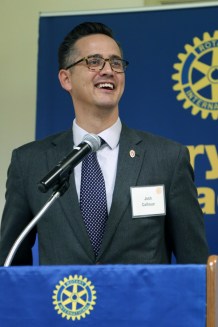
fonder-thom-11-9-16Fellow Rotarian Jackson Fonder—president and CEO of Catholic Charities of Madison—and Bev Thom—chair of the Bethel Lutheran Church homeless ministry board—were our speakers on Wednesday. Jackson led off. He recalled a Christmas Eve in 2015. Scot Sorensen, senior pastor at Bethel Lutheran, was going to have to close the homeless day center at Bethel because funding was ending. The Wisconsin State Journal ran a headline that read “Downtown Shelter to Close.” Somehow, private funding kept the shelter going during the winter. At the same time, Catholic Charities was thinking about what it could do for the homeless. Jackson and Scot, both Downtown Rotarians, met together and entered into a gentleman’s agreement: they would work together to provide day shelter for the homeless. In Madison in January 2016, there were 663 homeless people. Most of them are unseen to the public. Five percent of Madison Public School students are homeless at one time; 40 percent are homeless at some time. It’s a story of people rather than statistics — people who suffer from domestic violence, mental illness or substance abuse. A day shelter can provide a sense of belonging, of trust, of family.

Bev Thom offered the stories of three people who affected her:  three vignettes to explain how people become homeless. All suffered from abuse during childhood that profoundly influenced the course of their lives. Bethel gives people shelter and a chance to recover.

Jackson explained that a new day shelter, which he will lead, is scheduled to open in 2017 at 615 E. Washington Avenue, the former Chamber of Commerce building. The building is being completely remodeled and will become the “Homeless Day Resource Center.” He asked for help from people willing to volunteer their time and to serve on an advisory committee. The intention of the new center is to serve the homeless population and to be a great neighbor.

The partnership between Lutherans and Catholics is an historic coming together to serve the Madison community and was facilitated by the fellowship of Downtown Rotary. Jackson asked, “Isn’t that what Rotary is all about?” And he wondered whether this would have happened if Scot and Jackson had not been Downtown Rotarians.

Did you miss our meeting this week?  Watch the video here.

The Nature of Autumnal Storms in the Great Lakes States

–submitted by Larry Larrabee; photo by Loretta Himmelsbach

martin-jon-11-2-16With the enthusiasm of Jim Cantore of The Weather Channel, Professor Jonathan Martin informed and entertained us regarding the unusually severe nature of November storms in the Great Lake States region.  He is a member of the faculty of the Department of Atmospheric and Oceanic Sciences at the University of Wisconsin and nationally recognized for his studies of mid-latitude atmospheric dynamics.
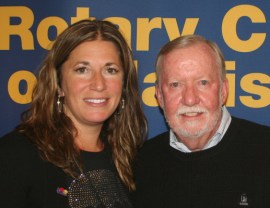
As Professor Martin informed us, UW is the birthplace of satellite meteorology and he was able to share with us numerous satellite images of past storms as they progressed through the Midwestern States.

He began his presentation by providing the physics behind hurricanes and cyclones as they travel across the world, divided north and south by the tropical weather pattern that flows in the opposite direction, east to west.

In his individual description of five specific November storms between 1911 and 2010 he illustrated the uniqueness of these weather phenomena and how the extremes of temperature differences and low barometric pressures contribute most significantly to the relatively high winds associated with these particular inland storms.

For instance, the November 11, 1911 storm contributed that day to Janesville, WI experiencing a daytime high of 70 followed with an overnight low of 20 with a 35-degree drop in just one-hour.  The community also experienced that day an F4 tornado and six inches of snow that evening.

The other storms described had their extremes as well.  In 1975, the Edmund Fitzgerald was sunk in Lake Superior as it succumbed to 80-foot waves and on October 26, 2010 the lowest barometric pressure ever recorded on Earth was recorded in Northern Wisconsin.

Professor Martin’s enthusiastic delivery and our in-born fascination with weather and it’s extremes made for an informative and enjoyable program.

If you missed our meeting this week, click to watch the video.

Stories Abound From the Grave

–submitted by Moses Altsech; photo by Jeff Burkhart

mccann-dennis-10-26-16

Dennis McCann pictured here with Club President Michelle McGrath

Whatever you thought you’d do after retirement, chances are it didn’t involve looking up graves. And yet that’s exactly what Dennis McCann did after leaving the Milwaukee State Journal. The stories he told us were not of ghosts, but rather of fascinating historical events—like the Peshtigo Fire or the Bayfield Flood—that he got to know more intimately by visiting cemeteries.

More importantly, through his cemetery visits, McCann got to know the people buried there—sometimes ordinary and sometimes extraordinary: Their story is sometimes captured by unique gravestone inscriptions (“In 1958 a contest was held to find the meanest woman in the world. Alas, I married both the winner and the runner-up… But if either are buried in this lot beside me there is going to be a resurrection”) and sometimes left unsaid—as in the case of John Heisman, whose tombstone doesn’t mention his Heisman Trophy fame.

Here in Madison we have the graves of 140 confederate prisoners of war held at Camp Randall, alongside the grave of the woman who once took care of their gravestones.

“Cemeteries are full of stories,” said McCann, obviously relishing the quest for discovering and telling those truly captivating stories.  In one instance, McCann interviewed a grave digger who took great pride in taking care of his cemetery much like he kept his yard at home.  “You got to be a cemetery man,” the man told him. “You got to be dedicated.” In Dennis McCann’s case, it takes one to know one.

If you missed our meeting this week, you can watch the video here.

For the Love of Nature

–submitted by Andrea Kaminski; photos by Karl Gutknecht

aldo-leopold-3

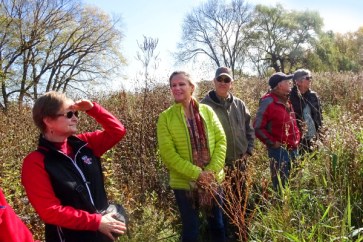
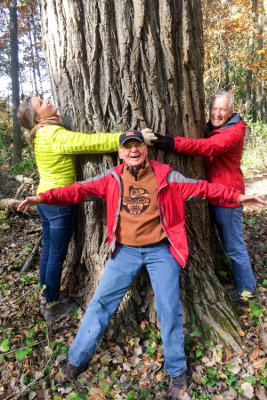
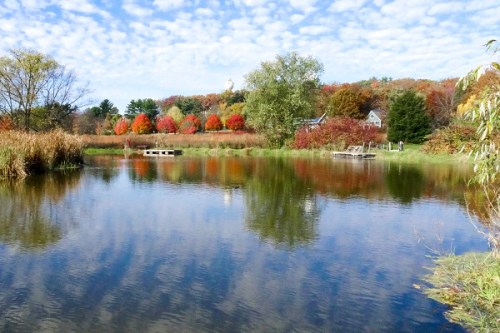
Many things brought a group of 10 Rotarians and guests to the Aldo Leopold Nature Center on Saturday, October 22. Did you know Debbie Gilpin is on the Nature Center’s board? Frank Stein quipped that only one tree grows in Brooklyn, where he grew up, and therefore he loves being among the trees in Wisconsin. Herman Baumann grew up not far from Brooklyn in New Jersey, and he became an outdoorsman and conservation writer after he moved here. Jeff Tews served on the Rotary Community Grants Committee when it made a grant to support the Center’s Campfire Fund, making it possible for 5 out of 14 economically-challenged children to attend summer camps at the Center this year. The rest of us simply were inspired by the opportunity to take a walk in this natural gem in an urban area on a beautiful fall day.

aldo-leopold-5aldo-leopold-4
Karl Gutknecht organized the outing and arranged for a guided tour of the property by Kelley Van Egeren, Director of Development and Stewardship. Kelley claimed to have the best job in the world, and she’s had it for 15 years. She loves the Center’s mission to connect kids, and all visitors, to nature.

aldo-leopold-6

Aldo Leopold Nature Center offers 21 acres of oak savanna, wetlands, prairies and woodlands, and it serves more than 20,000 kids per year. On our walk we encountered a group of Eagle Scouts engaged in a work project. They had obtained donated materials and were working to seat and build new workbenches near the pond. Several Brownies were busy identifying pond critters at a similar workbench nearby.

aldo-leopold-1

We finished our tour at a replica of Aldo Leopold’s home. Kelley explained that Leopold and his wife used a suspended, old-fashioned snow fence – the kind with wooden slats – as a bed for their five children. I wish I’d known about that 35 years ago. We could have saved a bundle on bedding for our kids!

aldo-leopold-7

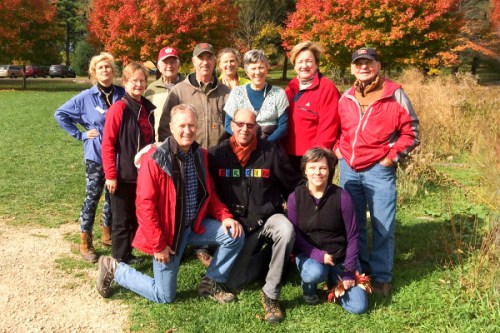
Hiking Fellowship  Downtown Rotarians and guests (front kneeling from left) Jeff Tews, Karl Gutknecht, and Deb Gilpin.  (Standing from left) Kelley Van Egeren, Aldo Leopold Nature Center; Leslie Overton, Dean Nelson, Herman Baumann, Susan Rather, Andrea Kaminski, Kay Schwichtenberg, and Frank Stein.