
submitted by Ellie Schatz
 One candidate accepted the invitation and spoke to our club about her background and plans for serving as Supreme Court Justice: Jill Karofsky. Having been a judge, a local and state prosecutor, and director of the state’s Office of Crime Victim Services, she has advocated for victims’ rights across every court in Wisconsin. She convincingly tells how she has the experience, values, and toughness to lead a legal system that works.
Supreme court cases have consequences for now and the future. To name a few, consider gerrymandering, women’s access to healthcare, and gun control. Whatever the case, following the rule of law is the bottom line, and Karofsky says her record of being fair and impartial is clear.
Her values include upholding laws to protect the environment. She is concerned about climate change but will follow the rule of law. She is strong on individual rights, attacking problems of racial disparity by informing policy makers of what she sees in the courtroom day after day. She says judges need to inform the legislature, have a dialogue with them, but are not there to legislate. More than anything, our courts are about constitutional rights and through the court systems she has fought for the needs of crime victims, stood up for racial justice and civil rights, and protected the right to marriage equality, never allowing for the rights of women to be rolled back. Her goal is to be collegiate on the court, to help pull all sides together under the rule of law. Right now she sees political forces seeking to roll back advances made in civil rights. We must not go backwards, she stresses.
As the Wisconsin Chief Justice is drawing up her budget, Karofsky is pushing for her to put treatment courts at the top of the list as opposed to a business court, which is essentially two courts – one for businesses and one for the rest of us.
When asked about the perception that she is a progressive candidate, she responds: “I am clear about my values, and I have support from Republicans and Independents. I ask for support as someone who follows the rule of law.”
Our thanks to WisconsinEye for videotaping our meeting this week. You can watch the video here.
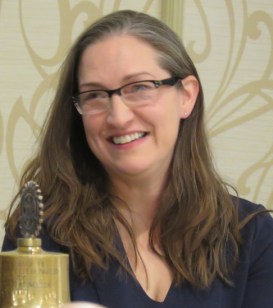 “Hamilton: The Musical is the biggest tour of a Broadway show to hit the road in years, maybe decades,” Sarah Marty, Producing Artistic Director of Four Seasons Theatre in Madison, told Rotarians on Wednesday, February 26. “Hamilton represents an entire industry, with ripple effects that go far beyond the lights of Broadway,” she said, adding that it had surpassed the reach of any other Broadway musical, including the phenomenal popularity of Oklahoma following its 1943 debut.
 UW System President Ray Cross gave an impassioned talk about the past and future of the UW System, and the role it has played in the development of the state and impact on the world.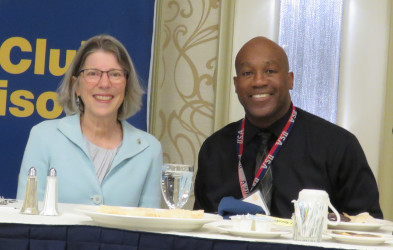
 Sara Eskrich, Executive Director of Democracy Found, spoke to us this week. She has herself been in electoral politics, as a Madison alder, and she is concerned that policy decisions are often stymied by politics. There is an inability to get anything done, even when a large percentage of the electorate favors a particular policy. Elected officeholders believe that there is no connection between acting in the public interest and getting reelected. One of the major problems lies in the two-party system today, which, in business terms is a duopoly, able to eliminate third-party and independent competition. This is done through legislation that makes it very hard to offer substantial money to independent candidates. This makes it extremely important for officeholders to ask themselves not whether a policy is good but rather whether support for that policy will lead to opposition in their partisan primary. Another practice that hinders effective governance is plurality voting, in which the candidate with the highest number of votes is the winner, even if the vote total is less than a majority.
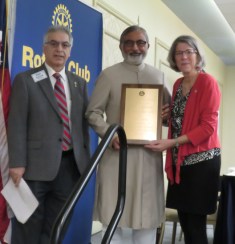 Dr. Masood Akhtar received our club’s Manfred E. Swarsensky Humanitarian Service Award at this week’s meeting. Along with this award, a $2,500 grant is presented by the Madison Rotary Foundation to an agency of the recipient’s choice. Dr. Akhtar has chosen United Against Hate to receive this grant. After presentation of his award, he took the stage to share information about the state-wide non-partisan movement he started called “We Are Many-United Against Hate.”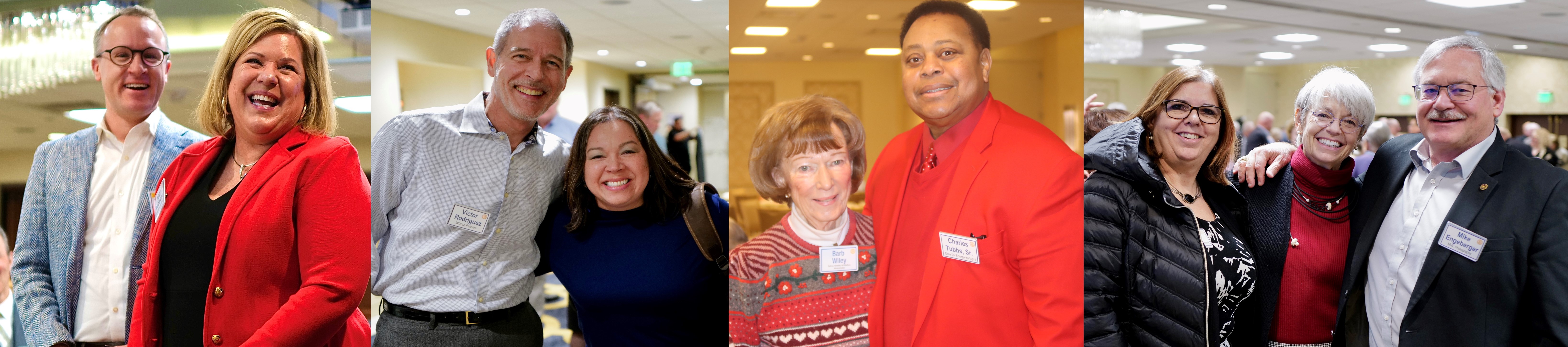
 Rotary Club of Madison, Wisconsin