
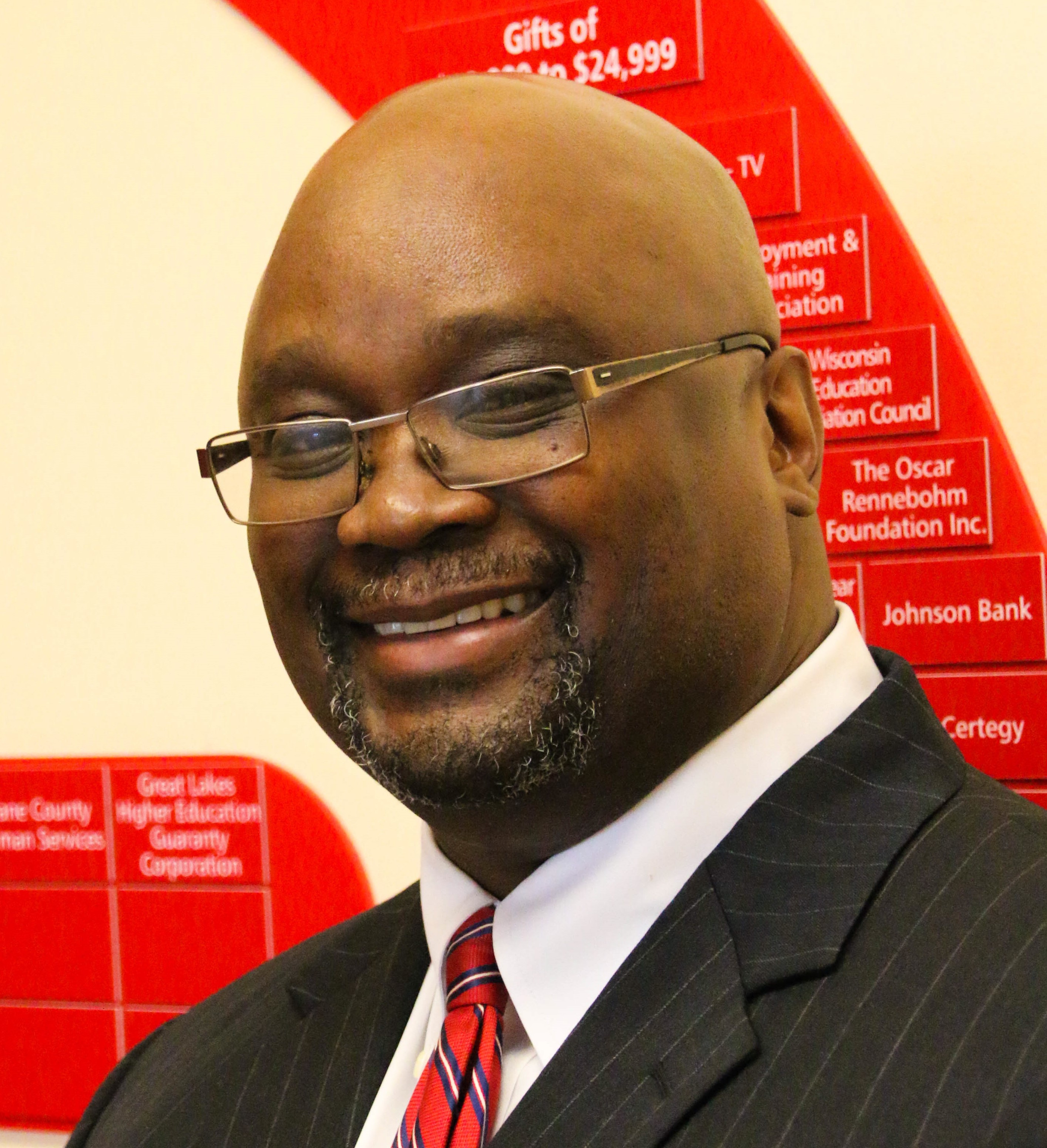
 Ruben Anthony addressed our March 31, 2021, meeting on the subject of “Continued Transformation of the Park Street Corridor.” He has been the President and CEO of the Urban League of Greater Madison since 2015.
The National Urban League was founded in 1910 and now has 92 affiliates throughout the US with the Madison chapter beginning 50 years ago in 1968. It has been a champion for the poor and the unemployed as a longstanding resource for people of color that helps to rebuild their lives and give them a second chance.
Ruben believes home ownership is the key to generational wealth, but, in Madison, only 10% of African Americans own their own home compared to 48% nationally. He detailed how the Urban League actively works toward assisting those individuals into owning their own homes.
The League was inspired by the Sherman Phoenix project in Milwaukee to promote and support African American small businesses in Madison. Thus, it is working to develop the Park Street Corridor on Madison’s south side by trying to establish a Black business hub. It has been aided by an initial $100,000 grant from Dane County followed by a $2,000,000 grant to acquire property and $400,000 in loans from American Family Insurance.
The project is at the corner of Hughes Place and South Park Street. Its first phase establishes core businesses, and the second phase will develop multi-family affordable housing. It is planned to initially have 15 to 20 businesses and additional government offices with the latter on long-term leases to provide more financial stability for the project.
We all can help this project by referring anyone we know who is looking for a business location or a place to start a new business. Low cost capital, in-kind contributions and philanthropic support are of course very much welcomed.
Our thanks to Ruben Anthony for his presentation this week and to Larry Larrabee for preparing this review article. If you missed our meeting this week, you can watch it here: https://youtu.be/O4pO-f0JeUk.
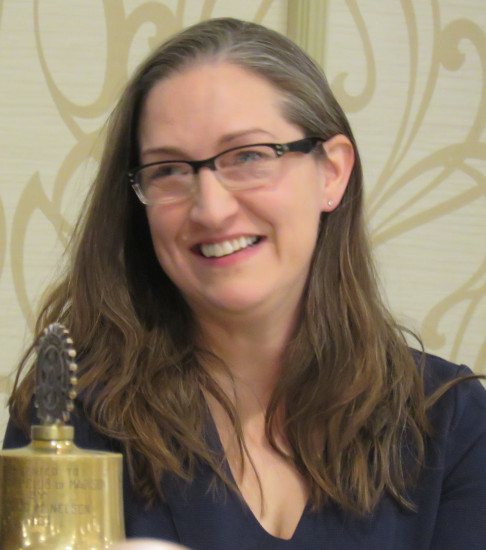 “Hamilton: The Musical is the biggest tour of a Broadway show to hit the road in years, maybe decades,” Sarah Marty, Producing Artistic Director of Four Seasons Theatre in Madison, told Rotarians on Wednesday, February 26. “Hamilton represents an entire industry, with ripple effects that go far beyond the lights of Broadway,” she said, adding that it had surpassed the reach of any other Broadway musical, including the phenomenal popularity of Oklahoma following its 1943 debut.
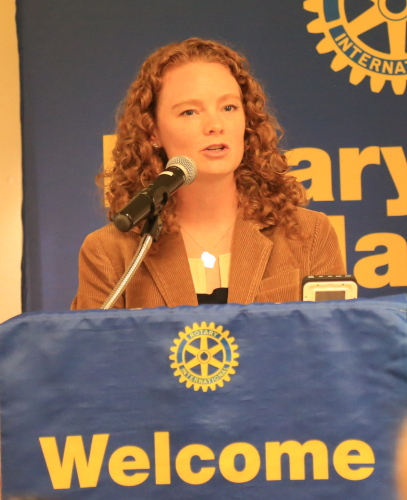 Sara Eskrich, Executive Director of Democracy Found, spoke to us this week. She has herself been in electoral politics, as a Madison alder, and she is concerned that policy decisions are often stymied by politics. There is an inability to get anything done, even when a large percentage of the electorate favors a particular policy. Elected officeholders believe that there is no connection between acting in the public interest and getting reelected. One of the major problems lies in the two-party system today, which, in business terms is a duopoly, able to eliminate third-party and independent competition. This is done through legislation that makes it very hard to offer substantial money to independent candidates. This makes it extremely important for officeholders to ask themselves not whether a policy is good but rather whether support for that policy will lead to opposition in their partisan primary. Another practice that hinders effective governance is plurality voting, in which the candidate with the highest number of votes is the winner, even if the vote total is less than a majority.
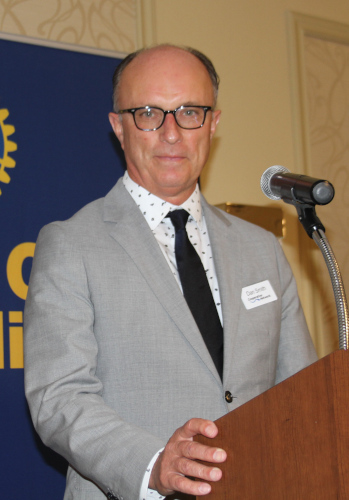 “Everything in Wisconsin’s dairy industry has changed!” That was the keynote hit by Daniel Smith, the president and CEO of the Cooperative Network, in a clear and well-organized talk to the club on Wednesday.
 Tom Lynch, Director of Transportation for the City of Madison, began his presentation by acknowledging the significant contribution of 13-year Director of Metro Transit, Chuck Kamp, for his energy and foresight in bringing the system into the future. Mr. Lynch then shared important aspects of Madison’s transportation system and its future.
 Rotary Club of Madison, Wisconsin