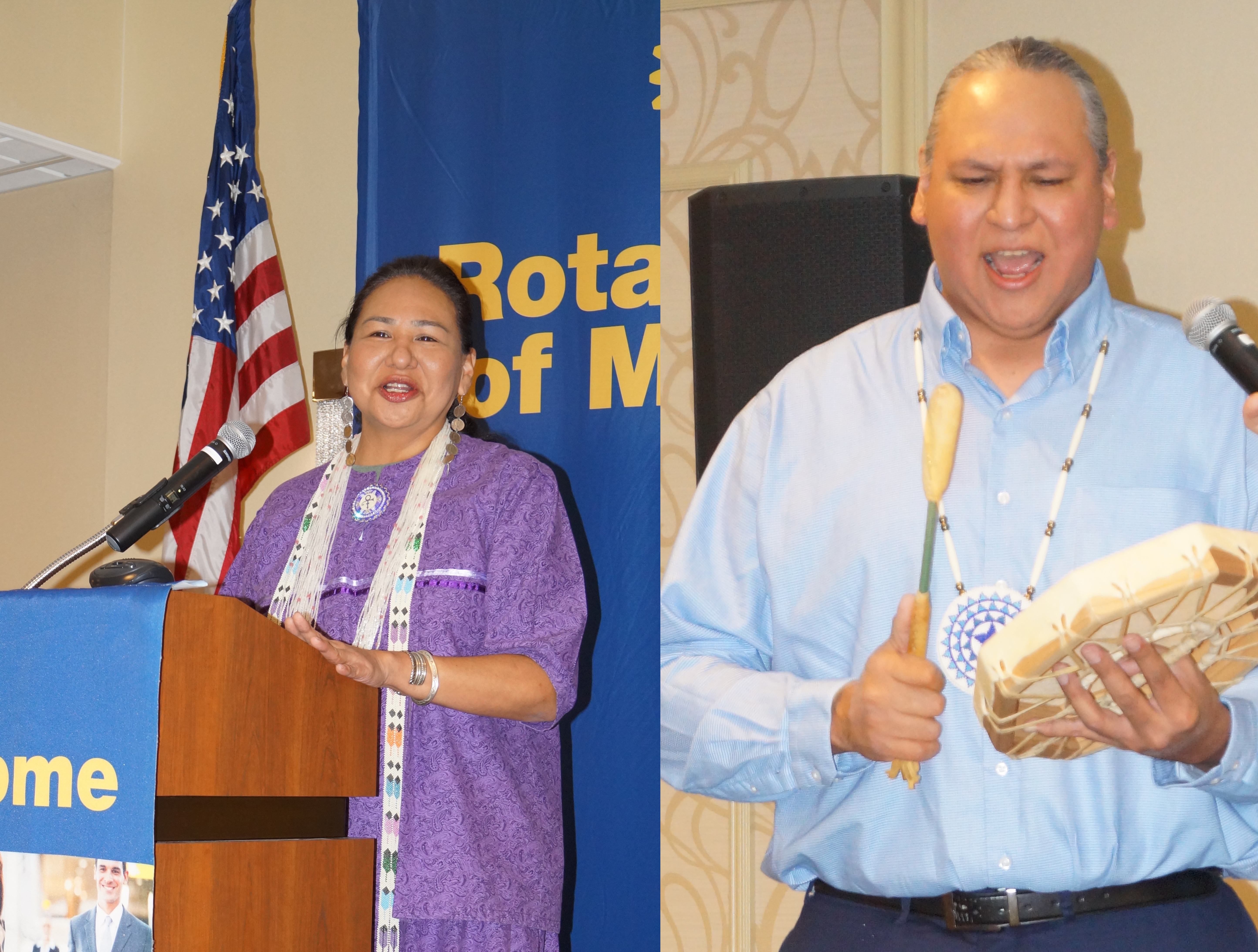
Anne and Josh Thundercloud of the Ho-chunk Nation spoke on Native American pow-wows, which are social gatherings held across the country. A traditional pow-wow focuses on social dances and songs of the hosting tribe. The American flag is often displayed aside the tribe’s flag in honor of the esteem the Native Americans hold for military veterans. The public is always welcome.
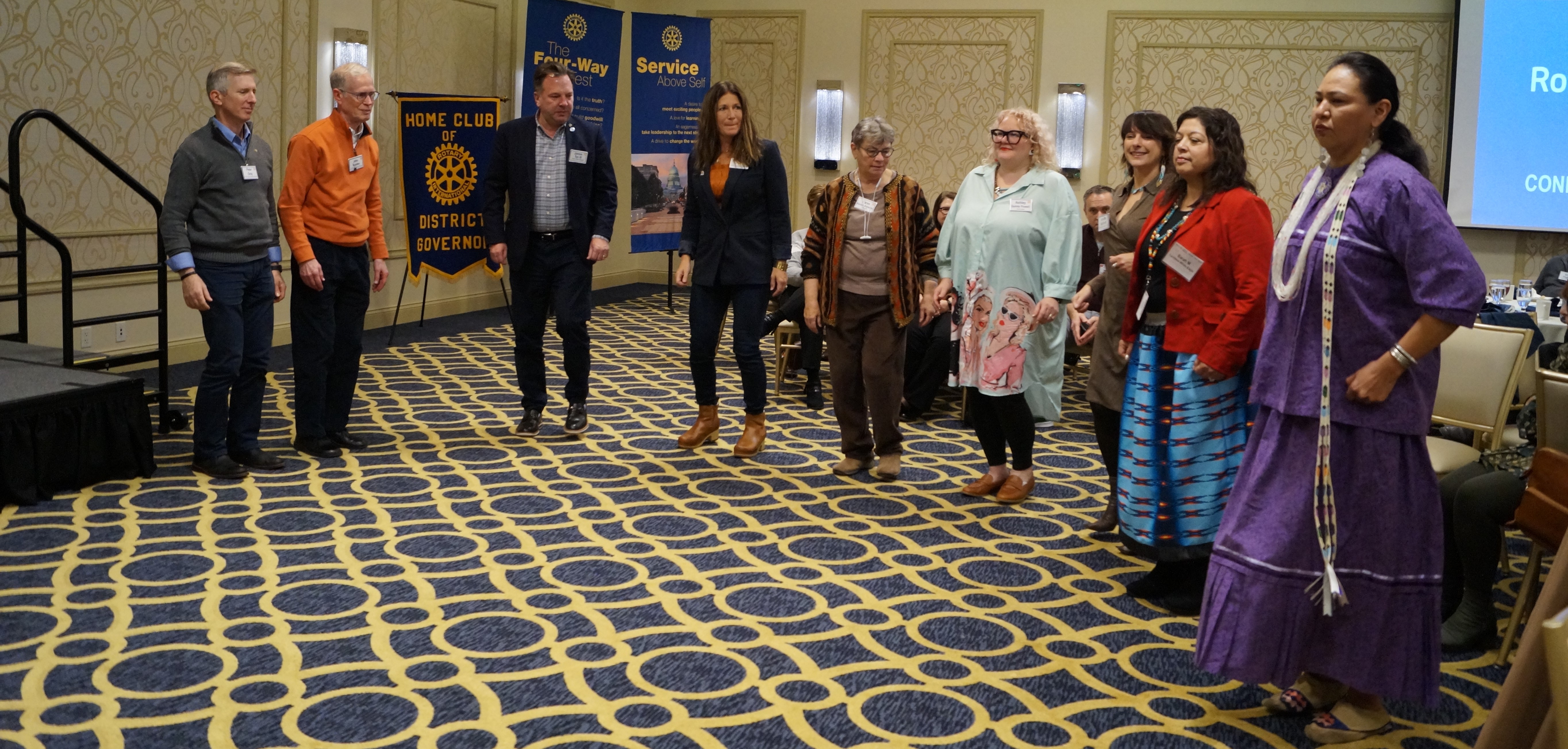
The brother and sister team ended the program with music and a dance, which soon had a couple dozen Rotarians joining the rhythm in a circle at the front of the room.
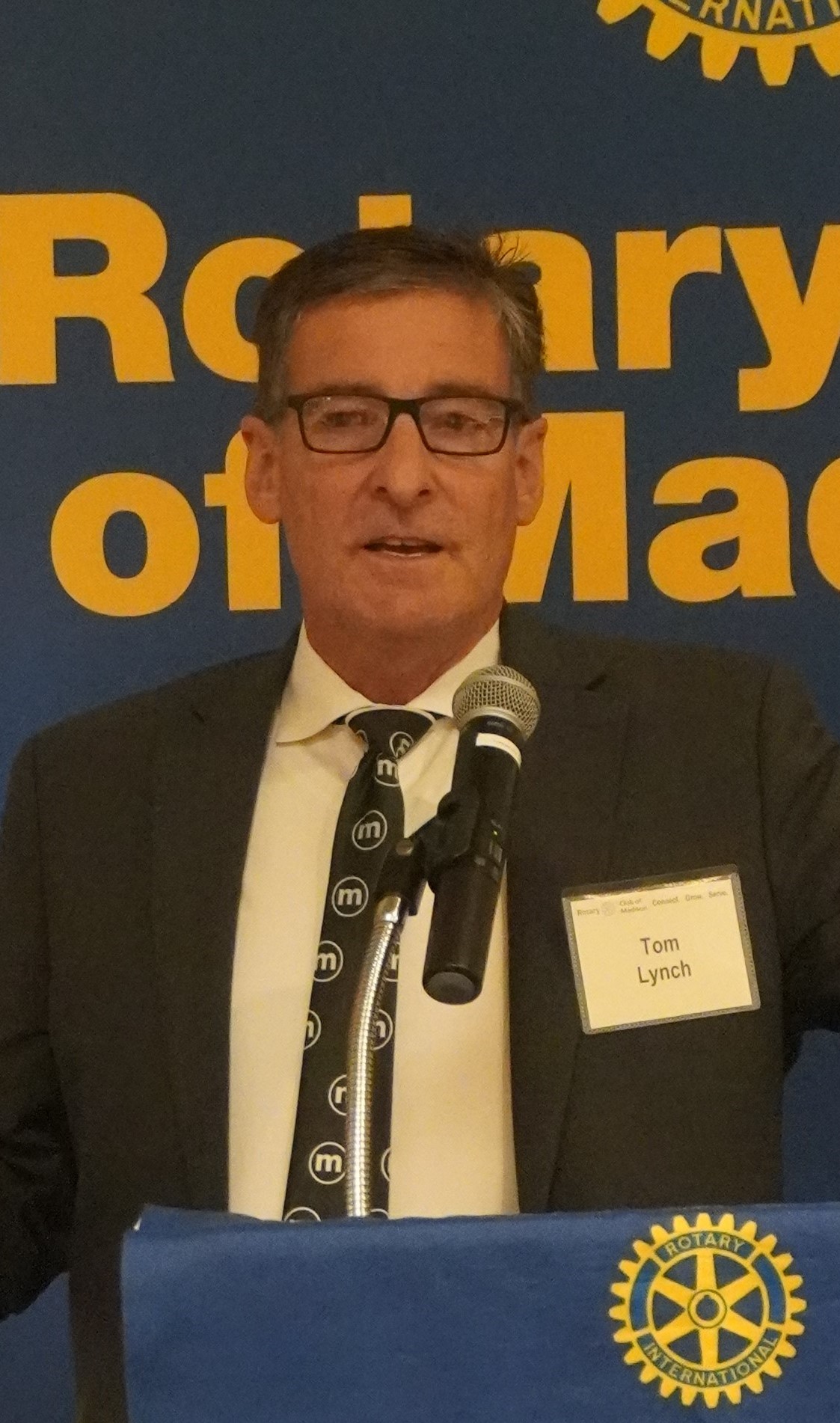
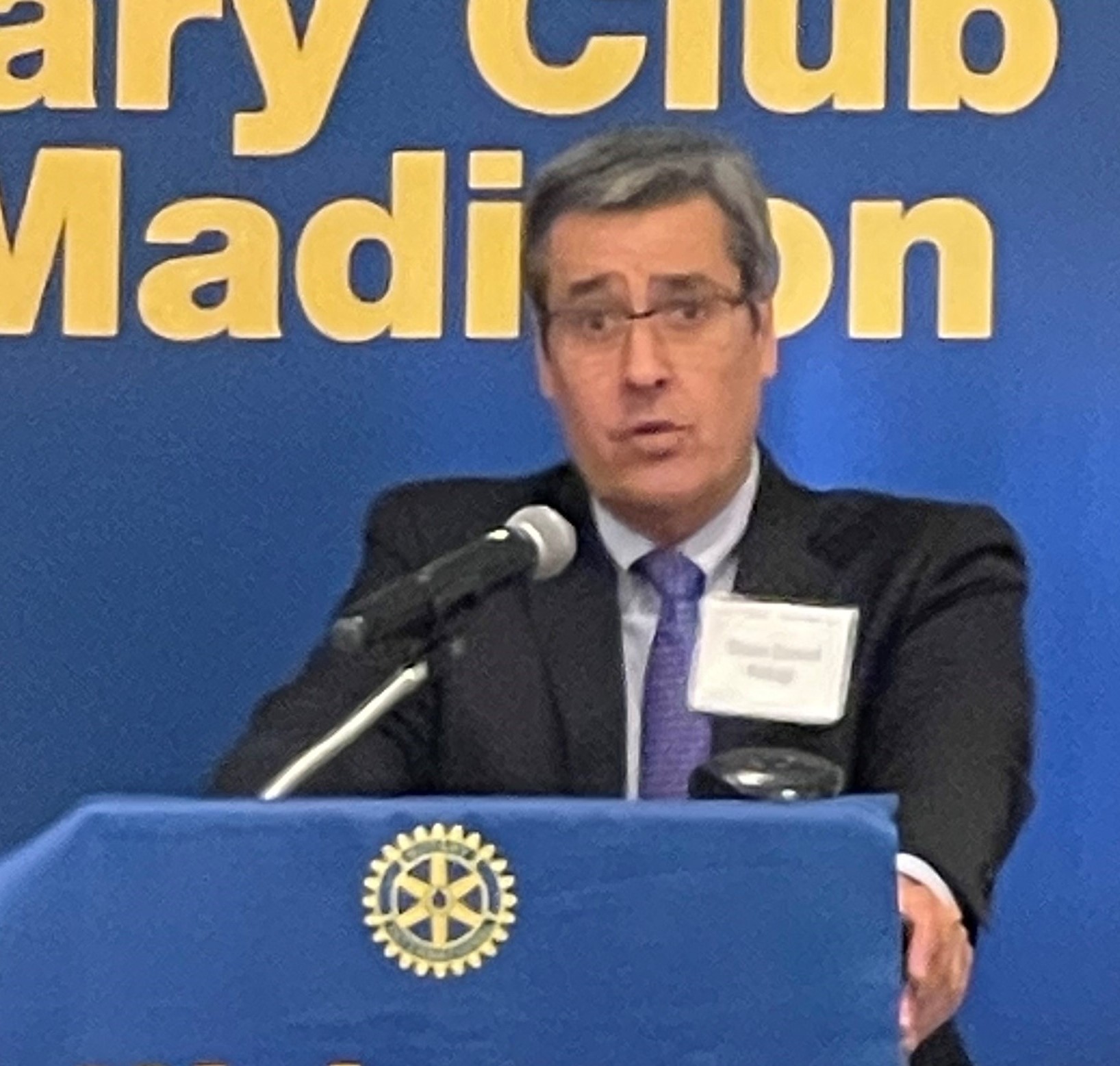
Madison City Transportation Director Tom Lynch shared how transportation evolved in Madison at the October 25 Rotary meeting. Milestones:
1869: Rail service begins; by 1899 Madison has 184 trains a day. State had to pass law limiting time streets can be blocked.
1884: Street cars begin; pulled by mules until 1892.
1901: First modern cars appear. By 1916 cars outnumber horses in Madison.
1949: First beltline built (now W Broadway).
1962: Passenger rail lost.
1965: Cycling on state street/square outlawed.
1968: Bus company leaves; city buys to maintain service
Lynch shared that both public and private transportation are subsidized. Those first mule-pulled street cars offered 5 cent rides but cost the city 9 cents. Today’s Lake Street Ramp costs the city about $700/stall/year with revenue of $212, a subsidy gap of almost $500 per car. Streets are also 40% wider to accommodate parking, another cost covered by property taxes.
Three initiatives were reviewed by Lynch. Vision Zero is designed to safely and equitably prioritize traffic needs. Bus Rapid Transit (BRT) is finally happening. Modest means and BIPOC citizens are especially helped by new schedules and technology moving buses more quickly. Passenger Rail could bounce back from that 1961 loss if the city wins part of 102 billion available federal rail grants. Watch for November announcements and January public meetings.
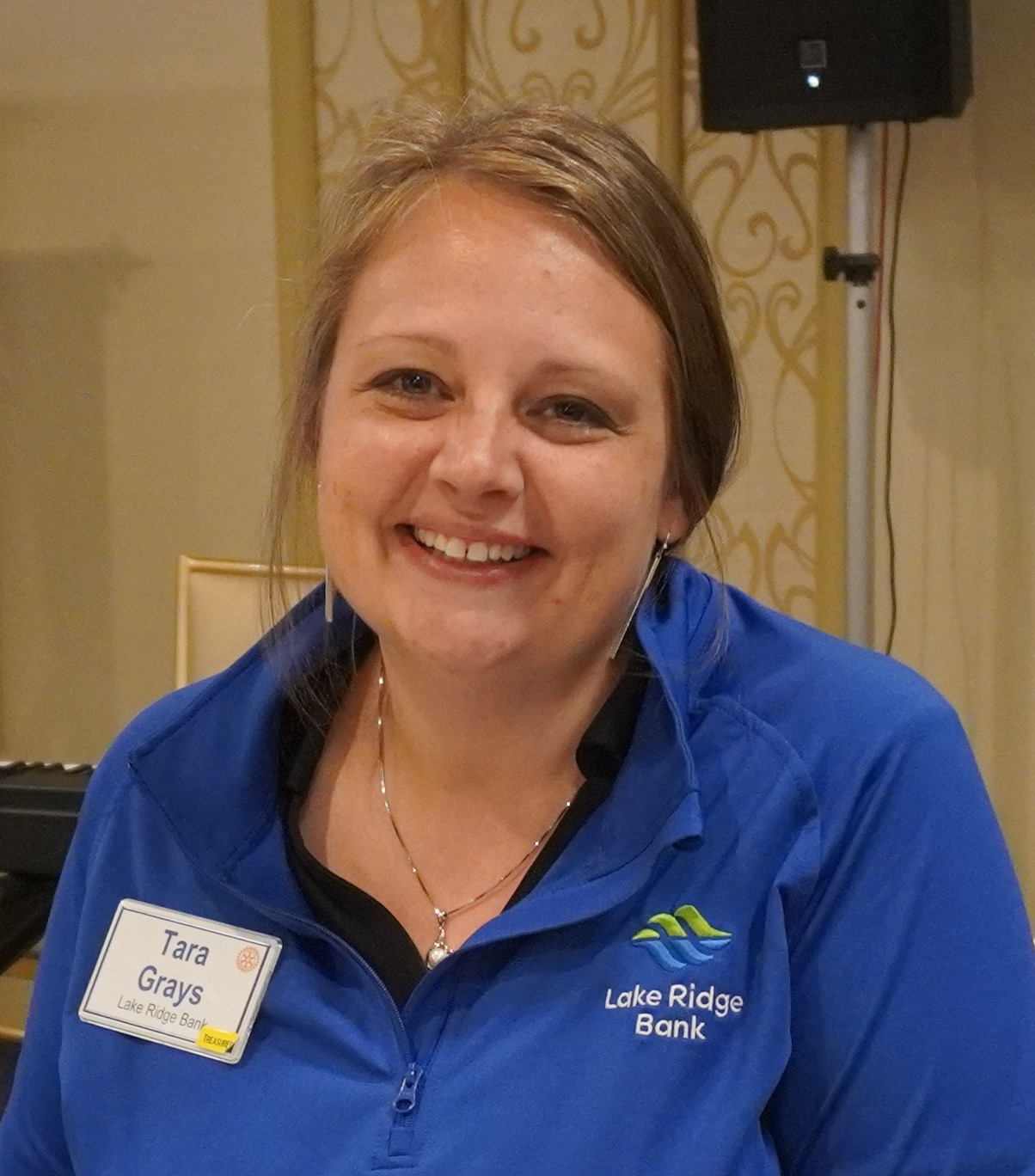
Rotarians heard from fellow Rotarian Tara Grays how several ideas are transforming Wisconsin businesses. Great ideas were celebrated by honoring nine recipients of Wisconsin Innovation Awards.
Hello Loom, a small-scale loom, makes it easier for people to start a fiber arts hobby, and was the first honoree example. Hello Loom is the size of a cell phone and just as portable.
Another honoree, Elephas, images a live Cancer tumor to predict which immunotherapy the tumor will best respond to.
Nurse Disrupted helps close the nursing shortage gap by deploying virtual nursing sessions from current staff.
Other honorees included: Synthetaic, NECTO, Virtual Foundry, Community Clothes Closet, and Managecore.
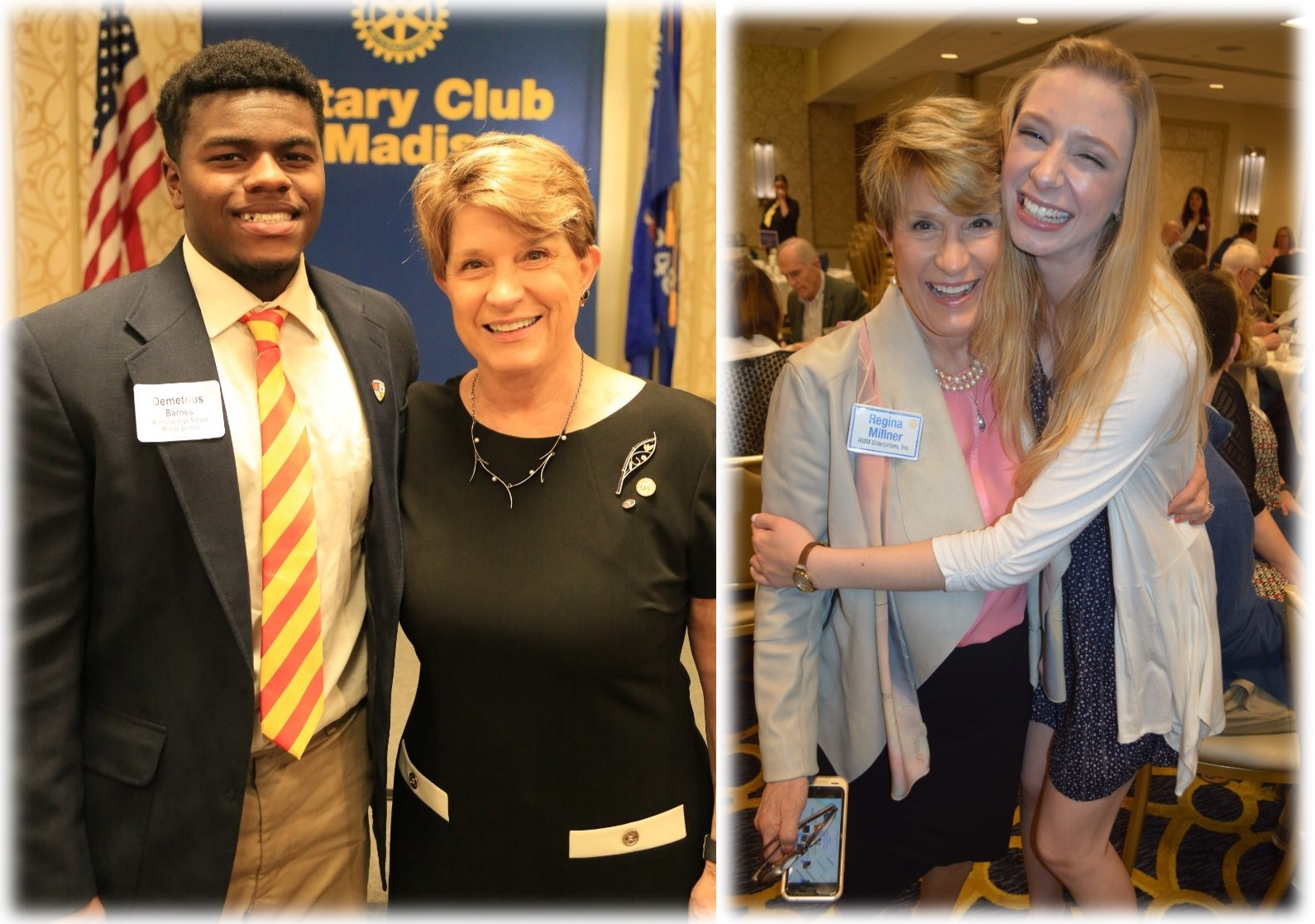
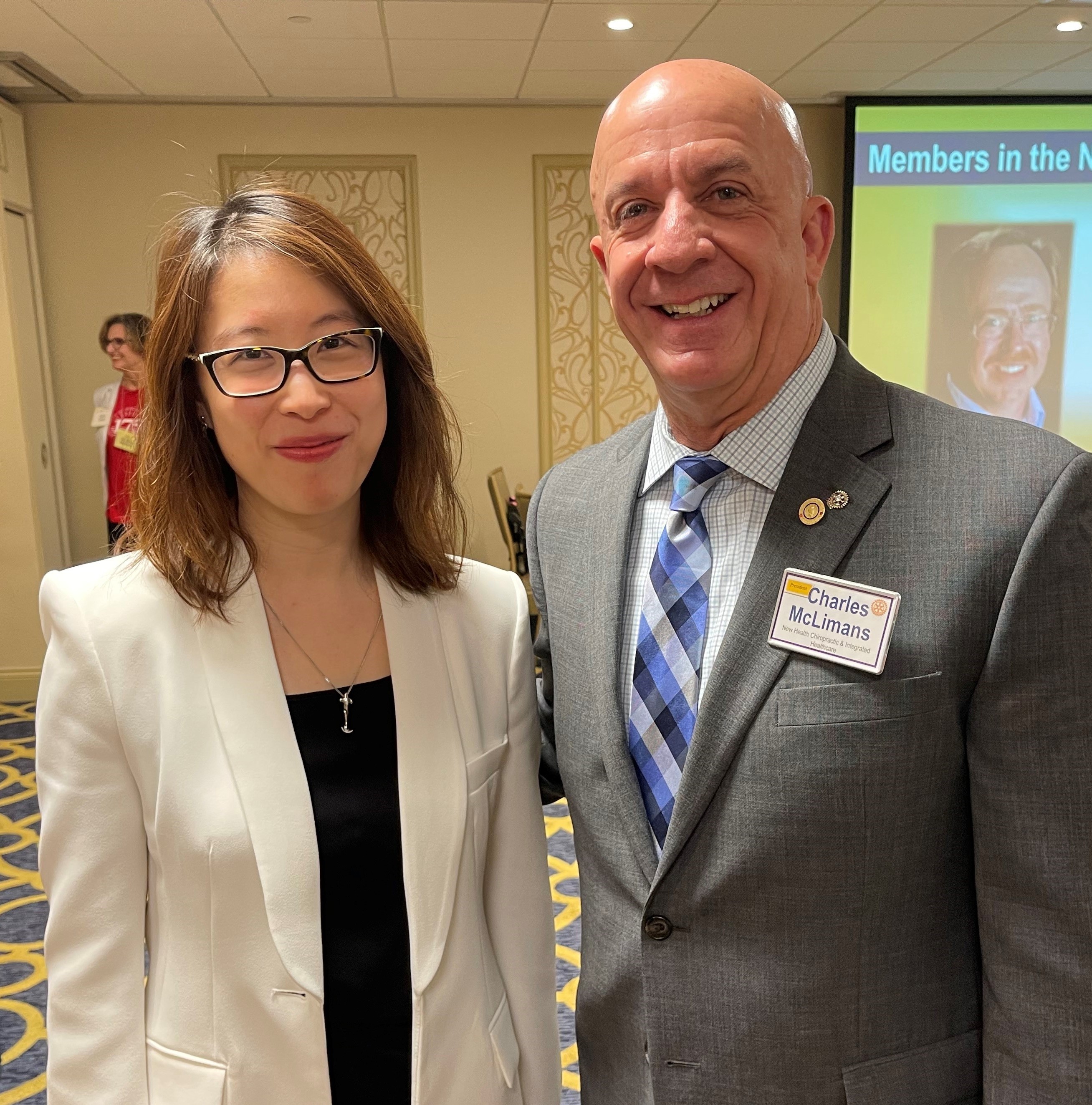
From left, Ellie Schatz, Club President Charles McLimans and Regina Millner
It was 1994 when Regina and I, already friends, joined Rotary. The professional element of membership is part of her story, but the friendship element prevails for me. It gives me great pleasure to be part of honoring Regina with the Joseph G. Werner Meritorious Service Award.
This award was established in 1974 in remembrance of Joseph G Werner, a dedicated Rotarian, who served as club president in 1953-54, district governor in 58-59, and a director of Rotary International in 69-71. He was in line to become Rotary international President at the time of his death in 1973. Throughout his life, Joseph G. Werner epitomized the Rotary objective and vision of “Service Above Self” at home and abroad.
Regina has been active in so many city and Rotary groups and committees that I can highlight only a couple of areas in which she has made major contributions.
First, her role in the creation of Monona Terrace. She believed that having a cultural center would be a catalyst for resurgence in downtown Madison. She helped make clear to developers the economic and fiscal benefits of such a center and then brought Rotary into the picture by encouraging members to serve as guides.
Second, her service on the Board of Regents. At the time the legislature was pushing to eliminate tenure. Regina was among those who fought for policy-driven tenure. This provided UW-Madison faculty the freedom to pursue bold research and teaching agendas, and ensured that scholarship was allowed to flourish.
In both the Monona Terrace and tenure track debates, Regina says her role was to promote an understanding of longterm traditions and how to align those with current ideas for needed change. She says, “I throw out ideas because I want to get things started. I then surround myself with people who will take up the dialogue.”
In Rotary, Regina is proud to have promoted the growth of our scholarship committee. Early on the vast majority of applicants were girls and thus awards to boys were sadly lacking. That situation may not be as dire as it was back then, she says, but giving scholarships and mentorships is the most important thing we do, and the role of maturation must be examined as applicants are being considered by school leaders and Rotary committee members.
As club President in 2006-07, Regina’s first focus was to bring in good, new members. Then she concentrated on advocating for excellent programs. Her leadership is now focused on the Program Committee. She feels strongly that the podium in not a pulpit. Bringing in entertaining as well as thought-provoking programs is most important.
Last but not least, Regina points out the power of Rotary International. She recommends following her commitment to Rotary while traveling. It was through visits abroad, she says, that she came to understand the common goal of “service above self” in clubs around the world but with different local goals that express cultural individuality.
In 2008, Regina and I were a part of a Rotary delegation to a project in Peru called Cecade. We visited schools, shared stories in English, Spanish, and Quechua, and interacted with children, who are wonderfully alike worldwide. Our hosts invited us to their home, took us into the mountains, and insured that we got to see their native citizens at rest, at work, and at play.
And finally we were driving home at something like 1-2 o’clock in the morning after a flight that had been rerouted from Peru to Panama because someone had died on board. We’d spent hours in a closed airport in the middle of the night because our large plane blew out 2 tires landing on a short runway and the replacement tires had to be flown in from Atlanta. Regina had her car at her son’s house not far from O’Hare and offered us a ride home. Needless to say we were all a little wobbly after a harrowing flight. We were nearing home when red lights and a siren were upon us from behind. In answer to the officer’s question as to why we were on the road, Regina said, “We’ve just come from Peru.” Evidently there had been a game at Perdue that day, because he exclaimed Perdue! “Not Perdue,” Regina replied, PERU. He let her drive on, warning us to stay alert.
So here’s to Rotary, friendships, the Werner award and the well deserved 2023 recipient, Regina Millner!
Dan Tokaji, Dean and Professor of Law at UW-Madison Law School, addressed sustaining and strengthening American democracy, focusing on election administration, restructuring elections, money and politics, and the big picture.
With humor, wisdom, a catalogue of issues, and some suggested solutions, Tokaji observed that a unique characteristic of American politics is the profound scale of local elections, inherently partisan, differing by state and often in conflict with federal election laws that, themselves, have changed significantly since the year 2000.
Redistricting, unlimited acceptance of private money, and the need for fidelity to truth further confound the election picture.
UW Professor Kaiping Chen explained last week that AI performs tasks that mimic human intelligence in order to help humans make decisions. There are visible applications, like Alexa or Siri; there are less visible applications such as a robot that can perform surgery; and there are invisible applications that can determine who gets medical care or whether a prisoner is released on bail or kept in jail. There are also deep fakes on the Internet intended to fool. To provide equity, decisions concerning applications should be made by a collective stewardship of the communities that may be affected, including the under-served and the under-resourced.


 Rotary Club of Madison, Wisconsin