
Due to Covid-19 we’ve been unable to meet in person since March, and we’re unlikely to resume in-person luncheons before at least January. Even then, many members may prefer to wait longer to return.
Most members have been paying dues that include the cost of weekly meals, but many of us may not know that 46% of pre-paid meals are not actually consumed by members which helped fund our club’s operating expenses each year. The board recognized that continuing to charge members for meals they can’t consume is not sustainable, but we know that without the surplus generated by meals, the club would have an insurmountable operating deficit. That’s why an ad-hoc committee was formed to study this and make actionable recommendations. The committee included the following members: Jason Beren, Jorge Hidalgo, Teresa Holmes, Jason Ilstrup, Andrea Kaminski, Charles McLimans, Mark Moody (chair), Valerie Renk, Haley Saalsaa Miller, Susan Schmitz, Rob Stroud and Rob Van den Berg.
The new approved dues structure reflects the true costs of the club and spreads them more equitably among the different types of members. Lower dues for Exempt and Life members will continue, in recognition for their many years of service and financial support to the club. Standard members will pay $390 for dues per six months, and this is retroactive to July 1, 2020; Exempt members will see an increase in dues effective for the next billing cycle of January – June of 2021 from $185.50 to $235; and Life members will change to $225 starting July 1, 2021.
The Board acted under emergency authority to approve these changes. Once the pandemic emergency has subsided to the point where a membership vote is possible, the revised dues structure will be put to a vote of the members. We believe these changes to our dues structure are necessary and appropriate to assure the financial viability of the club. We agree that the elimination of the meals subsidy was overdue and necessary, and the dues now reflect the true cost of operation of the club.
Our ad-hoc committee will hold a Zoom Q&A on August 20th at noon for interested members who have questions or want to hear more background. A letter about this new dues structure was mailed to members on August 11, and a link to the August 20 Zoom meeting is included in the Friday, August 14 email from the Rotary office.
Jorge Hidalgo, Club President
 When UW-Madison closed campus in March, 8,000 classes were converted to remote learning. Thirteen days later, 97.5% of classes were online. Closure was a heavy lift, but reopening is a much bigger lift.
 Lisa Peyton-Caire is the Founding CEO and President of The Foundation for Black Women’s Wellness (FFBWW), a Wisconsin based organization committed to eliminating health disparities and other barriers impacting Black women, their families and communities.
 Greg Frank, a co-owner of the Food Fight Restaurant Group in Madison and current Treasurer of our club, gave an overview of the history of restaurants, their current status and future challenges facing the industry during these uncertain Covid-times. Most recognize that the restaurant business can be quite difficult, and operations must survive on very low margins, typically less than 5%. Nevertheless, restaurants are an integral part of virtually every community, and have been so since the late 18th century when the first restaurant opened in France. The first American restaurant established, Delmonico’s in New York City, was established in 1830, and restaurants throughout the world have evolved in a variety of formats over the years.
 Jeremy Suri, the Mack Brown Distinguished Chair for Leadership in Global Affairs and Professor of Public Affairs and History at UT-Austin and formerly a professor at UW-Madison, spoke to Rotarians virtually on Wednesday, July 22, 2020.
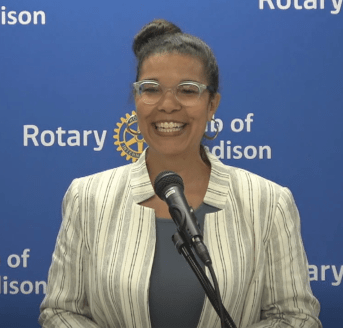 Rotarians were challenged July 15 by Annette Miller to be part of the equity solution.

 Rotary Club of Madison, Wisconsin