
submitted by Jessika Kasten; photo by Valerie Renk
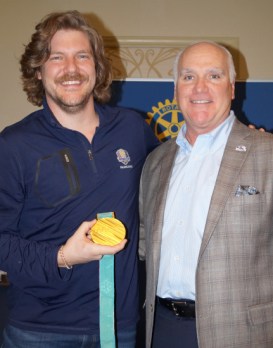 On January 22, USA Curling Interim CEO Rich Lepping and Olympic Gold Medal Curler Matt Hamilton spoke to the group about the sport of curling and Matt’s experiences as an Olympian. USA Curling was established in 1958 and is a non-for-profit headquartered in Stevens Point, WI. The organization consists of nearly 200 clubs and 26,000 members. After the Gold Medal Games, the organization saw a rise in membership and interest, resulting in a 12% increase in membership. USA Curling is already beginning to think about the Beijing 2022 Olympic Games and is starting trials. The USA Olympic Curling Teams will be chosen about a year in advance.
Rich and Matt took part in an interview style presentation where Matt reflected on his “wild media ride” that occurred in the two years since the Olympics. He’s gotten to throw out first pitches at MLB games, drop the puck at NHL games, announce the 2028 Ryder Cup as well as make appearances on Jimmy Fallon and TKO.
Matt was introduced to curling by his father and then again by a friend when he was 15. He spent much of his high school years at the Curling Club playing in leagues or substituting whenever someone needed another player. One of the pivotal points in his life is when a mentor shared with him that “Curling isn’t about making all of the shots, but rather making the right shots at the right time.” This advice has stuck with him throughout various parts of his life.
Matt also talked about his role as the “energy” on the team, and how important sports psychology and teamwork is to the game. He also reflected on how lucky he is to be able to share the world’s stage with his sister, Becca, in mixed-doubles curling. Matt’s very appreciative for the experiences he’s had, and would tell anyone who has their sights set on the Olympics that it all comes down to putting in the time.
 Kurt Paulsen, UW Associate Professor of Urban Planning, reviewed the issues regarding the workforce housing shortage in Dane County and its impact on the economy. Currently, Dane County’s population is increasing 1.3% a year, with job creation at 1.7%, and new housing units at 1.1%, so housing is not keeping up with population demand. In addition, rents are rising faster than income, so many are excluded from living in Madison. Presently, more than 100,000 workers live outside Dane County, which means that they have long commutes.
 UW System President Ray Cross gave an impassioned talk about the past and future of the UW System, and the role it has played in the development of the state and impact on the world.
 Sara Eskrich, Executive Director of Democracy Found, spoke to us this week. She has herself been in electoral politics, as a Madison alder, and she is concerned that policy decisions are often stymied by politics. There is an inability to get anything done, even when a large percentage of the electorate favors a particular policy. Elected officeholders believe that there is no connection between acting in the public interest and getting reelected. One of the major problems lies in the two-party system today, which, in business terms is a duopoly, able to eliminate third-party and independent competition. This is done through legislation that makes it very hard to offer substantial money to independent candidates. This makes it extremely important for officeholders to ask themselves not whether a policy is good but rather whether support for that policy will lead to opposition in their partisan primary. Another practice that hinders effective governance is plurality voting, in which the candidate with the highest number of votes is the winner, even if the vote total is less than a majority.
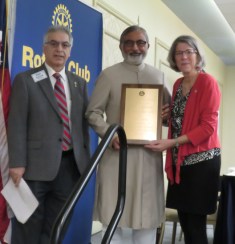 Dr. Masood Akhtar received our club’s Manfred E. Swarsensky Humanitarian Service Award at this week’s meeting. Along with this award, a $2,500 grant is presented by the Madison Rotary Foundation to an agency of the recipient’s choice. Dr. Akhtar has chosen United Against Hate to receive this grant. After presentation of his award, he took the stage to share information about the state-wide non-partisan movement he started called “We Are Many-United Against Hate.”
 Rotary Club of Madison, Wisconsin