
–submitted by Ben Hebebrand; photo by Dennis Cooley
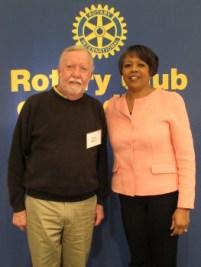 The river that stretches 2,350 miles dissecting the United States has earned many monikers throughout its storied history– it has been referred to as America’s lifeblood, Ol’ Man River, or the Big Muddy. Dennis McCann, who addressed the members of the Rotary Club of Madison on November 29, refers to the Mississippi as “This Storied River,” which is the title of his recently published book that celebrates particularly the Upper Mississippi’s history and role in shaping the Midwest.
McCann, a UW graduate and celebrated journalist for the Milwaukee Journal and Milwaukee Journal Sentinel, traveled the river’s path across the Midwest, including the headwaters at Lake Itasca State Park in northern Minnesota, where, according to McCann, you can see “the little trickle that becomes the mighty river.”
McCann frequently referred to the river as the feature that “divides and unites our country,” implying that its geography divides the United States into east and west and also brings us together.
A highlight of McCann’s research centered on his first-hand experience on his participation on the 150-year anniversary Mississippi cruise of the Grand Excursion, which originally sailed in 1854 in an effort to attract attention to the river as an economic engine to the towns along the river. It is during this commemorative cruise that McCann encountered the towns and cities that border the river in addition to discovering the river’s beauty, power and rich history.
Starting with the river’s earliest days as the river of native Americans, McCann particularly stressed the 40- to 50-year steamboat era, when “elegant steamboats came into town” and introduced settlers to travelers who often came from faraway places.
Throughout the years, however, the settlers of the Upper Mississippi have maintained a culture of their own, referring to themselves as River Rats, who construct shacks along the river and rebuild them following significant floods.
 When the US entered World War 1 in 1917, the war came to dominate the daily life of citizens in Wisconsin. There were initially concerns about our state since 38% of the population had been born in Germany or had a parent born in Germany. Riots were expected on the first day of the draft, yet they did not materialize. Instead 218,000 people (106% of the estimated eligible number) registered, and 5% of the state’s population served in the military. Families were urged to conserve food, grow a garden and avoid eating wheat, sugar, meat, and fat, all of which were critical to the war effort. There was not just social pressure, but aggressive action to ensure that people bought war bonds, and volunteers told those who bought fewer than their means allowed that they would be reported to the County Council on Defense. Dozens were indicted under the Espionage Act for criticizing the war, insulting the flag, opposing war bonds, and other “unpatriotic” remarks. Vigilante groups like the Knights of Liberty took the law into their own hands against “disloyal” citizens, and German language school books were burned.


 Our October 25, 2017, program presenter was Soren Stauss, one of the world’s leading experts on technical social engineering. He has written and lectured on the practice and the mitigation of social engineering-based cyber attacks. Mr. Stauss is the principal of Burtelson Security Labs, a company that tests private and corporate security measures as well as advising on how to correct the deficiencies he finds.

 Rotary Club of Madison, Wisconsin