
–submitted by Mike Wilson

Mike & Patty Wilson
The Rotary Wine Fellowship Group met at Mike and Patty Wilson’s home to taste wine to compare the major French wine regions with their new world protogees. We had white and red Burgundy, Bordeaux, as well as Northern and Southern Rhone wines and virtually all were selected from the Wilson wine cellar. The examples were nearly all very well rated by respected rating organizations (88 – 95 points, mean score 92) and many of the vineyards were very old (one wine from Australia where the vineyard was planted 124 years ago and several others over 100 years, and yet others the oldest regional vines available.
We tried a 2014 white Puligny Montrachet from Pernot, and discussed the Burgundian village (now just used to house workers) and that the area included the greatest white wines of the world (e.g. Montrachet, Chevalier-Montrachet and Batard-Montrachet). This wine is still available at Steve’s for a modest sum. This was compared with a Robert Young Vineyard Alexander 2013 Chardonnay ranked among the best of California that year, and a Wilson favorite. We also compared it with a 1995 Kalin chardonnay Cuvee W which is the current release of Kalin having being kept by the owner for 20 years before releasing to the public for purchase – an extraordinary practice for a business given that now even the great wineries now make their wine for immediate sale and early consumption. At Kalin cellars the owners are microbiologists (Terrence and Frances Leighton) and the sole winemakers, that make all their own wines from bought grapes. They produce about 7000 cases per year, and are credited with being the first Californians to pioneer the unfiltered Sur Lies approach to white wines. Kalin also champions the fifth taste – Umami (the meaty brothy taste that is represented by MSG  but without the MSG salt contribution). They seek this out in their wines before release. The Puligny narrowly wins as the best tasting compared to the quintessential Robert Young Vineyards and the very different Kalin.
Next we tried the red Burgundy and I had selected a Premier Cru Nuits-St-Georges Les Pruliers by Lucien Boillet where the grapes were planted in 1911. Nuits-St-George is considered the main village of this region and is slightly smaller than Beaune to the North. Nuits-St-Georges has no Grand cru vineyards but there are 41 Premier Cru vineyards of which Les Pruliers is one. This wine was compared to similarly rated 2006 Oregon Pinot from Belle Pente Murto Vineyard and a 1995 Kalin Cuvee DD bottled in 2000 (some 17 years ago, and this is the current release vintage). The Oregon Pinot Noir was considered the best of the bunch.
 We had two 2000 Bordeaux blend wines and compared this to a 2006 Rubicon Estate
Rutherford Cabernet Sauvignon. The Bordeaux were a Chateau Talbot and Grand-Puy-La-Coste, respectively 4th and 5th Growth wines in the 1855 Classification of the Haut-Medoc region that includes 61 wines and is the current quality standard of these wines. The 2000 vintage was considered an excellent vintage on both the left (Graves, Medoc, and Haut-Medoc) and right (Pomerol and St. Emilion) banks, a unique situation in the history of these wine regions. This vintage is considered one of the Great vintages because of this, and is one of the few vintages that the price has never fallen below the pre-release prices (when I bought these 2000 wines). The clear winner was the eminently drinkable Californian Cabernet despite it’s lower point assessment (90/91 compared to the Bordeaux: 93 and 94/95 ratings).

From left: Beth & Rob Van den Berg; Chris & Elaine Rich; Jennifer & Bob Winding
We tried the Upper Rhone (Syrah only red grape allowed) 2009 Cote-Rotie La Landonne by Rene Rostaing and this was compared to an Australian Barossa Valley Shiraz that come from a vineyard initially planted in 1893, and a 1998 Hanna Sonoma Syrah. While the Cote Rotie was the winner, it was scored at less than the Australian Shiraz (93/94 vs 95) in recent accepted tastings. The Cote Rotie is interesting as Etienne Guigal (a Rotary tasting will be at Steve’s on University on the 27th April that will assess Guigal’s wines – wait for the call for signup) came to the region, recognized the potential of the wine, restored the reputation of these wines. In the 1940’s when the AOC was created there were only 40 hectares left in grapes, the rest having been converted to Apricot trees. The land was converted back to vineyards as the quality returned to it’s former glory and the apricot trees were removed to get the total acreage back to 210 Hectares. The vines had been uprooted as the slopes approach 60 degrees and concrete walls and terraces need constant maintenance for tending the vines and picking the grapes.
 The last wine we tried was a Chateauneuf-du-pape (CNP) which is from the southern Rhone and has mainly Grenache, Syrah and Mouvedre (the GSM label made famous by Australia with their exports of this blend). Other red and white grapes provide an AOC appellation requirement minimum of six different varietals while the appellation allows at least 9 red and 6 white wines. The ground here is different, having huge heat retention stones (galets) extending from fist sized examples to huge boulders. When Patty and I visited Ch. Beaucastel in the mid 1980’s we wondered how they could even plant the vines in those “rock fields”.
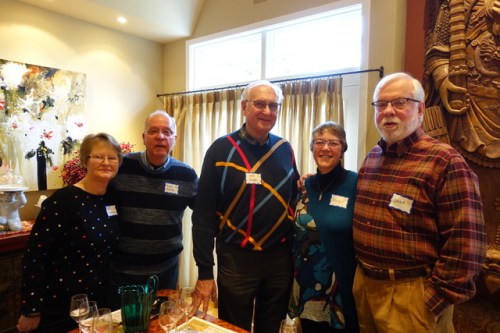
From left: Leslie & Peter Overton; Ken Yuska; Sandy & Dana Corbett
We tried a Chateau Beaucastel Famille Perrin 2011, the most expensive wine of the tasting. Ch. Beaucastel always uses 13 grapes in their CNP. We tried it against a 2011 Paso Robles Tablas Creek Esprit GSM with additional Cunoise, and the interesting fact is that Ch. Beaucastel (Perrin family) co-own this Paso Robles property with their US importer (Robert Haas). They found a property, stocked it with 8 vines from Ch. Beaucastel, waited out the 3 year quarantine, and now sell the Rhone wines and the Rhone vines from their USA winery. The Esprit de Tablas is the second best wine from Tablas Creek and the Famille Perrin is Beaucastel’s second best CNP, so it was a good comparison altho the wine from France would have much older vines. We also tried a GSM from Adelaida, also the same year. All were excellent, all were well rated and there was no definite winner, just personal favorites, with no one wine getting a majority vote.
 This was a great tasting and we had 5 cheeses (3 of which are pictured here) selected for these wines and chocolate covered strawberries made by Patty. These included a local Mozzarella on melba toast, with Normandy Brie also on Melba Toast. We had Dubliner (invented by an Irish UW faculty while getting his PH.D. in Ireland – now sold by Kerrygold (but not currently banned like the butter). We had Cambozola, and Wensleydale cranberry cheese (another story of old English cheese slowly disappearing until owner of the last factory sold to the management who regenerated the business). The Mozzarella and Brie went well with the white and lighter Pinot Noir, while the other cheeses and chocolate strawberries stood up to the reds. Overall, the tasting was great fun for everyone.


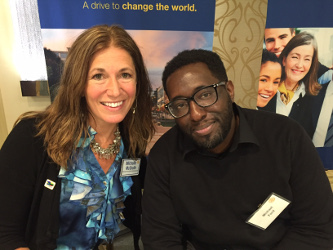
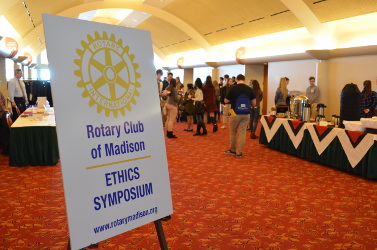 More than 200 students from 20 area high schools assembled at Monona Terrace Convention Center on February 17 for the 17th Annual Rotary Ethics Symposium, underwritten by our club’s Madison Rotary Foundation. They were welcomed by 2017 Ethics Symposium Chair Steve Johannsen, who noted that we all face ethical dilemmas several times a week. He explained that often it’s a small matter, for example, what to do when your cell phone starts ringing in a meeting. Other dilemmas can be gut-wrenching. Steve introduced the students to a hierarchy of four stages of ethical decision-making:
 The First Wave Hip Hop Theater then opened the event artistically with dramatizations of three ethical dilemmas that teens might have to face: what to do when the friend who drove you to a party gets drunk; what to make of a famous athlete’s protest during the national anthem; and how to talk with a friend about a decision he has made. First Wave is a cutting-edge, multicultural, artistic program for UW-Madison students. It was the first university scholarship program in the country centered on the spoken word and hip-hop culture. The actors portrayed the dilemmas with humor and insight, and the moderator (a First Wave alumnus who now teaches in the Verona schools) invited audience participation between acts.

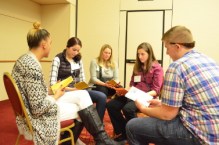

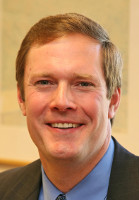 Entrepreneurship is one of the most important drivers of economic and job growth in our state and across the globe. It is also a topic that is of growing interest to today’s college students. On February 15, Dan Olszewski, the Director of the Weinert Center for Entrepreneurship at UW-Madison School of Business, spoke with us about how UW-Madison is one of the leaders in teaching and inspiring students interested in entrepreneurship as a potential career.

 Rotary Club of Madison, Wisconsin