Fostering Ethical Decision Making

–submitted by Ben Hebebrand; photos by John Bonsett-Veal and Mike Wenzel
DSC_0048

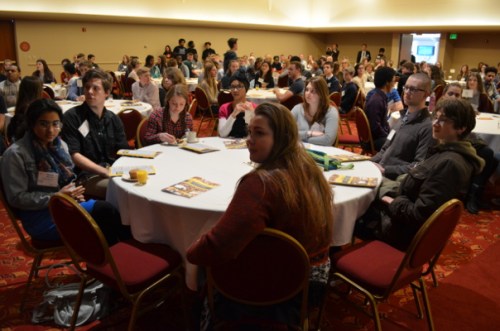
Almost 250 11th grade students from 20 different Madison area high schools met for the 16th annual Rotary Club of Madison Ethics Symposium on Friday, Feb. 19 at Monona Terrace in Madison, affirming at the culminating luncheon the need not just for adolescents but all of us to “think all the way through decisions.” This kind of thinking, the students expressed, could be enhanced by discussing dilemmas with others including those whom we do not know and those who are different than us.

“Discussing issues with others can broaden your viewpoint,” said Katie Feller of La Follette High School. “It’s interesting to see how people can change their view (by thinking and talking it through),” added Liz Dominguez of Marshall High School.
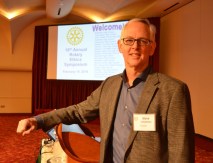
DSC_0012The five-hour symposium kicked off with real-life reminders that ethical decisions abound throughout history and contemporary life. Steve Johannsen, the 2016 Rotary Ethics Symposium Chair, reminded students that the day was a significant date in history as US President Franklin D. Roosevelt issued Executive Order 9066 in the aftermath of the Pearl Harbor attack, authorizing the deportation of Japanese Americans to internment camps. “It is a decision that is still being discussed today,” he said, leaving “tacit” the current political dialogue on the Syrian refugee crisis and immigration.
DSC_0069   DSC_0079   DSC_0049

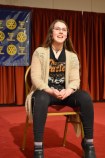
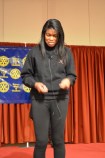
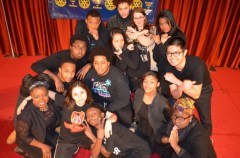
It was a group of UW students by name of “First Wave Hip Hop Theater” that in the opening session framed and underscored the importance of ethics by its artistic representations of the Holocaust, slavery (particularly vivid  and thought-provoking through a simulation of a public whipping of a slave), police brutality and the Black Lives Matter movement with particular reference to the Madison protests in the wake of the March 5, 2015, police shooting of 19-year-old Tony Terrell Robinson, Jr. First Wave is comprised of a diverse group of UW students, all of whom are part of the first university scholarship program in the U.S. centered on the spoken word and hip-hop culture. The group’s performance helped the assembled 11th grade students indeed grasp how ethics not only shape individual lives but instead entire cultures and societies.
IMG_0492   DSC_0099

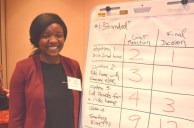
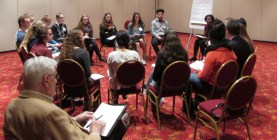
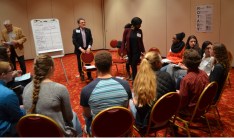
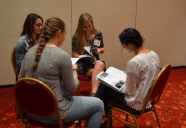
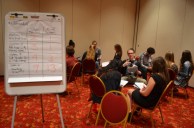
In three separate breakout sessions of about 20 students each, the high school students with the aid of a Rotary facilitator discussed the ethical implications of adolescent alcohol use and the potential for drunk driving, affirmative action directed toward youth of color, and the use of a locker room by a transgender student  who has not had gender reassignment surgery. Many of the students remarked not only how timely these topics were, but also incredibly important for them to discuss.

The three sessions not only provided rich dialogue among the high school students, but also introduced them to a hierarchy of moral and ethical thinking. Students initially were challenged to record their gut decision, and subsequently made decisions through the lens of “egoism” (What Action Will Benefit Me the Most?); “social group relativism” (What Action Do My Friends or Group Members Think I should Do?); Utilitarianism (What Action Would Produce the Greatest Amount of Good and the Least Amount of Harm?); and the “Right Approach” (What Action Will Best Respect the Rights and Dignity of Each Person?).
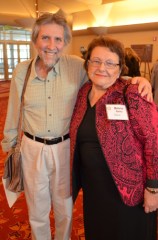
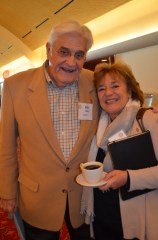
DSC_0022   DSC_0024   DSC_0023

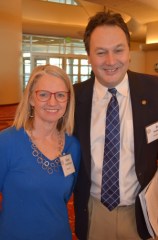
Photo 1: Denis Collins & Melanie Ramey; Photo 2: Mike Casey and Rotary District Governor Mary Van Hout; Photo 3: Karen Christianson & Ben Hebebrand

“We want the students to think about these stages. Our goal is to lead them toward the Rights Approach,” said Denis Collins, who, as a Business Ethics Professor at Edgewood College, has lent his expertise to the symposium since its inception. “Creating a forum and a framework in a safe setting with new acquaintances,” is what defines the essence of the symposium, according to Johannsen. Affirming the sense of safety was a student speaker who proclaimed that “sometimes, but not today, our opinions get discounted.”

The sense of safety is no accident. All Rotarian facilitators underwent a five-hour training session, stressing ground rules best summarized by the mandate that participants need to “treat every single person with complete and unconditional respect.” The training for the facilitators included a presentation by local psychologist Dr. David Lee on “LGBTQ Discussion on Transgender and Identity Issues.”

The symposium also offered accompanying teachers and principals the opportunity to ponder possibilities to introduce further outlets for students to discuss ethical dilemmas. Rotarian Bob Shumaker pointed out that often it is the kids who bring back to their schools the need and desire for further ethics education. “Belleville High School kids created an Ethics program,” he said. “The kids created and gave their teachers ethical dilemmas relating to student discipline and assessment of student work.”
DSC_0107   DSC_0113  DSC_0117

Education, including learning about an ethical framework for decision-making, is of course enlightening. Thomas Mulholland of East High School summed it up this way: “Apathy is dangerous; ignorance is more dangerous.” Equally uplifting was an impromptu remark by a student during the public comment session that “after today, we can still have faith in humanity.”
Freedom of Speech and Faculty Tenure

–submitted by Bill Haight; photo by Stacy Nemeth

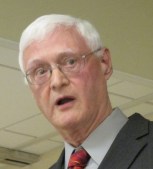
Donald Downs (2)Academic freedom of speech, which dates to the time of Socrates, and faculty tenure, which is about 500 years old, were the subjects of UW-Madison Professor Donald Downs.
A couple of the basic changes in tenure that have occurred recently in Wisconsin include:

  • Faculty dismissal is allowed beyond the original criteria of either “just cause” or critical financial cuts. Now other factors such as “program changes” can be considered which gives broader ability to dismiss, and could be misused, according to Downs.
  • Shared governance of faculty, staff, and students has been demoted to more of an advisory role rather than a co-governance role with the administration.

A practical concern is that weakening of tenure policies at the UW puts the institution at a competitive disadvantage with other universities trying to attract quality faculty.

Tenure protection for faculty is a means to an end, the end being academic freedom, according to Downs.

Academic freedom, is defined by the famous statement adopted by the UW Board of Regents in 1894: “Whatever may be the limitations which trammel inquiry elsewhere, we believe that the great state University of Wisconsin should ever encourage that continual and fearless sifting and winnowing by which alone the truth can be found.”

Academic freedom and tenure, it is believed, is essential to the central mission of the University, which is pursuing truth, teaching and pushing the frontiers of knowledge.

A long-standing social contract allows academic freedom to take place with priority over politics, ideology, fashion or other social pressures. This does not allow, however, creation of absolute dogma or indoctrination. Defining what is not within that social contract is not always easy.

In the 1980’s many universities enacted policies against offensive speech by faculty or students. But in practice, these chilled intellectual honesty.

Downs related incidents of extreme speech codes, such as one from an eastern institution that prohibited “inappropriate laughter.” “Is anyone clairvoyant enough to be able to tell when laughter turns ‘inappropriate’?” asked Downs. Another policy urged campus members to report “discomforting” speech. “Isn’t much of learning somewhat discomforting?” asked Downs.

CLICK to watch the video.

What is the Value of a Liberal Arts Education?

–submitted by Andrea Kaminski; photo by Stacy Nemeth

Scholz KarlIn a lively presentation, UW-Madison College of Letters & Science Dean John Karl Scholz made the case for a liberal arts education, especially when it comes from UW-Madison. However, he stressed that the University needs the input of employers and alumni to make it happen.
According to the Bureau of Labor Statistics, the average weekly earnings of people with less than a four-year degree dropped between 1979 and 2014, while those of people with a bachelor’s degree or higher rose 14.1 percent. Scholz was proud to report that the median student graduating from UW-Madison has no student debt. The almost 50 percent who do have student loans graduate with an average of $27,000 in debt. While that can be a significant factor in a new graduate’s life for several years, Scholz (an economist) compared it to an average return on investment of $500,000 to $1 million in additional earnings over a lifetime.

There are 35 departments in the College of Arts & Letters, encompassing the physical sciences, social sciences and humanities. The College offers nearly 60 percent of all credit hours at UW-Madison, according to Scholz. He noted that employers are looking for the skills and qualities that students gain in the College: a broad knowledge base, problem-solving skills, communication skills, especially writing, and critical thinking.

A recent survey of alumni who are one year out of college, or eight to ten years out, found that in general they have been successful in getting jobs. Their earnings are good, and 90 percent said they use their liberal arts education in their professional work. Scholz highlighted two recent graduates who have excelled: one becoming a Rhodes Scholar and the other a Marshall Scholar.

Outstanding research in Letters & Science includes the discovery of a new species of humans in our evolutionary history, and research projects examining the origins of the universe and international humanities. Scholz also noted that the UW Geology Museum is a gem which is visited by more than 50,000 school children per year.

Metrics for student success are good, including an average time-to-degree completion rate of 4.13 years and a 95.8 percent retention of freshmen. UW-Madison is rated ninth in the nation for best value for students.

But academic triumph has to be matched with cultivation of job and life skills in order to make students successful in their careers, particularly for first generation college students. That is why the College has launched the Letters & Science Career Initiative, which applies dedicated faculty and staff to work with alumni, employers and students. A new course for sophomores will help them reflect on their skills, define their aspirations and build on their strengths. Students will learn how to write a top-notch resume and build a professional network.

Another program, Career Kickstart, will create an immersive, residential learning community for 600 sophomores, with onsite academic advising and mentoring.

Scholz noted that no one is in a better position to help students build their professional network and succeed in a career than past graduates of UW-Madison who have done just that.  Alumni will be active in mentoring, doing informational interviews and offering internships. Scholz envisions that, through outreach and partnerships with employers, there will be more opportunities for students. UW Letters & Sciences seeks to be a “go-to place” for talent in the job marketplace.

Scholz was asked what we, as Rotarians, can do to help, and he asked us to help project the University’s success story throughout the state and beyond. He noted that state legislators will take note if they hear positive news about the university from “unexpected sources,” i.e., not university administrators.

CLICK to watch the video on our YouTube channel.

Is Your Business Ready for the X’ers?

–submitted by Donna Hurd; photo by John Bonsett-Veal

Seeger Debbie

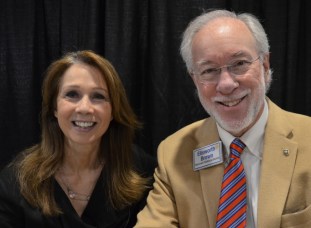
Debbie Seeger, (pictured here with club president Ellsworth Brown) in her presentation entitled “Shift Happens,” provided a futuristic view of the incoming workforce, the ensuing competition to attract and retain talent, and how to prepare for the inevitable.

By the numbers: Baby Boomers represent one of the largest generations in history (78 million) and we are aging.  The succeeding generation, Gen X, represents just over half of the baby boomer population.  Clearly, the laws of supply and demand indicate the supply of available workers will not sufficiently meet the potential demand of employers.  The repercussions of poor planning or absence of planning will prove detrimental to a business’s viability.  Defining the gaps in knowledge with the loss of boomers will be an integral part of assessing the needs of the business in its attempt to successfully move from one generation of workers to the next.

Technologically astute, this up and coming generation knows what they want and are not afraid to ask for it.  Unlike their predecessors, X’ers will continue to seek employment opportunities that align with the way they want to work and value their contributions.  Blind loyalty will not be afforded to businesses that have not done their homework.  Understanding what motivates this group is integral to drawing, engaging and retaining this talent.  Enticing this limited resource with money only will prove to be a losing strategy.  Emotional compensation (the feeling of being valued) has to be part of the package.  Determining the right blend of financial and emotional compensation will be a recipe for success for both employer and employee.

Aligning their mission, vision, and values with their recruitment, development and retention strategies businesses are sure to have an advantage over those that do not.  Trust is the foundation that will support the shifting paradigm in order to engender loyalty from the incoming talent pool.

CLICK to watch the video on our club’s YouTube channel.

Brandon on Madison’s Business Climate

–submitted by Rick Kiley; photo by Mike Engelberger

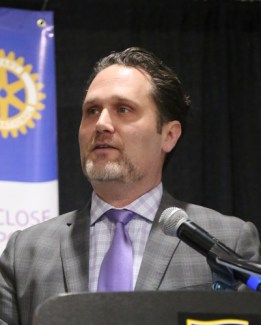
Brandon ZachZach Brandon, President of the Greater Madison Chamber of Commerce, addressed our Club regarding “Madison’s Business Climate,” citing four trends to explain where we are headed.

The first trend is “sector density,” the types of jobs and industry we have.  These include growing industries such as biomedicine and bioscience, health tech and information technology.  Three-fourths of local jobs created are diverse sources in the private sector, not just Epic Systems; recent hiring is by Google, Amazon, Zen Desk and Microsoft.

One reason for this job creation is jobs in technology and engineering are easily filled with local employees and do not pay relatively high salaries.

The second trend is our development of talent.  We are a large market for software creation.  State-wide software development is nearly as large an employer as manufacturing.

We have a significant in-migration of “millennial” workers, born in the late 1970s.  Unlike most cities, in Madison this group tends to buy homes and settle.

The third trend cited is our area’s reputation.  We have a lot to boast.

Recently, Forbes magazine listed us fifth among cities “winning the battle” for info-tech jobs; the Millken Institute ranks us eleventh among cities for high-tech job growth; per capita, we rank fourteenth for raising venture capital to fund early-stage companies.

In addition, we rank #1 among cities for successful aging.  What underlies these encouraging rankings?  Proximity to education, Mr. Brandon says.  However, we are nearly the most income-segregated city, a troubling situation that requires the attention of the entire community.

The fourth trend is wealth creation.  “Madison is the epitome of how to win the coming jobs war”, he says.

Concluding, Mr. Brandon sees the Madison area as “on the upswing,” but we “need to learn how to brag” to communicate our strengths, that “we are the next big thing;” “we solve the world’s problems;” and “we export solutions.”

CLICK to watch the video on our club’s YouTube Channel.

Wine Fellowship Event on January 18

–submitted by Mike Wilson; photos by Mike Wilson

PhotoW6

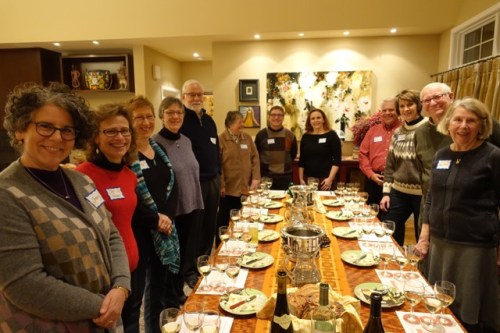
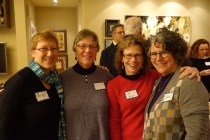
Our club’s Wine Fellowship met at Mike Wilson’s home for a BYO wine tasting on Monday the 18th January 2016.  We snacked on bread (Whole Food’s; Italian, Ancient Grain, and cranberry/walnut) and crackers, with grapes and chocolate-covered strawberries.  We also had some Beautiful Bruschetta’s, warm Rachel Ray spiced shrimp on sticks, two Marvellous Marieke Gouda cheeses, a triple cream beautiful Brie served with sliced apples, an artichoke dip (with some tasters requesting the recipe) and salami/pepperoni wrapped Mozzarella straws.

PhotoW9  PhotoW11  PhotoW10

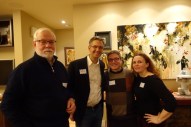
Photo 1: Becky Steinhoff, Sandy Corbett, Joy Gander & Cheryl Wittke; Photo 2: Karl Wellensiek, Mary Janet Wellensiek, Meryl Mixtacki & Steve Mixtacki; Photo 3: Dana Corbett, Bob Winding, Mike McKay & Mandy McKay

Going with these were some marvelous wines sorted into groups.  These included an Alsatian Pinot Gris and a Spottswoode Sauvignon Blanc, followed by a Miner Chardonnay and a Guigal Cotes du Rhone white blend.  We next tried an Unti Segromigno (Sangiovese and Montepulciano), an Adelaida Cinsaut, and a Gnarly Head Merlot that were all Wonderful Wines.  The last series was Owen Roe Ex Umbris Columbia Valley Syrah and an old (2002) Amon-Ra Shiraz from Australia (hence Shiraz and not Syrah), and a Decoy Zinfandel.

PhotoW7  PhotoW4  PhotoW3

I rated 4 of the wines as exceptional and the rest as excellent quality, and we all had a great time.