Tag Archives: Madison WI

December 8: Impact of Large and Small Capital Projects on Their Communities

submitted by Kevin Hoffman
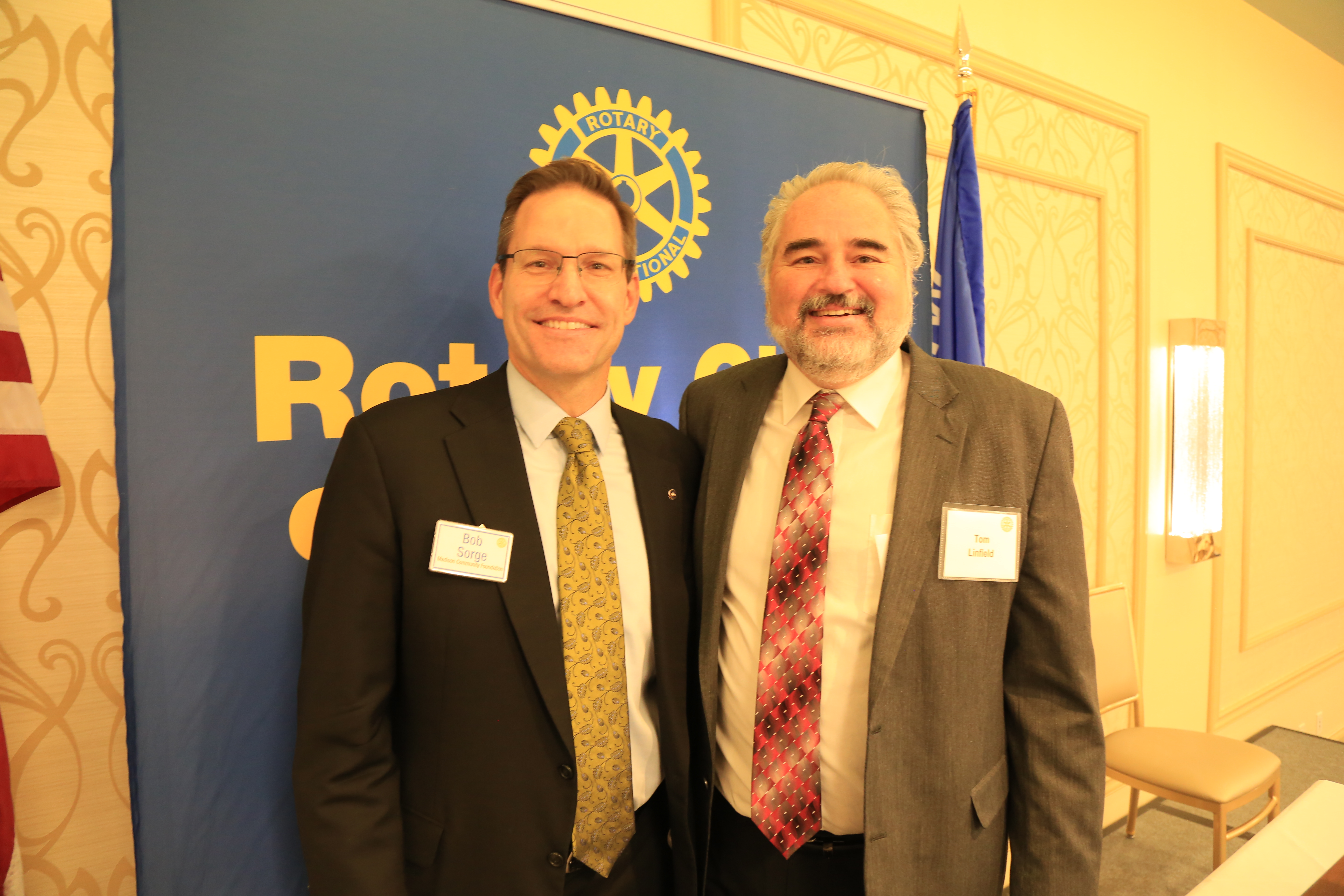
Club Member and Past President Bob Sorge (left) and Tom Linfield (right) of the Madison Community Foundation (MCF) gave an informative, eye opening and thought-provoking presentation on the tangible benefits of non-profit capital projects on the Madison area. 

Bob gave background information on the MCF and the financial resources directed into the community.  MCF distributed about $29M in grants in 2020 that were largely directed by individual fundholders.  The MCF was also able to help other non-profits in the area leverage another $114M in resources from outside agencies for a total impact of $143M.  In addition, to create an authoritative reference for making informed giving decisions, the MCF has spent the recent past developing capabilities for researching and evaluating area non-profits.  The result has been the Greater Madison Nonprofit Directory which can be found on the MCF website.  This is a resource open to all community members. 

Tom covered the impact of capital campaigns on the Madison area by pointing out that buildings quickly become a community asset elevating the area surrounding the structure and becoming a center of development in the neighborhood.  New buildings also transform the non-profit’s capacity for services and development of resources to benefit the community.  Think about the impact that libraries, schools, health centers, community centers and affordable housing (to name a few) has on a given area.  There are about 15 building campaigns a year.  The financial impact is large not just for the physical buildout, but it also creates momentum within the non-profit for increased services, outreach, performance space, work efficiencies, and hosting/meeting space.  Once complete, this allows the non-profit entity to leapfrog to the next level to the community it serves.

If you missed our meeting on December 8, you can watch the video here: https://www.youtube.com/watch?v=QybkuIpEtT4&t=5s.

December 1: Braver Angels: Starting Conversations, Not Fights

–submitted by Kevin Hoffman

Cameron Swallow (left) and Susan Vergeront (right) are the state coordinators for Braver Angels, a national organization that was founded in 2016 to address the growing partisan political divide that is occurring in the United States.  Increasingly, we are defining one another not as multi-faceted human beings but as good or bad people on one side of a Red or Blue divide.  Worse, we have let this polarization become emotional and personal.  Instead of searching for truth and understanding we seek victory.  This win-lose demonization is a threat for our democracy.  Braver Angels’ mission is to bring Americans together to bridge the partisan divide and strengthen our democratic republic.  Using programs with equally balanced representation, they bring people together from opposite sides of the Red/Blue divide to seek understanding when agreement is not possible and to realize that we have more in common than we are different.  This is done through workshops that facilitate and offer strategies for communicating civilly among people who disagree – and with like-minded people who veer into contempt and ridicule.  The goal is not to change views on issues but to change and inform our views of each other.  On the policy level, by speaking to each other in civil discourse, the objective is to find collaborative solutions for the common good.

If you missed our meeting this week, you can watch it here: https://www.youtube.com/watch?v=Cp52UDxKE2E&t=3s

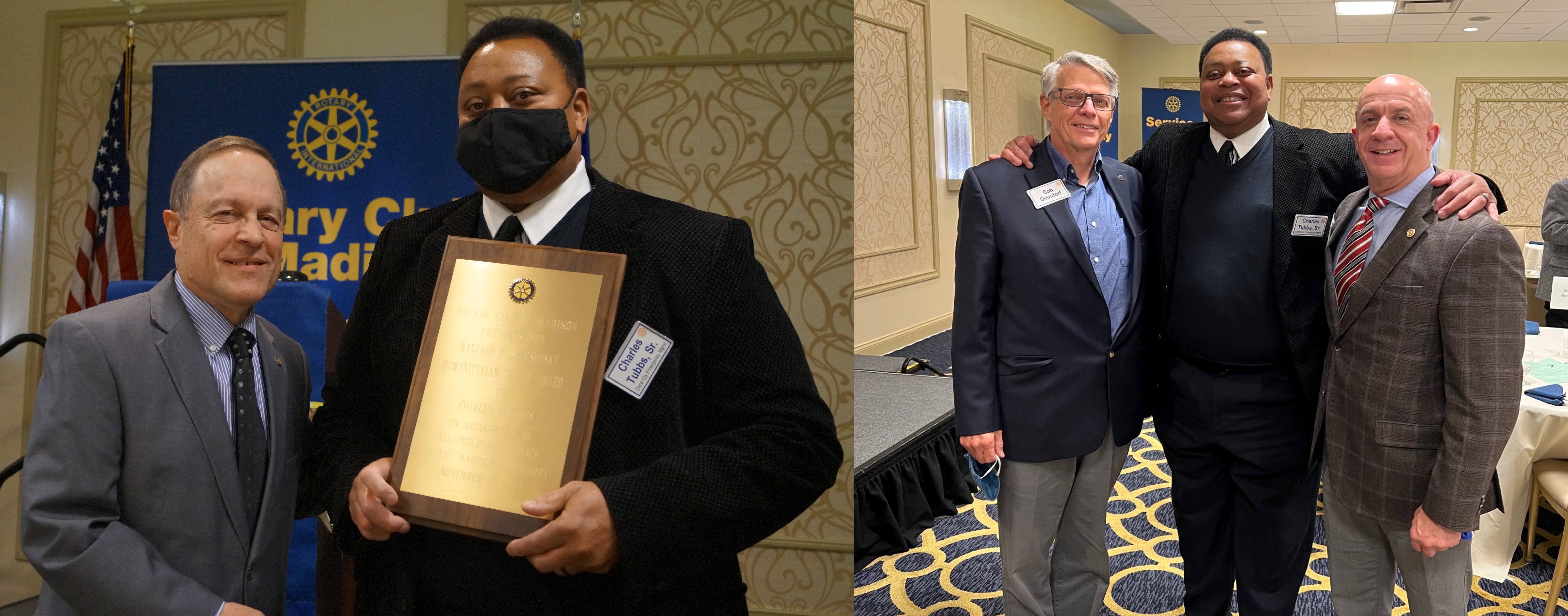
Charles Tubbs Receives 2021 Manfred E. Swarsensky Humanitarian Service Award

Introduced by Steve Goldberg

Top left: Steve Goldberg and Charles Tubbs; Top right: Bob Dinndorf, Charles Tubbs and Charles McLimans

Charles Tubbs is the Director of Dane County Emergency Management, but that’s just part of his story. Charles has been a model of humanitarian service and leadership throughout his entire career, leveraging his skills as a peace-maker, a problem solver, a healer, a mentor, an innovator and a bridge-builder way beyond his profession and across many communities. His lifelong career has been in the field of law enforcement and public safety, and he has approached all of his jobs in this field in much the same way Rabbi Swarsensky would have done.

For example, he has always insisted on treating incarcerated individuals with dignity and respect. That’s what the Rabbi would have done. He places a high priority on protecting the most vulnerable, marginalized citizens in our community and throughout the country. That’s what the Rabbi did. He uses his special talents and insight on mental health and addiction issues to lead local and national initiatives addressing those complex challenges. That’s what the Rabbi would have done.

Ten years ago, Charles placed himself at the center of the prolonged demonstration in and around the State Capitol building to provide a calming influence during a volatile, tense time — much as the Rabbi did during the Vietnam War protests in the sixties. And just like the Rabbi, he places the highest value on each person entrusted to his care. And today this man plays a key role in leading us through the pandemic.

He’s served in leadership roles with local human service organizations, including 100 Black Men of Madison, Journey Mental Health Center, Restoring Roots, Madison’s NAACP Chapter, and many others. 

His nominators wrote: “Charles is engaged in the same fierce pursuit of justice and mercy that made Rabbi Swarsensky such a remarkable gift to our Rotary Club, to the community and to the world. Indeed he lives the very qualities that led our club to establish the Swarsensky Humanitarian Service Award.”

He’s the type of humanitarian Rabbi Swarsensky would have been proud to know; proud to work with; and proud to walk with. So it is in that spirit that the Rotary Club of Madison presents the 40th annual Manfred Swarsensky Humanitarian Service Award to Charles Tubbs.   

Along with this award, a $2,500 grant is presented by the Madison Rotary Foundation to an agency of the recipient’s choice.  Charles Tubbs has chosen Restoring Roots to receive this grant.  

The Manfred E. Swarsensky Humanitarian Service Award was established in 1982 and identifies individuals who have, through their voluntary efforts, made a particularly outstanding contribution to the humanitarian service in the greater Madison community, in the tradition so well exemplified by the life of Rabbi Swarsensky.   The award-winning documentary video, “A Portrait:  Rabbi Manfred Swarsensky,” that was created and produced by Rotarian Dick Goldberg with assistance by Wisconsin Public Television, provides background on Manfred Swarsensky and can be viewed on YouTube, and the Rotary office also has a copy of the video for any member wishing to view it.

The Housing Mixtape: Madison, WI       

November 17, 2021 Rotary Guest Speaker

–submitted by Ellsworth Brown

Justice Castaneda a man on a mission, delivered a distillation of his academic work with the passion and intensity of a community advocate.  He cares deeply about Madison, a city in which he was raised and moved many times before concluding his teenage years.  Castaneda knows intimately the challenges that caused and perpetuate the strictures of redlining, covenants and zoning.  He concluded his presentation with a summary that gives this complex subject a frame:

  • Contemporary housing patterns are limited by historical and contemporary land use policies and practices that contribute significantly to housing volatility, absence of strong community ties, and family cohesiveness.
  • Volatility in housing tenure—sometimes 50% turnover a year—is an undercurrent in pathological associations with concentrated poverty.  For example, affordability of land available for development in Madison is limited to former redline sections that are depressed and underserved, formerly redline sections of the city.  Purchase of this lower-priced land for economic development often removes the availability of affordable housing.
  • Impediments in access to democratic processes and institutions are detrimental to collective efficacy.
  • The structure of local governments, their deliberate pace extending through two or three administrations, limits the use of long-term mitigation strategies.

Castaneda added that the absence in Madison of viable, efficient transportation routes between neighborhoods, services and sources of employment in historically redlined, covenant restricted areas continues to contribute to ongoing volatility of housing.

UW Support of Military Connected Students                                            

–submitted by Bill Haight

Rotary Guest Speakers on November 10, 2021

Joe Rasmussen, Director of University Veteran Services and UW student Brooke Villella addressed the club on the status of veteran students. 

Since the average veteran is 6 years older than the typical student, they are often left  out of the mainstream of campus life. The Veteran Services Office is  moving from a role of being simply a facilitator of benefits, to one of reaching out to make Veterans more inclusive.  Veterans are now a part of the University’s “Identity and Inclusion” initiative, which includes other minority populations. This puts the Veteran Services Office in a more visible position than in recent years. However Veterans have yet to be assigned a dedicated meeting place on campus, a goal the Rotary Veterans Fellowship is helping them attain. 

This link takes you to information about veteran benefits available on campus: www.Veterans.wisc.edu. This link takes you to a research study on veterans in higher education: VETWAYS – The Veteran Education to Workforce Affinity and Success Study (wceruw.org)

If you missed our meeting last week, you can view it here: https://www.youtube.com/watch?v=AT_cxASJ29M&t=1s

Nelson Cummings Receives Joseph G. Werner Meritorious Service Award

Introduced by Renee Moe on October 20, 2021

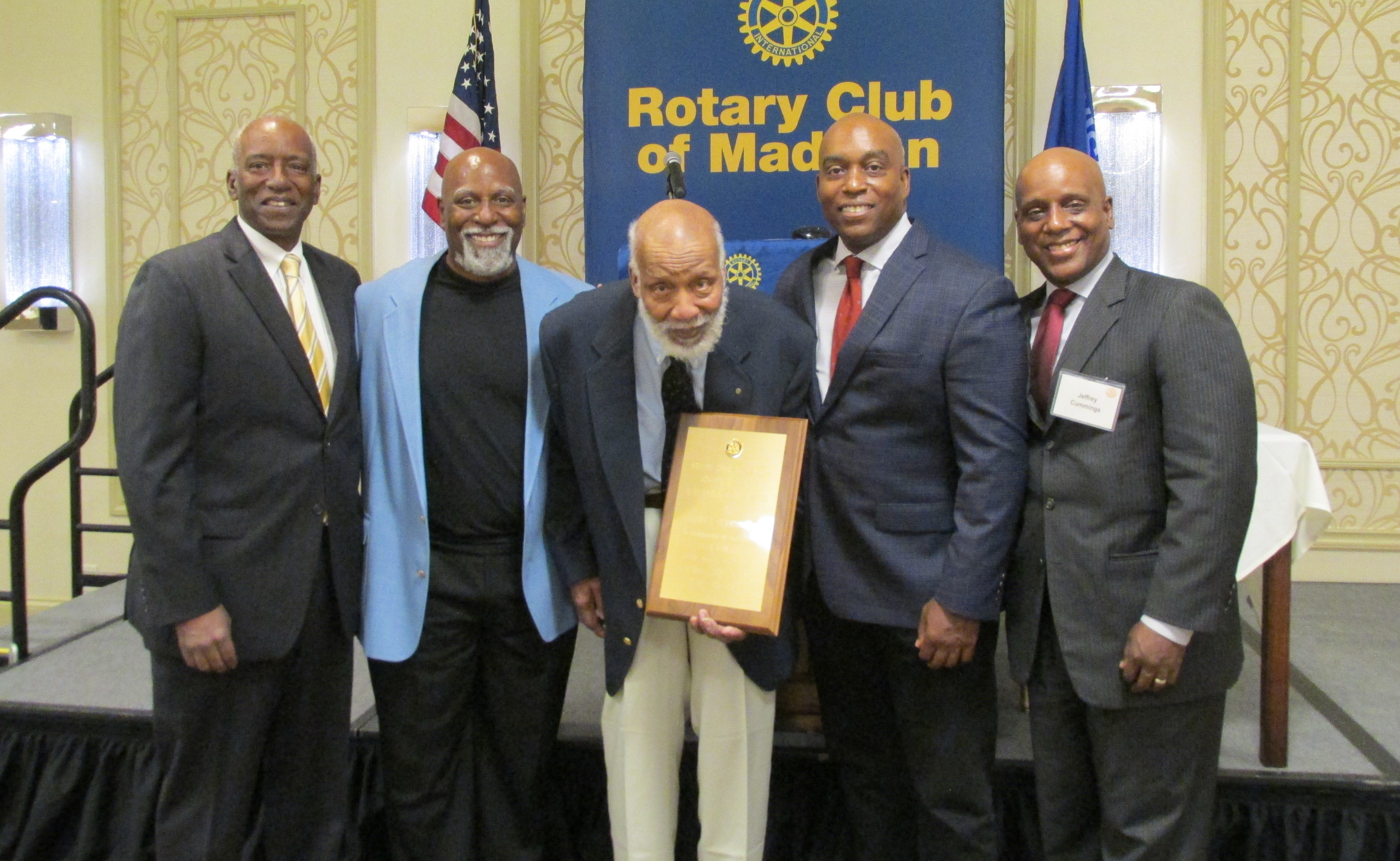
Nelson Cummings pictured here with Renee Moe (left) and Club President Teresa Holmes (right)

Our club’s Joseph G. Werner Meritorious Service Award is granted in recognition of outstanding club service in the Rotary tradition of “Service Above Self.”  Joseph G. Werner was a committed Rotarian.  He chaired many significant committees, both before and after serving as club president in 1953-54.  He served as district governor and became the second member of this club to serve as director of Rotary International.  He later served Rotary International in many other positions.  Following his death, in 1974, the club established the Joseph G. Werner Meritorious Service Award as the club’s highest recognition for club service.  The Werner honor is not an annual event, but is given under special circumstances when warranted.

Today we are going to recognize Nelson Cummings, a valued member that we all adore, with this prestigious award.  We are pleased that his four sons and other family members are in the audience today as we recognize Nelson.

Nelson was born in Springfield, Illinois on August 18, 1934.  He received an A.B. Degree from Texas College and holds a Master’s Degree from St. Francis College. 

He came to Madison in 1968 to become the first Director of the Madison Urban League.  He later became a counselor at Beloit School System and worked for Madison Public Schools and Wisconsin Education Association.

Within the community, Nelson has served on the boards of Catholic Charities, Dane County Mental Health Center, Madison Hospital Foundation and Four Lakes Council of the Boy Scouts.  He also was a member of the Madison Redevelopment Authority for 10 years.

In 1969, Nelson was the first African American to join our Rotary Club.  He maintained 100% attendance starting in 1973 until the pandemic caused us to stop holding in-person meetings last year.  In fact, Nelson holds the third longest record of 100% attendance in our club, and he has enjoyed seeing 52 club presidents up here at our podium.

He was on our club’s bowling team and led the Civic Bowling League for 40 years.  He bowled every year until he retired.  Nelson says that even though it was sometimes lonely because others in the league did not look like him, he was accepted and enjoyed the company of so many Rotarians.  He says “I love Rotary!  You meet so many fine people you would not otherwise meet.  I come to meetings because I enjoy it. It has broadened my opportunities, and it is educational.”  He takes Rotary’s Four-Way Test to heart, and he is especially proud of the scholarship program and the many students we are able to assist each year in obtaining a college education. Nelson says the greatest Rotary event he recalls is when women were allowed to join in 1987.  Nelson has been a long-time volunteer of our annual Rotary Ethics Symposium, and he loves greeting the students and helping them feel welcome at our event.  Nelson has also served on our Club Board of Directors. 

Nelson is a pillar of our Rotary Club.  He is always a friendly face in our audience, and he makes everyone he meets feel welcomed.  We enjoy his company, and the recognition we are providing to him today is so well deserved.

It gives me great pleasure to recognize Nelson Cummings as our 30th recipient of the Rotary Club of Madison Joseph G Werner Meritorious Service Award.   Congratulations, Nelson!

Nelson Cummings pictured here with his four sons.