
 It takes a special kind of person to have the courage to wear this nation’s uniform and stand ready for whenever they are needed. One who raises their right hand and pledges to protect this country at all costs, including giving their lives if necessary to defend our republic. This week, on Veteran’s Day, Brigadier General Joane Mathews provided a look into those service members who make up Wisconsin’s National Guard – 10,000 citizen soldiers and airmen that live in and work in every county. They are your friends, your neighbors, your coworkers, your employees, your children’s soccer coach. Remarkably, they balance their professional careers with their family lives along with their military service. Family, community and employer support is key to ensuring the strength of our Wisconsin National Guard.
Veteran’s Day is a day to honor all of those men and women who have made such a noble commitment to their country and their communities. Brigadier General Mathews eloquently quoted U.S. Army Veteran Charles M. Provence, who wrote that it is the soldier, not the minister, who has given us freedom of religion, the soldier not the poet who has given us freedom of speech, the soldier not the lawyer who has given us the right to a fair trial, the soldier not the politician who has given us the right to vote. On Veteran’s Day we honor those soldiers for securing those rights we all enjoy every day.
Brigadier General Mathews explored the wide breadth of calls that our Wisconsin National Guard members answer. The National Guard’s roots go back to years prior to Wisconsin even becoming a state, when soldiers were called upon to fight in the Civil War. The National Guard sent servicemen to all wars following that and continue to do so into 2020, as members have been deployed to Afghanistan and throughout the Middle East. They provide top levels of support for the citizens of the State of Wisconsin as well, as the Wisconsin National Guard serves at the call of the Governor. In March of 2020, the National Guard mobilized over 1,400 soldiers to help with the COVID-19 response, from staffing testing sites, calling citizens to alert them of test results, to filling in at a senior living facility after an outbreak of COVID-19 caused a staffing shortage within the facility. There is no call that the National Guard cannot or will not answer to assist the citizens of Wisconsin. To date, WI National Guard members have administered more than 800,000 COVID-19 tests statewide.
More than 1,200 National Guard members mobilized to Milwaukee, Madison, Racine, Kenosha and Green Bay in the weeks following the death of George Floyd in Minneapolis to assist with unrest breaking out across those cities and have continued to answer calls to assist with unrest across the State over the subsequent months. Just last week, 400 National Guard members staffed polling places across the state due to a shortage of poll workers arising from the pandemic. It is truly an understatement to say that our Wisconsin National Guard members receive no call they cannot answer to support and protect and serve our nation. On this Veteran’s Day, we honor all of those who have served and sacrificed on our behalf— on each and every one of those calls stateside, nationwide and across international borders – where they were called to duty to secure and provide our country and people with the many gifts that we all enjoy as freedoms in this life.
Our thanks to BG Joane Mathews for her presentation this week and to Jessica Giesen for preparing this review article. If you missed our meeting this week, you can watch it here: https://youtu.be/NcB7XdCg2GY?t=530.
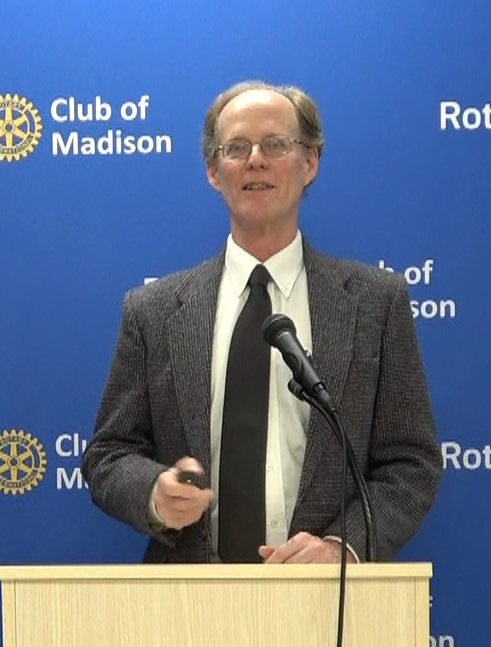 After being glued to our televisions, radios and phones for over twenty-four hours trying to dissect and understand what was happening with the 2020 United States Presidential election, it was a breath of fresh air to welcome Professor David Canon to the Rotary stage to help put things into perspective and answer so many nagging questions that many of us had had on our minds for years – and other questions that had arisen only minutes before the presentation began (Question: Will Wisconsin have a recount? Answer: Perhaps, but an election recount has never shifted a result where the vote margin was over 20,000 votes, which was the case in Wisconsin at the time of the presentation).
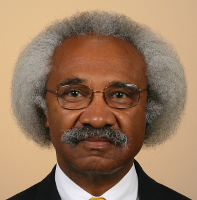 Dr. Floyd Rose was chosen to receive this year’s Manfred E. Swarsensky Humanitarian Service Award for his decades-long contribution to education in Madison. The November 18th Rotary meeting will be allocated to this award, and Floyd Rose will be presenting the Rotary program that day. We look forward to his presentation on November 18.
  It was a mere nine months ago when rumblings of a pandemic were unfolding, and the word ‘zoom’ as a communications tool was all but foreign to many people.
 Eileen Harrington, who spent her career in public service, recently served as Chair of Madison’s Taskforce on Government Structure (“TFOGS”). At the Rotary podium on October 21, she pointed out Madison’s city government needs restructuring. For example, fewer Madison residents are represented by local government compared to cities like Minneapolis and Austin.
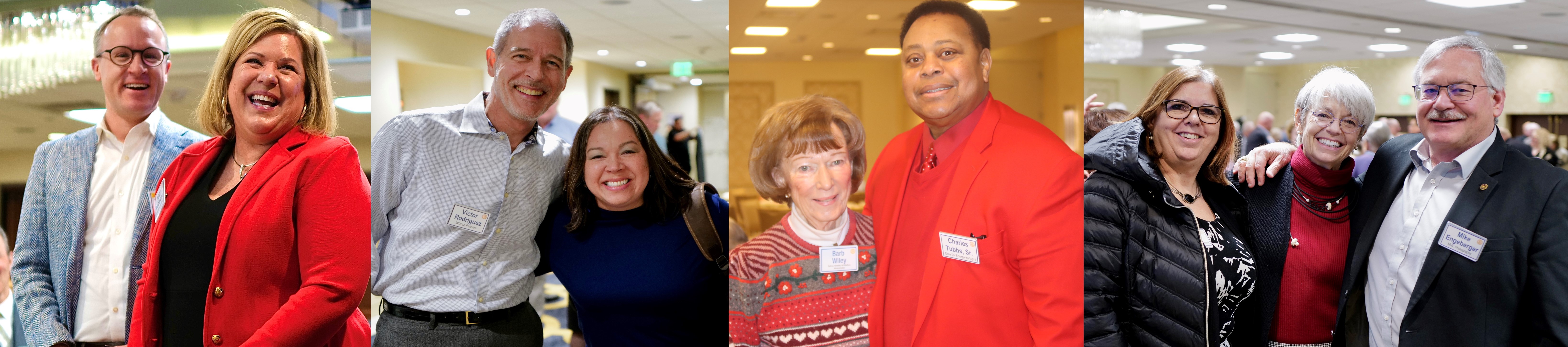
 Rotary Club of Madison, Wisconsin