
submitted by Stan Inhorn; photos by Mike Engelberger

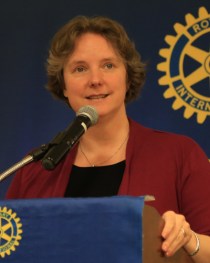
Abigail Becker from The Capital Times moderated the March 13th forum for the two mayoral candidates–incumbent Paul Soglin and Satya Rhodes-Conway. In his opening remarks, Soglin pointed out that when he became mayor in 2011, race and poverty were critical issues in Madison. Madison was not a racist city, but the national legacy of economic disparity, a biased criminal justice system, and lack of leadership have created this problem. Under his leadership in the last eight years, African-American unemployment has been reduced four-fold and household income has increased appreciably. Rhodes-Conway, who served on the City Council for three terms, now chairs the UW-Madison Center on Wisconsin Strategy. As mayor, her goals would include increasing affordable housing for residents at all levels of income. Another objective is to create a system that brings public transportation to more residents, by examining systems that work in other cities.
Regarding climate change, Paul indicated that most of the problem resides at the state and federal levels. Madison is one of many U.S. cities that stays focused on the Paris Accord. He is promoting the use of electric buses and solar power in cooperation with MG&E. Satya would promote the reduction of greenhouse gases by developing a better rapid transit system that would keep more cars off the road and by pushing for buildings that are more energy efficient.
In answer to the question on how to reduce debt service, Satya indicated that there is a need to improve the infrastructure and to distinguish between wants and needs, with the Judge Doyle Square an example of an unnecessary project. Paul suggested that from 2003 to 2011 the City Council failed to provide for infrastructure although the budget skyrocketed.
Satya addressed racial inequality by noting that housing is restricted and middle-class minorities have difficulty moving into white-only neighborhoods. She suggested that police should be held accountable for their actions. Paul believes that minority businesses must be promoted. He believes that the city must work with developers to build apartments that included minority accessibility. Regarding the work of the City Council, Soglin believes that the council is too large for a city of its size. Rhodes-Conway noted that the committee system demands lots of time from its members, often without substantive results.
If you missed our meeting this week, you can watch the video here.
 Madison’s Mayor Paul Soglin, serving his 20th year as mayor, made his 26th appearance at our club. Here to discuss what Madison might be like in 2050, he gave a few facts about Madison in 1950: a population of 96,000; about 95% white; occupied an area of approximately 33 sq. miles. Today we have a substantially more diverse population and occupy about 80 sq. miles. By 2050 Madison will probably be a city occupying about 103 sq. miles. In 1950, the major employer was Oscar Mayer. Today the largest employers are UW Health, Epic, the UW Hospital, and American Family Insurance. Madison is one of 5 U.S. cities considered a bicycling community which is rare among metropolitan areas not in the south, but that is growing. It is also the 3rd coldest — after the Twin Cities and Anchorage, Alaska. Epic has created an atmosphere hospitable to tech companies and entrepreneurial businesses. As household numbers decline, we need more units; 1,000 new units per year barely keeps us even.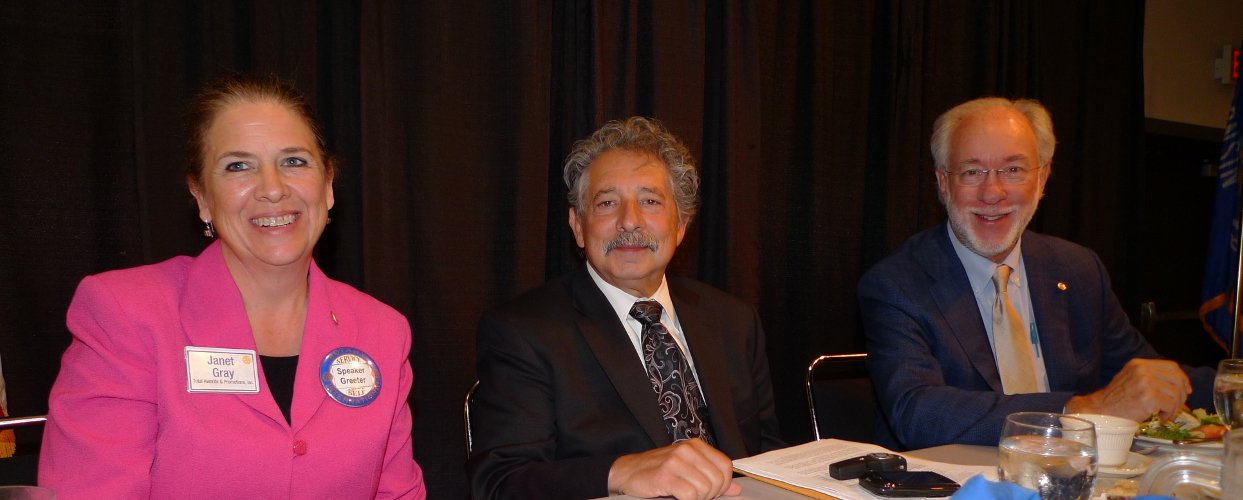
 Rotary Club of Madison, Wisconsin