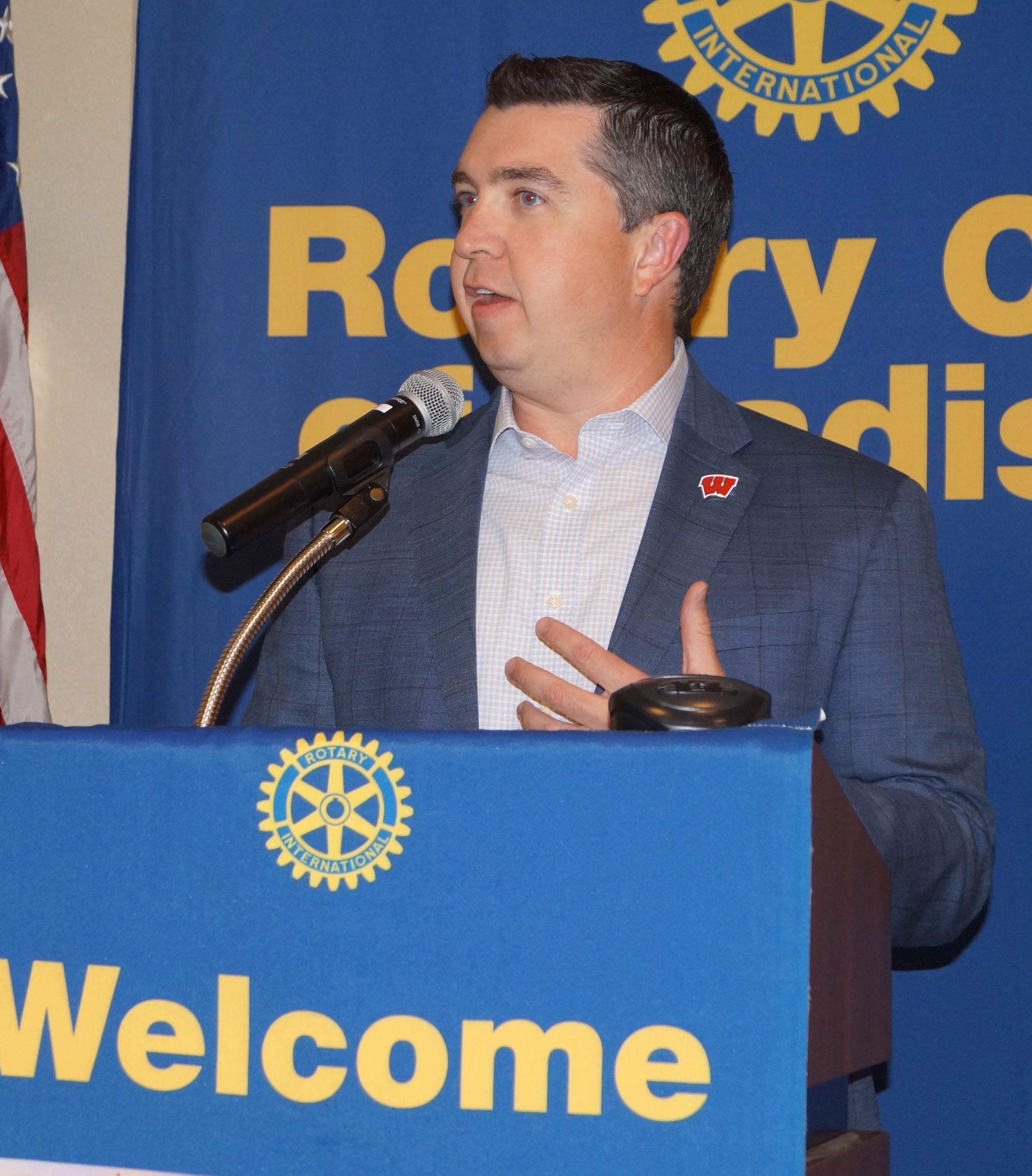
Brian Mason is the Director of Name, Image, Likeness (NIL) Strategy with the UW Athletic Department. Under recent state legislation and Supreme Court decisions the rights of student athletes to control and use their name, image and likeness for monetary gain was established. There is also federal legislation pending with the objective of creating a level playing field for all athletes and programs instead of fifty different sets of laws to follow. He clarified that NIL cannot be used as a recruiting inducement by schools.
The NIL strategy at UW seeks to facilitate the connection between student athletes and businesses. In addition to the traditional pillars of athletic performance, academic achievement, and personal development, the impact of financial advancement is also positively guided and supported. The UW Athletic Department works toward helping the student athlete develop the business and life skills to manage NIL benefits.
UW-Madison psychology professor Markus Brauer punctured some myths and practices in programs designed to bring about change and good behavior; specifically, with application to Diversity, Equity, and Inclusion (DEI) efforts. These efforts include providing information in the hopes people will change; targeted initiatives such as mandatory training; and relying on good people with knowledge, interest and common sense. They are all ineffective and sometimes counterproductive.
Methods that have worked include using a structured, studied approach that targets behaviors, audiences, identifies barriers and benefits, and uses social marketing elements to achieve DEI goals. Importantly, changing people’s perceptions of social norms by creating conditions for social pressure and conformity has great benefit for DEI success for marginalized groups. Additionally, having committed, supportive, and positive leadership and adequate resources devoted to DEI is critical.
Bestselling author, journalist, and former Madisonian David Maraniss spoke about the subject of his latest book, Path Lit by Lightning: The Life of Jim Thorpe. Thorpe was a gifted Native American athlete who excelled in all sports but was best known for professional football, baseball, basketball, and winning Olympic gold medals in 1912 in the decathlon and pentathlon. Despite personally enduring racism and prejudice and broader efforts by the US government to “erase” Indigenous culture and language, Maraniss felt that Thorpe transcended sports fame. He overcame many tragedies and challenges in his life to be a lesson in perseverance for him and his people.
Many of you may have seen the powerful essay that appeared in the New York Times this past April 30th by Dr. Vivek Murthy, the US Surgeon General entitled, “We have become a lonely nation, it’s time to fix that.” In this essay he writes,
“Loneliness and isolation hurt whole communities. Social disconnection is associated with reduced productivity in the workplace, worse performance in school, and diminished civic engagement. When we are less invested in one another, we are more susceptible to polarization and less able to pull together to face the challenges that we cannot solve alone — from climate change and gun violence to economic inequality and future pandemics.”
In the essay Dr. Murthy describes his own struggle with loneliness and depression and uses the essay to introduce a national platform to address “Our Epidemic of Loneliness and Isolation 2023, the US Surgeon General’s Advisory on the Healing Effects of Social Connection and Community.” The advisory lays out the problem and then goes on to recommend 6 pillars to advance social connection that we as a nation can implement:
1: Strengthen Social Infrastructure in Local Communities
2: Enact Pro-Connection Public Policies
3: Mobilize the Health Sector
4: Reform Digital Environments
5: Deepen our knowledge
6: Cultivate a Culture of Connection
For example, under pillar 6, cultivate a Culture of Connection, the recommendations are to:
• Cultivate values of kindness, respect, service, and commitment to one another
• Model connection values in positions of leadership and influence
• Expand conversations on social connection in schools, workplaces, and communities
So, are any of you aware of an organization that cultivates a Culture of Connection through kindness, respect, service, and commitment to one another and to our community?!
BINGO! Rotary shares and promotes these values and is a part of the solution to the epidemic of loneliness, separateness, isolation, and hopelessness. Our Rotary Club of Madison brochure states:
The Rotary Club of Madison empowers you to Connect, Grow and Serve. We exist to help our members form new, positive, and diverse relationships, grow personally and professionally while working to make our community and world better places to live for all.
I believe Dr. Murthy would wholeheartedly agree that Rotary is an antidote not only to the epidemic of social isolation but to a plethora of other social issues that plague our society.
Thus, it is very fitting that our Rotary International President for 2023-24, Gordon McInally, has chosen for our annual theme, “Create Hope in the World.” I had the opportunity to meet President Gordon this past spring at the President Elects Training Symposium, and he shared his vision for the year ahead, on how Rotarians create hope in the world. He has also asked clubs worldwide to focus on mental health challenges in our community and shared his personal story of losing his younger brother to suicide. He has dedicated his life and this Rotary year to creating hope in the world for others. I think it’s a wonderful theme for our club to embrace as well.
When you think about the many ways that our club and individuals in our club create hope in the world, who and what comes to mind? Look at your neighbor, how do they create hope? How do YOU create hope for others?
If you look around this room, you see the community leaders in business, nonprofit, education, public service, etc. who make Madison the outstanding community that it is. We do that, Rotarians! Each one of you individually and through your organizations help to create hope in the world.
Collectively, we as a club create hope in the world through providing nearly $1 million dollars per year in student scholarships, community grants, our ethics symposium, and dedicated scholar mentors. Through our philanthropy, and through our community service, club service, vocational service, youth service, and international service we provide HOPE in the world and in our community. And we’ve been doing so for over 110 years!
As your club President for 2023-24, my major focus areas and goals for us as a club are:
That we will continue to create hope in our community and in our world through our philanthropy and service. As you may be aware, we spent the past two years studying and revising our community grants process and this Fall will introduce new funding and service opportunities to expand 1. Excellence in Education for all students, 2. An expanded Ethics Symposium to introduce more students to the Rotary Four Way Test Framework for ethical decision making, and 3. Grants to fund innovation in our community.
My second challenge to us as a club is that we will continue to share the joy of Rotary, to connect, grow and serve with more members of our community, by inviting them to be a part of an organization that creates hope in the world. Rotary International has just come out with some new graphics for members to share on social media platforms that you can see on the slide.
I invite you to share your story as a Rotarian with others, why you’re proud to be a Rotarian and what Rotary means to you. Share your WHY as a Rotarian, then invite someone who shares our values for connection, kindness, and service to join us for lunch. That’s the Power of One, that each one of us as members can help to ensure our club’s continued growth and success by inviting just one person to join us.
We will also be focusing on Gratitude throughout the year and hearing stories from individual Rotarians about Why they are grateful to be a Rotarian. Gratitude creates hope in the world too.
And so, my fellow Rotarians, let’s continue to go out into the world to create hope! I think if we were to invite Dr. Murthy to come here to experience the Rotary Club of Madison, he would wholeheartedly endorse our efforts to advance a healthy, connected community. Perhaps Janet Piraino and the program team could get him here to join us?
You will find on your tables the 2023-24 Rotary theme pin, “Create Hope in the World,” please take one and wear it proudly throughout the year. The pins are courtesy of our District Governor and fellow club member, Michelle McGrath. Thank you, Michelle! And thank you for listening to me and for your commitment to Rotary.
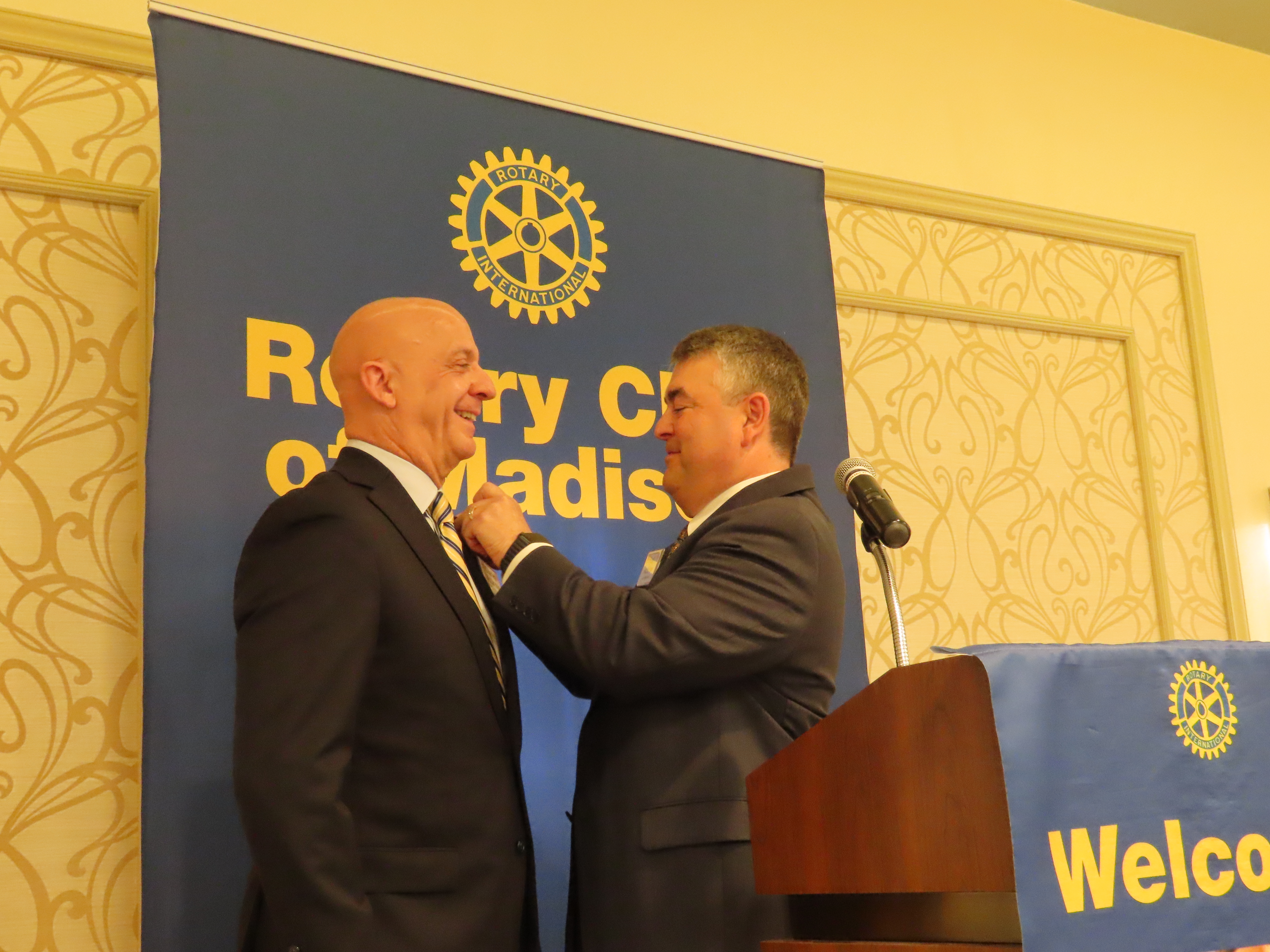
Outgoing Rotary President Paul Hoffmann Transferred the Gavel to the Club’s 2023-24 President Charles McLimans
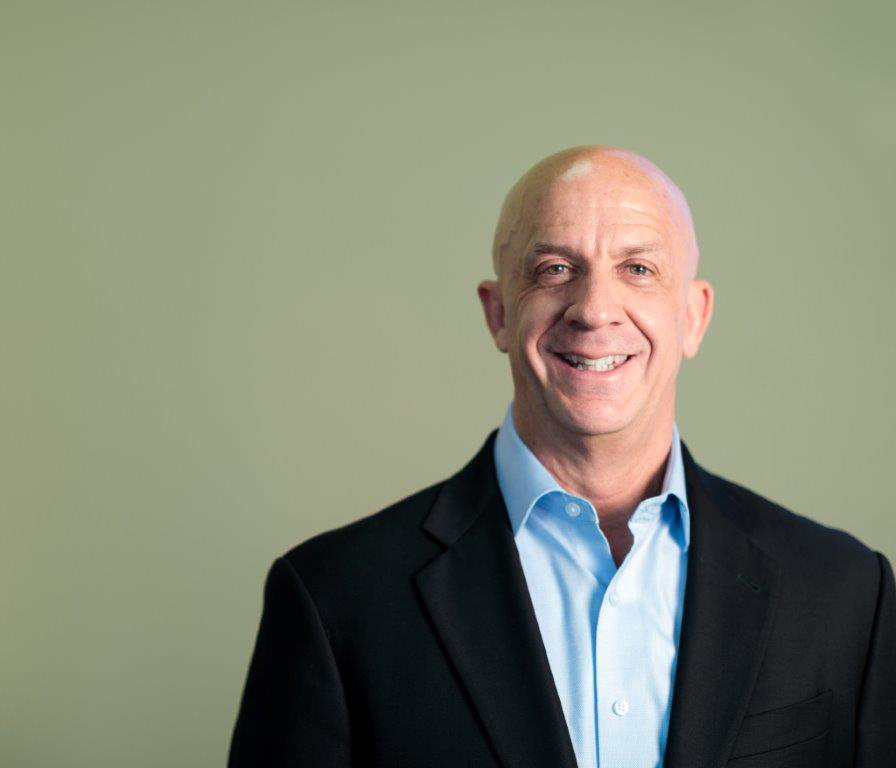
On June 28, Paul Hoffmann was given a resounding send-off during the Changing of the Guard Rotary Program. He told Rotarians and the 40 guests present that he was proud to have been the club’s 110th president. “Wow, that went fast?” (referring to the past year) I know Charles McLimans is going to be a fantastic president.”
Paul pointed out many ways Rotary continues to give back to the community. He noted, “When I asked someone to do something, I almost always received a yes.” From reaching and exceeding goals when asked to contribute to community grants programs, to heading programs and fellowship groups, he paid tribute to club members for making contributions on all levels of involvement.
“I appreciate that Rotarians stand up in their resolve to make the world a better, different place,” he said.
A brief video roasted the outgoing president by focusing on his attention to numbers, since, after all, he is a banker.
One number of the screen was the #1 –indicating the number of Rotary meetings Paul missed during his tenure as president.
Another was the #42—indicating the number of times he “appreciated” the program presenters over the last year.
Many Rotarians would probably say, we appreciate you, too, Paul!
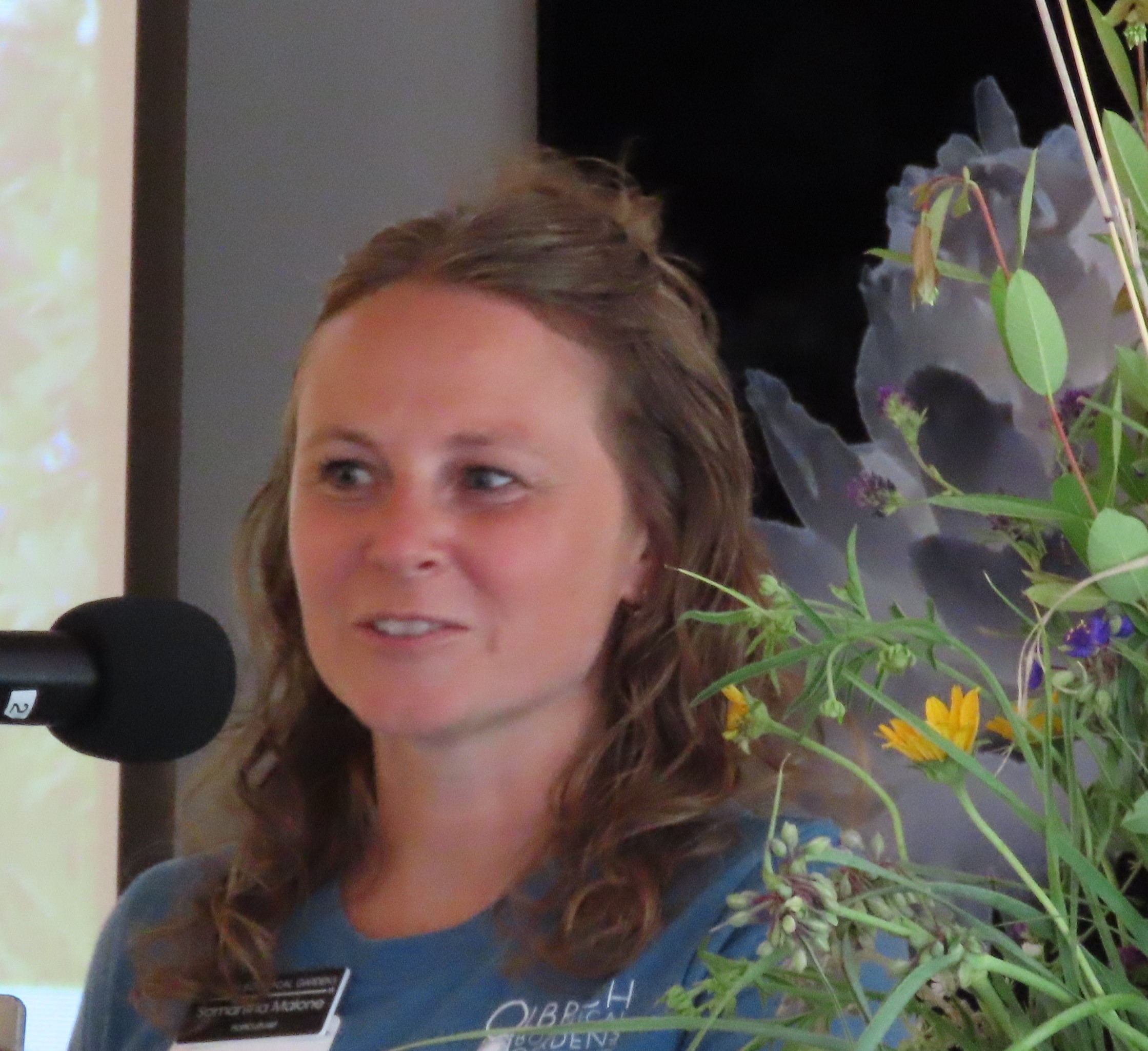
This week’s meeting was held at Olbrich Botanical Gardens, featuring horticulturist Samantha Malone. Sam spoke on the important role inspects play in our gardens, as well as the mutualistic relationship many plants and insects have with each other. Sam also presented on the resilient nature of insects due to their size (they don’t need much food to survive), their strength (many have a strong exoskeleton) and their reproductive systems that allow for millions of eggs. Sam’s calls to action for the group were to keep your fall clippings onsite over the winter and to focus on growing native plants.



 Rotary Club of Madison, Wisconsin