Tag Archives: Rotary Club of Madison

Nelson Cummings Receives Joseph G. Werner Meritorious Service Award

Introduced by Renee Moe on October 20, 2021

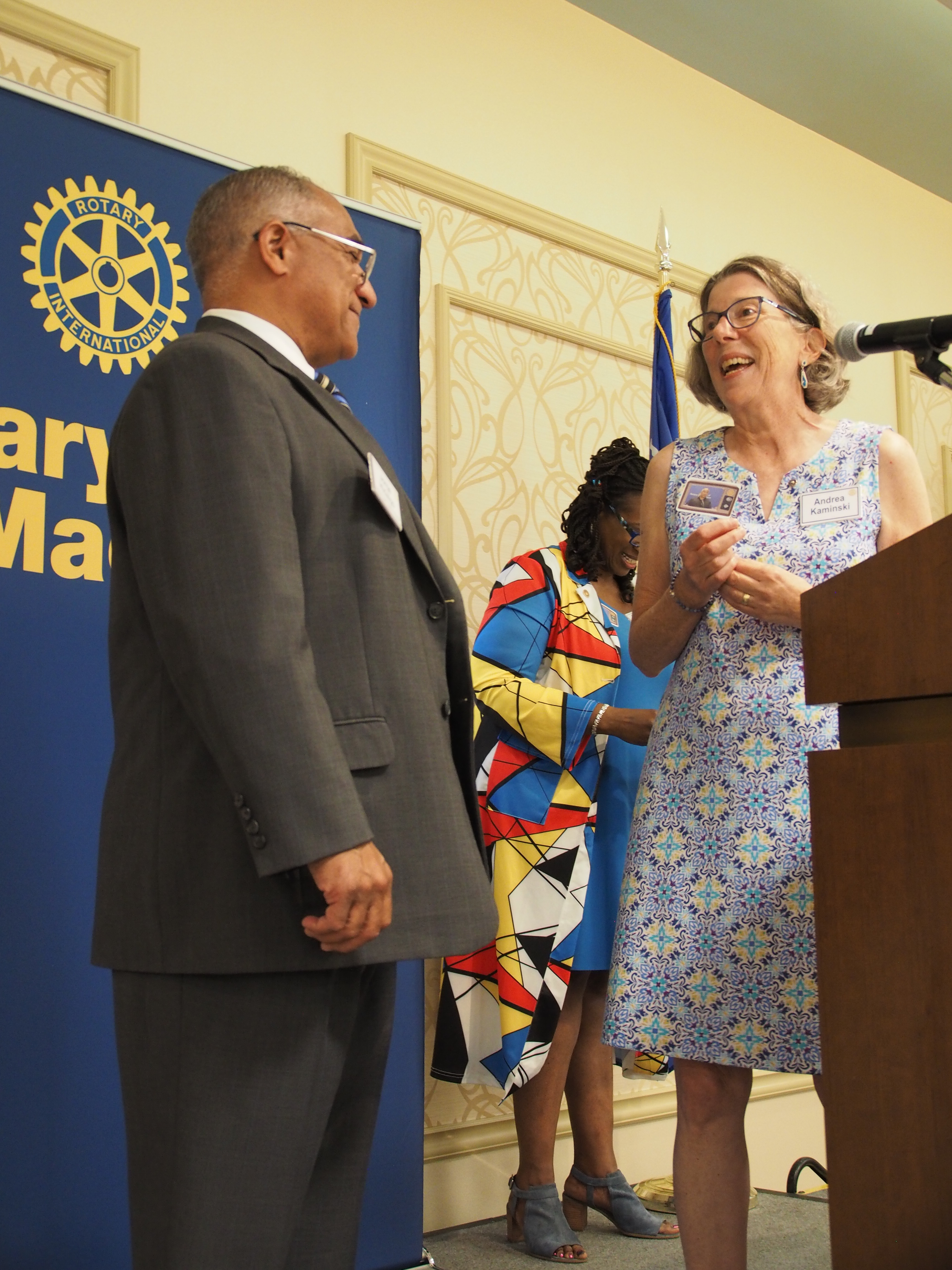
Nelson Cummings pictured here with Renee Moe (left) and Club President Teresa Holmes (right)

Our club’s Joseph G. Werner Meritorious Service Award is granted in recognition of outstanding club service in the Rotary tradition of “Service Above Self.”  Joseph G. Werner was a committed Rotarian.  He chaired many significant committees, both before and after serving as club president in 1953-54.  He served as district governor and became the second member of this club to serve as director of Rotary International.  He later served Rotary International in many other positions.  Following his death, in 1974, the club established the Joseph G. Werner Meritorious Service Award as the club’s highest recognition for club service.  The Werner honor is not an annual event, but is given under special circumstances when warranted.

Today we are going to recognize Nelson Cummings, a valued member that we all adore, with this prestigious award.  We are pleased that his four sons and other family members are in the audience today as we recognize Nelson.

Nelson was born in Springfield, Illinois on August 18, 1934.  He received an A.B. Degree from Texas College and holds a Master’s Degree from St. Francis College. 

He came to Madison in 1968 to become the first Director of the Madison Urban League.  He later became a counselor at Beloit School System and worked for Madison Public Schools and Wisconsin Education Association.

Within the community, Nelson has served on the boards of Catholic Charities, Dane County Mental Health Center, Madison Hospital Foundation and Four Lakes Council of the Boy Scouts.  He also was a member of the Madison Redevelopment Authority for 10 years.

In 1969, Nelson was the first African American to join our Rotary Club.  He maintained 100% attendance starting in 1973 until the pandemic caused us to stop holding in-person meetings last year.  In fact, Nelson holds the third longest record of 100% attendance in our club, and he has enjoyed seeing 52 club presidents up here at our podium.

He was on our club’s bowling team and led the Civic Bowling League for 40 years.  He bowled every year until he retired.  Nelson says that even though it was sometimes lonely because others in the league did not look like him, he was accepted and enjoyed the company of so many Rotarians.  He says “I love Rotary!  You meet so many fine people you would not otherwise meet.  I come to meetings because I enjoy it. It has broadened my opportunities, and it is educational.”  He takes Rotary’s Four-Way Test to heart, and he is especially proud of the scholarship program and the many students we are able to assist each year in obtaining a college education. Nelson says the greatest Rotary event he recalls is when women were allowed to join in 1987.  Nelson has been a long-time volunteer of our annual Rotary Ethics Symposium, and he loves greeting the students and helping them feel welcome at our event.  Nelson has also served on our Club Board of Directors. 

Nelson is a pillar of our Rotary Club.  He is always a friendly face in our audience, and he makes everyone he meets feel welcomed.  We enjoy his company, and the recognition we are providing to him today is so well deserved.

It gives me great pleasure to recognize Nelson Cummings as our 30th recipient of the Rotary Club of Madison Joseph G Werner Meritorious Service Award.   Congratulations, Nelson!
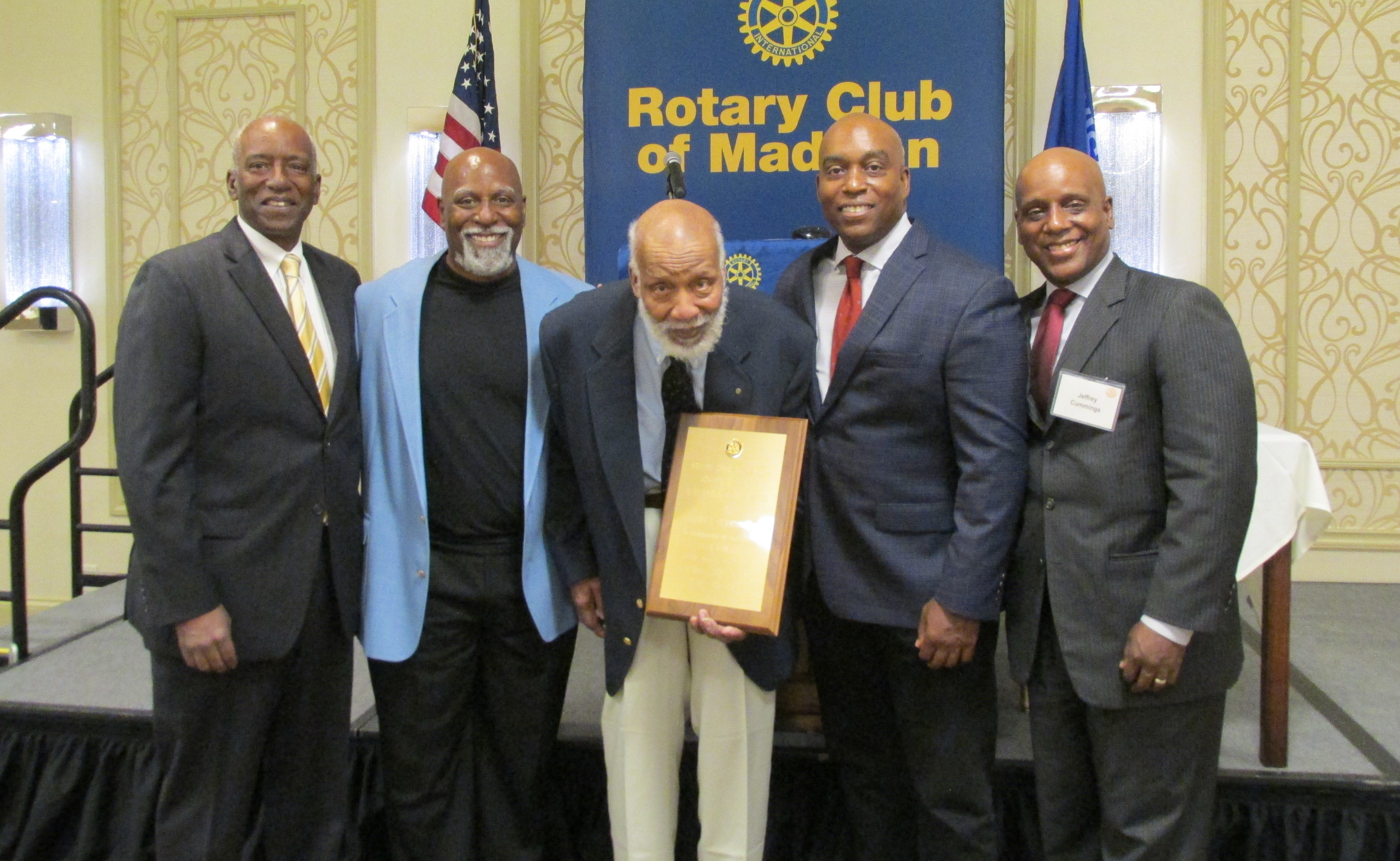
Nelson Cummings pictured here with his four sons.

Club President Teresa Holmes: In Her Own Words

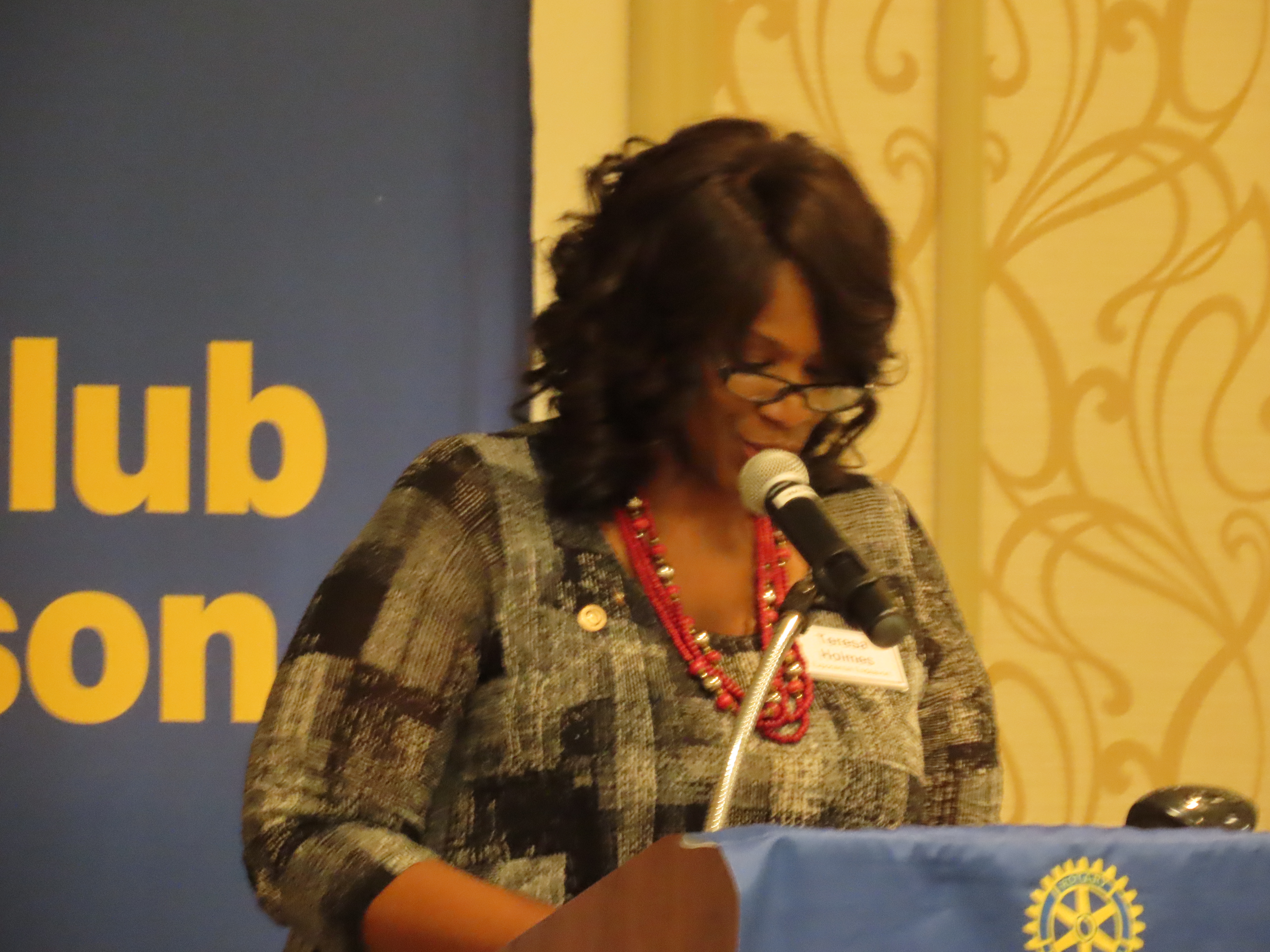
Today is our official kickoff to the Rotary year so I wanted to share a bit on my personal background, Rotary journey, and what you can expect from me during the evolving aspects of our year together. 

I am the oldest of three children born to a mother who worked in various areas of law enforcement and a father who served in the Navy.  Over the years, I’ve tried to make it a habit of asking for what I need so if I sounds like I’m telling you instead, please don’t take it personally; giving others instructions is a part of my history.  I’m a native of Milwaukee and for years lived one block away from the core of the original site where Juneteenth Day is celebrated. Most of my family members still live in Milwaukee so my other home is not far away.

I often refer to myself as a twice transplant to Madison, as I initially moved here in 1989 to work for what was is now Alliant Energy but moved back to Milwaukee after only 5 years. At that time, I would’ve been known as a Gen Z, and my mom, who by then had transitioned into the Human Services field, encouraged me to follow my heart knowing that I had aspirations for changing the dynamics of how users experienced working with computing professionals.  By the time I was 23, I had several experiences with initiating change within teams, systems and corporations in the US and in other countries through the use of my natural gift to simplify tedious processes whether manual or technological.  I had no idea that I’d return to Madison 20 years later after creating my own firm, now Exponential Endeavors. I lead a team of Solution Architects, who have backgrounds in either engineering, technology or creative arts and are identifying efficient and innovative ways to transform manual processes thru technology or reduce the time it takes to implement technology engagements.  I can speak tech English, folks! Right before the pandemic, I was asked to utilize my business model to assist a company in Madison with rapid redesign of its entire technology infrastructure and because of the need to pivot quickly when the stay-at-home order began in March of last year, my team and I were able to do the same for companies locally and throughout the Midwest while leading them into resiliency during the COVID year.  So, change and doing things sooner than initially planned is ‘in my lane’.  Did you know that I was supposed to be your president – next year?  

My Rotary journey began only 5 years ago in May of 2016 after being invited to attend the Scholarship luncheon by then Rotarian Derrick Van Mell.  I had been asked to join the organization before but declined because of what I believed was not present in the room.  Attending one luncheon can make all the difference and after seeing the scholarships awarded to 25 local students – I said Yes without hesitancy.  Service is a part of my DNA as I come from a long line of WI and Texan public servants and prior to that experience lacked the awareness I now have of the Rotary Club of Madison.  

My first year of my Rotary service, I attended the international convention held in Atlanta, Georgia, and couldn’t believe what Rotarians were doing locally and internationally and have dug in my heels since then to Connect, Grow and Serve where led and often asked to do so. I’m a person with a deep sense of Faith and belief in the ability to dream and live well throughout the process of evolving circumstances.  A few of you have cautioned me not to use the podium as my ‘pulpit’, fret not. I don’t need a pulpit when an expansive mission field is right before me.

The accelerated transition to VP caused me to get to know many of you in ways that I’ve enjoyed while also growing in the understanding of the traditions this club and Rotary International hold near and dear. I’m looking forward to spending time with many of you, while walking, dining, at local activities that combine those two or a fellowship or community event.

As we serve, the evolving aspect of changes we’ll all be affected by and journey through are not intended to harm or hinder our organization from continued success and service – rather meant to create more continuity within the organization while better positioning our service teams – our committees to execute their creative ideas throughout our community.  The ideas presented and approved by leaders w/in this club are meant to be seen and experienced far beyond a single term of the presidency so our club’s VP-Paul Hoffman and others who follow him will carry the torch of ideas forward and brightly! Throughout the year, I’ll lead the way in communicating and navigating the various aspects of how we’ll enhance what we’re doing.

Being President of our club wasn’t what I thought I’d be doing at the end of my board term.  As I reflect while dreaming, I realize it has become an extended part of my journey of Service above Self!  I’m honored and humbled to serve as our club president. Thank you for such an opportunity!

Highlights: Year End Rotary Meeting June 30, 2021


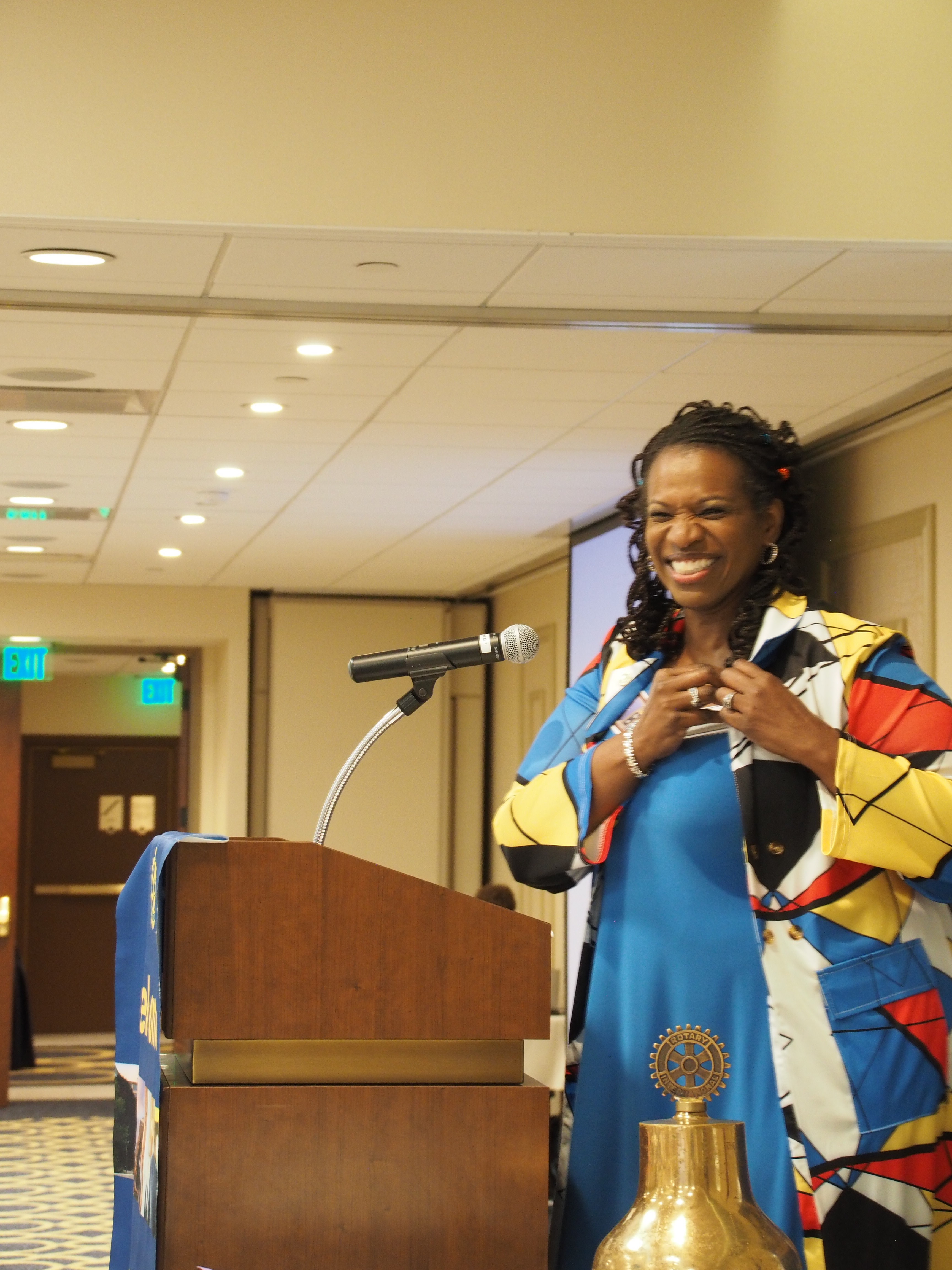
   The Changing of the Guard, (or as Andrea Kaminski put it, Jorge’s transition to the “famed Past President’s Club and to oblivion, disrespect, benign neglect, etc.”) had elements of commendation, praise, pins, and a plaque . . . Past President’s pin and plaque presented by Jason Beren, Paul Harris Fellow pin AND a heavy gift bag that Past President presenter Donna Moreland hoped was as good as the one she received, the new President’s pin presented by Jorge Hidalgo to Teresa Holmes (comes with a gavel and a big bell), and the Vice President’s pin that Teresa presented to Paul Hoffmann.

   President Jorge held the stage as long as he could, although for the better, sharing the podium with others.  Dawn Crim, Madison Rotary Foundation Vice President, summarize the past year’s work of the Foundation, which provided $749,000 in community support. $45,000 was also raised from our members for the Rotary International Foundation annual campaign.

   Jorge introduced Jenni Jeffress, chair of our Community Projects Committee, who provided highlights of six volunteer opportunities by 51 members, many for more than one project.

   Jorge pointed out that Jenni is among 40 members of the club who served as chairs of committees in the past year and that the majority of the club members made good use of technology to continue participation, as did over half of the 29 fellowship groups that met online.

   Best of all, both Jorge and Teresa shared a few thoughts.  Teresa’s were prospective, promising fun, change, and even better food—and more information will be shared in her inaugural speech on July 14th

   Jorge’s view was retrospective:  full of thanks for committee chairs and many hands of help and especially for Jason Beren and Brian Basken for their heroic video work for every virtual meeting.  (Jorge failed to thank them for their thoughtful documentation of Jorge Bloopers we were shown). 

   In his “swan song” (thankfully he didn’t actually sing), Jorge attempted to salvage his reputation, citing a few reasons why he should be remembered and proclaiming himself to be our Club’s “best . . . “ (wait for it) . . .”virtual president”.  He closed with his plans for the future, including making cold calling to sell Medicare supplemental insurance and reverse mortgages for retirees. 

   Thank you, Past President Jorge, for a challenging job well done.  And congratulations, President Teresa, on the promise of your vision and your willingness to serve.

   Our thanks to Ellsworth Brown for serving as photographer and summary article writer. Visit our club’s blog and facebook page for more photos.

New Police Chief Brings His Goals for a Better Community to Madison


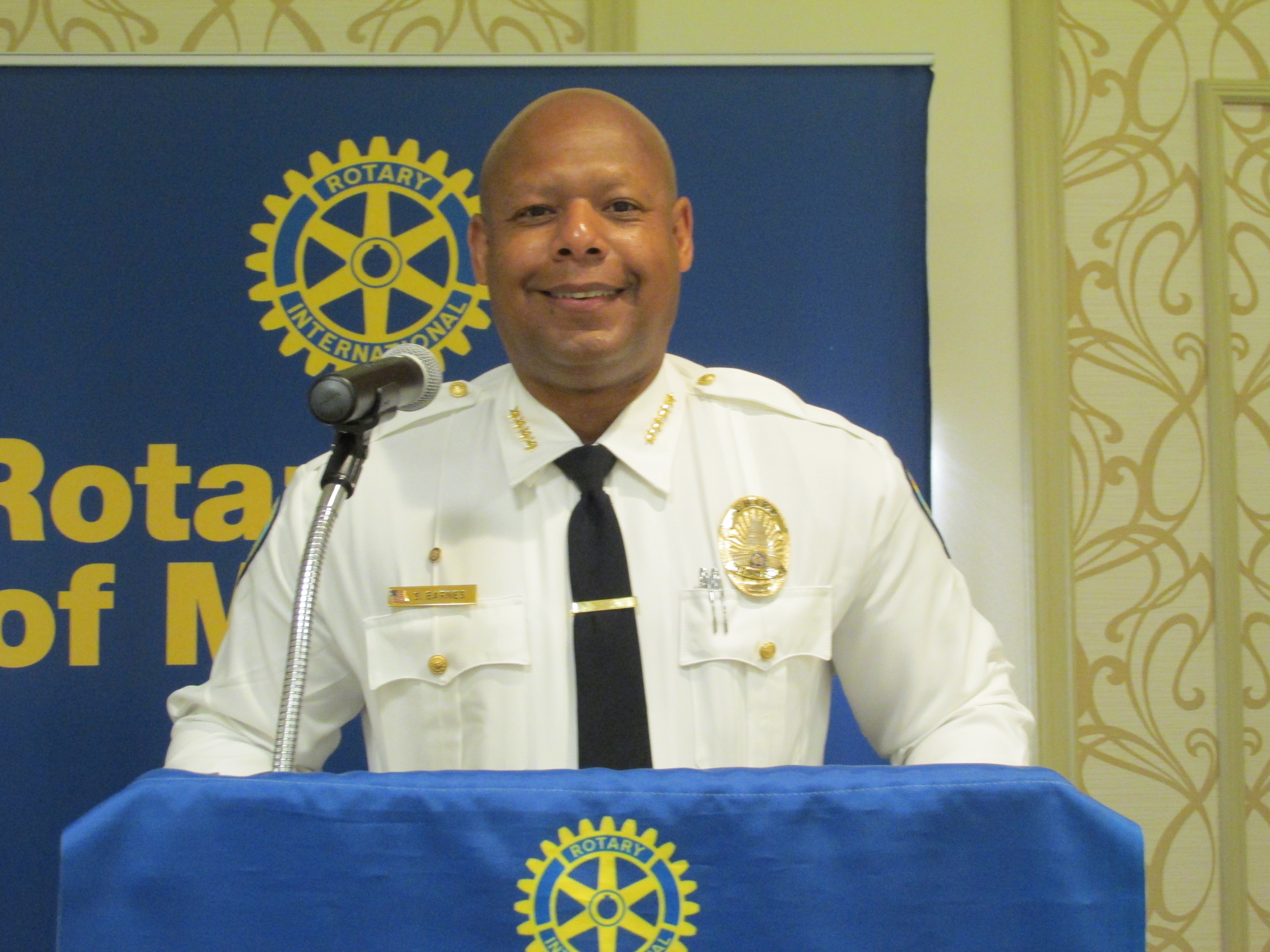
Why would Madison’s new Chief of Police of four months, Shon Barnes, spend most of his allotted speaking time presenting his journey from child to Chief?

   By doing so, Barnes not only shared his vision for our Madison force, but also how this vision became to be.

   Barnes wanted to serve in order to help others.  This he learned from his father, an automobile mechanic who developed a successful small business without advertising but on trust:  repair costs without overpricing, transparency of diagnosis, dependable delivery, and word of mouth.

   His college history major and four years teaching it gave him a long-view perspective, backward and forward.  He’s still learning about the legacy and power of history.  In fact . . .

   One of his most significant life events was a personal journey to Selma, Alabama with two officer friends.  They came to Selma, read archival materials, crossed the infamous Edmund Pettus Bridge of Bloody Sunday of March 7, 1965 history, and then walked 54 miles to Montgomery.

   During his walk, he learned that people want to be seen and to participate; they want to be heard; they were accountable for the welfare of the three walkers; and the world is not as divided as it is often portrayed to be.

   Barnes translated his life’s experiences into practice:  trust, active listening, transparency, accountability, the use of technology to increase efficiency, avoidance of over-policing, and—as he learned as a Rotarian— “being nice for no reason”.

   Barnes’ goal?  Madison’s police force will be the national model for exceptional policing.  

Our thanks to Police Chief Barnes for his presentation this week and to Ellsworth Brown for preparing this review article.  If you missed our meeting this week, you can watch the video here: https://youtu.be/9FrhUD8GDOo.

Rural Broadband: The Economics and Relationships Needed for “The Fix”


Brittany Beyer, Chair of the Governor’s Task Force on Broad Band, presented The Economics and Relationships Needed for “The Fix”.

Today’s mashup of acronyms, mastered by Beyer to her credit, demonstrates widespread and as-yet relatively uncoordinated efforts to advance universal broad band access, but a growing awareness of their importance.

Embedded are fundamental elements of equity, diversity and inclusion, the divide between sparsely settled rural and densely settled urban environments, outdated mapping of coverage and profit disparities attendant to the commerce of coverage, and the profound need for universal collaboration and coordination.

Beyer framed the fundamentals as access, affordability, and adoption.

Access is best and almost universal in urban areas, but the rules of measurement—mapping population together with broad band coverage—tilts systemic access heavily to cost-efficient urban areas while omitting high-cost, less efficient access to rural areas.

The resulting dilemma is captured in the subject of affordability, which requires a collaborative and systemic mix of commercial, government, philanthropic, and personal funding that is moving slowly toward the need to address the growing acknowledgment that, like electricity and rural mail delivery, broad band access has become a universal necessity and equalizer.

Adoption, the third leg of the stool, highlights the need to educate and aid those yet unfamiliar with the technology and capability that can be available to them.

There are test models and examples of successful local or at best regional well-led initiatives that work—in Reedsburg, WI and surrounding towns, for example; in Iowa County, a leader in a systemic mapping of service needs and population density; and in Brown County, where a model expansion is underway.

Today’s program was but a piece of the story.  Two complementary Rotary programs will present other facets of the quest for a systemic approach to universal high speed broad band service, one in July and one in August.    

   Our thanks to Brittany Beyer for her presentation this week and to Ellsworth Brown for preparing this review article.  If you missed our meeting this week, you can watch it here:  https://youtu.be/HiLfVKXGTLA.

TREK Thrives Even Under Adverse Conditions

Steve Malchow, Trek Bicycle’s Vice President of Operations, Engineering and Sourcing, had to move fast in the last three years to avoid hitting—or being hit—by three “black swans”:  Tariffs on Trek’s principal supplier of bicycles, from China; the pandemic, which shut down production facilities; and the combination of these two factors to create a third swan, the exploding demand for bicycles.

Trek is a billion dollar a year company with 4,000 employees, business in over 100 countries; race teams; comprehensive analysis of market share; and nimble, aggressive adjustment to the retail side of the business. 

Trek is also an enlightened company headquartered in Waterloo, Wisconsin, that is committed to healthy lifestyles for customers and employees.  Facing rising health insurance costs, it built its own clinic in 2014 and has not raised insurance costs since and serving 4,000 visits last year.  Trek’s chef serves its Waterloo employees healthy three meals a day.

600,000 bikes per year manufactured in China had to be relocated to non-tariff sources, including parts (about 300 in each bike), manufacturing supply chains, and delivery.  Trek used to back order 73,000 bikes, now 3.9 million as new orders jumped from 1.5 million to 3.8 million per year.  Even the ship that blocked the Suez Canal still contains a large order of undelivered bicycles.

And yet Trek thrives, aggressive on the elements of manufacturing and delivery, moving plants out of China to a total of 7 different countries world-wide including Taiwan and Cambodia, and expanding their BCycle city program to dozens of American cities.

Trek is also a leader in its largest market, E-bikes, a fleet of which are being tested in Madison now, even as the universal shortage of digital chips presents the latest delay.

Steve considers Trek successful and lucky under the circumstances.  Most of us would say “not lucky, just really good”.

Our thanks to Steve Malchow for his presentation this week and to Ellsworth Brown for preparing this review article.  If you missed our meeting this week, you can watch it here:  https://youtu.be/PNS0-1ZSRjM.