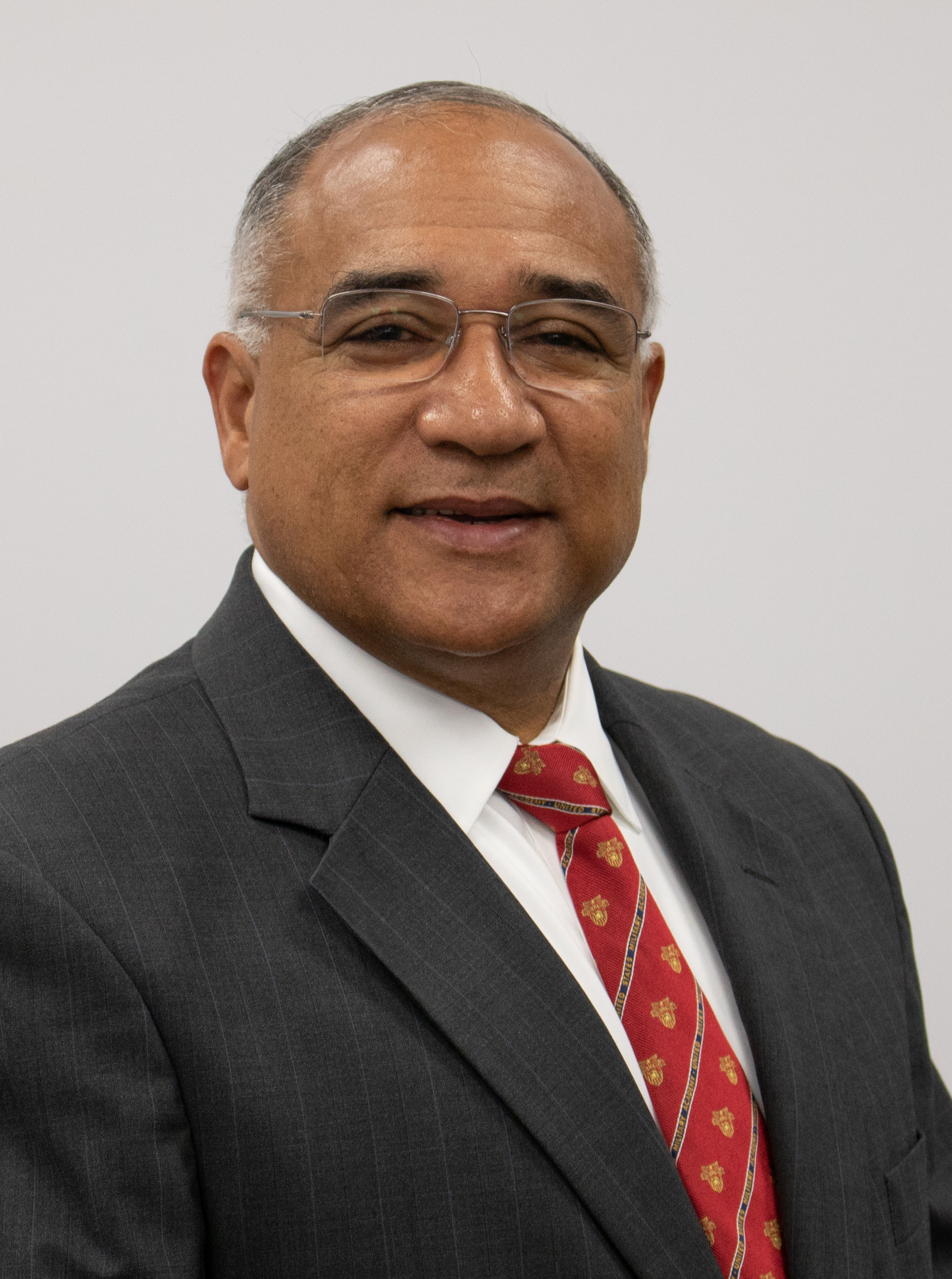
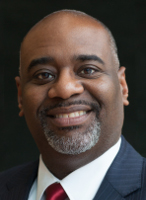
 As we begin a new Rotary year on July 1, we wanted to share some background on our new president.
Jorge Hidalgo joined our Rotary Club in 2014 and is president of Wilde East Towne Honda. Previously, he was a Harley-Davidson Executive. He is a graduate of the United States Military Academy at West Point with a Bachelor of Science degree in Economics and received his Master’s degree in Operations Management from the Massachusetts Institute of Technology. He served in the U.S. Army for more than 12 years as an Infantry Officer where he was an Army Ranger and Airborne Jumpmaster. Jorge has served on the Board of Directors and as President of the Sun Prairie Chamber of Commerce; served as Vice President of Fisher House of Wisconsin; and has been board president for the Wisconsin Heartland Honda Dealers Advertising Association. He is a recipient of the 2016 Latino Entrepreneur of the Year Award by the Latino Chamber of Commerce and the 2019 Sun Prairie Chamber of Commerce Community Business Leader Award.
In Rotary, Jorge has served on our Strategic Planning, Welcoming and Veteran’s Assistance Committees and was elected to our board of directors for a 2018-2020 term. He also participates in the Hiking/Skiing, Scotch Whisky and Sporting Clays Fellowship Groups and is chair of the Veterans Fellowship Group.
Jorge was born in the Dominican Republic, grew up in New York City and now lives in Sun Prairie with his wife, Andrea. They have 3 adult children and eight grandchildren. Here are some details reprinted from the Wilde East Towne Honda website that provide insights into Jorge:
“My favorite band: The Eagles.
Three Words that describe me: Duty, Honor, Country.
My childhood dream job was: To be a professional baseball player.
If you could spend the day with one person, deceased or alive, I would choose: My son, Daren, who was killed in Afghanistan (while serving his country in 2011).
Favorite TV shows: “Walking Dead” and “Blue Bloods.”
We welcome Jorge Hidalgo as President during our 108th Rotary year!
Jorge Outlines His Plans for Upcoming Rotary Year: “Respect the Individual”
I know that the current pandemic has affected all of us, and every aspect of our lives—so it’s natural that our Club has been affected too. We haven’t been able to meet in person for a while, and the road to returning to full-Club in-person meetings will be slow, and it will be gradual. But we’re resilient and we have adapted, with committees, fellowship groups and even our Wednesday meetings taking place virtually. It may not be ideal, but it’s a way to stay engaged with Rotary at a time when our Club needs our support.
As your President, I plan to remind us all of why Rotary matters, and mention one great thing Rotary has done each and every week. I also plan to highlight Members in the News each week from the podium, to celebrate the active role we play in the community. I want our meetings to be fun and upbeat; I want us to laugh more often. I’m sure whatever problems we’re dealing with every morning will still be waiting for us when we get back to the office after lunch; let Rotary be a little break from that stress. If our average age wasn’t 107 I’d call it recess—but even though “recess” doesn’t fit, you still get the idea. We’ll try new things, and not all of them may work—but we’ll keep trying till we make it work! We’ll even address members’ questions and concerns brought up on the member survey. We’ll have speakers that address a broad range of topics, including not only social issues but also leadership, history, business, inspirational life experiences, scientific discovery, and artistic pursuits.
There’s no shortage of things that draw divisions among people; different political and religious beliefs, different views on social and economic issues—and we absolutely MUST respect our differences, and respect each other, first and foremost, as individuals. So to be crystal clear, my theme for this year is “Respect the Individual.” We need to spend more time on discovering what brings us together: I want us to get to know each other better, discover things we have in common, and celebrate our accomplishments: One of the many ways to do this is by asking a new member to introduce a long-time Rotarian once a month. Among our members we have a Freedom Rider from the Civil Rights movement and someone who discovered a life-saving medical procedure, engineers and artists, veterans of foreign wars and Peace Corps volunteers; there’s a lot we can learn about and from each other. And let’s not get all greedy; we need to give others a chance to be part of this great Rotary Club: Each of us should set a goal of recruiting one member to Rotary this year; just one, though if you bring in more I promise I won’t get mad at you.
I want to thank you for trusting me with our Club’s leadership and let’s all work together to have a great Rotary year!

 When UW-Madison closed campus in March, 8,000 classes were converted to remote learning. Thirteen days later, 97.5% of classes were online. Closure was a heavy lift, but reopening is a much bigger lift.
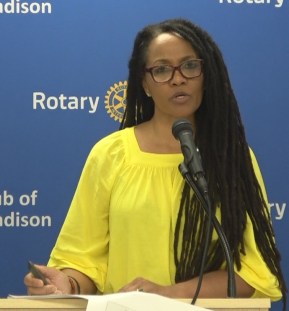 Lisa Peyton-Caire is the Founding CEO and President of The Foundation for Black Women’s Wellness (FFBWW), a Wisconsin based organization committed to eliminating health disparities and other barriers impacting Black women, their families and communities.
 Greg Frank, a co-owner of the Food Fight Restaurant Group in Madison and current Treasurer of our club, gave an overview of the history of restaurants, their current status and future challenges facing the industry during these uncertain Covid-times. Most recognize that the restaurant business can be quite difficult, and operations must survive on very low margins, typically less than 5%. Nevertheless, restaurants are an integral part of virtually every community, and have been so since the late 18th century when the first restaurant opened in France. The first American restaurant established, Delmonico’s in New York City, was established in 1830, and restaurants throughout the world have evolved in a variety of formats over the years.
 Jeremy Suri, the Mack Brown Distinguished Chair for Leadership in Global Affairs and Professor of Public Affairs and History at UT-Austin and formerly a professor at UW-Madison, spoke to Rotarians virtually on Wednesday, July 22, 2020.
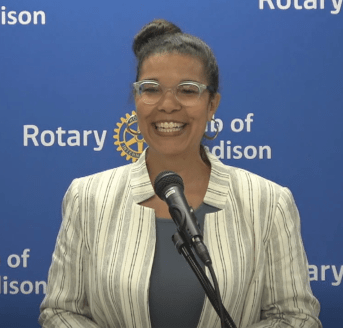 Rotarians were challenged July 15 by Annette Miller to be part of the equity solution.
 Rotary Club of Madison, Wisconsin