
Tag Archives: Rotary Club of Madison

Staying Connected

submitted by Club President Andrea Kaminski

Because it is unlikely that we will be able to hold luncheons with 200 Rotarians in one room for some time to come, several of our directors, officers and committee members have been reaching out to club members to find out how people are doing and how Rotary can best serve our members and keep folks connected in the coming months. As part of this effort, I’ve had the pleasure of speaking with several Rotarians about how the pandemic has affected their personal, family and professional lives, as well as how they are feeling about Rotary in this new environment.

We have not yet heard officially about any club members who have personally become ill with Covid-19. However, we have members who are working on the front lines to provide health care or elder care or to keep people safe. We have educators teaching children online and bankers  working around the clock to administer the federal government relief package to assist small businesses. We have business owners and directors of nonprofits who are struggling to maintain their workforce despite drastically reduced demand for things like restaurant meals, new cars, consumer goods and the performing arts. And of course we live in a community where many service workers and gig workers have lost their jobs.

Yet the dozen or so Rotarians I have spoken with have been generally positive despite the challenges, and they value what Rotary has to offer. Most have been viewing the online weekly meetings, and a few have participated in the fellowship groups or committees that have been meeting online.

Longtime Rotarian Karl Gutknecht said,  “Although our lunch meetings have built many friendships, I find enduring value in our Four-Way Test. When we apply our resources, abilities and energies into bettering our community and our world we will continue to make a positive difference!”

It is clear that our Rotary meetings will look different in the future because there are likely to be restrictions on large gatherings for some time. Also, we know that many of our members, for good reason, will not feel safe attending a big luncheon. The board and our executive director are looking at a number of options to address these concerns. For example, one possibility might be to have the weekly meeting at the Park Hotel with a speaker and a program, which would be live-streamed to smaller gatherings in community rooms on the east and west sides of the city. In this scenario, members who are more vulnerable to the virus would have the option to view the streamed meeting online from home.

Let us know if you have any suggestions for how to continue Rotary’s tradition of providing fellowship opportunities, excellent programs and service to the community through the pandemic and beyond. Send an email to rotaryoffice@rotarymadison.org or give me a call at 608-957-2865. I look forward to hearing from you.
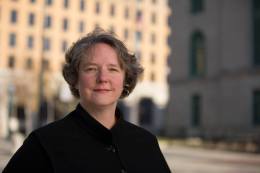
Mayor Rhodes-Conway: How Madison is Responding to COVID-19

submitted by Dave Mollenhoff

Satya+Rhodes+ConwayIn Rotary’s first live Zoom meeting, Mayor Satya Rhodes-Conway, against a backdrop of red tulips and the capitol dome, provided a comprehensive 30-minute overview of Madison’s responses to COVID-19.

“Our goal,” she began, “is to keep people safe, reduce the number of COVID-19 infections, and not overburden our health care facilities.  Our initial focus was to help the most vulnerable, especially the homeless and those faced by food insecurity.”

To achieve that goal, she said the City has taken dozens of steps. One third of city employees are teleworking, most city committees have been paused, and the City’s IT department is working overtime to facilitate virtual meetings. The library and Monona Terrace are closed. Bus schedules have been changed and riders enter by the back door. Parking regulations have been relaxed so that businesses can provide curb service.

“But be warned,” she continued, “the economic impact of the pandemic will be drastic.”  It has inflicted substantial increased operational costs and we have already lost $35 million in revenue, so coming up with a balanced budget will be incredibly challenging.

She reminded everyone that our extraordinary parks system is open and available with only a few new restrictive policies.  Then she added wistfully, “How I wish I had time to get out there and enjoy them. In fact, I spend so much time attending Zoom meetings that my Fitbit thinks I’m dead.”

The mayor ended her talk about a long list of “hard and depressing” topics with hope and optimism.  “Madison,” she reminded everyone, “is amazing, and I believe we will emerge with a city that is more accessible, equitable, sustainable and affordable.”

Club member Jason Ilstrup provided a spirited introduction and posed members’ questions to the mayor at the end.

If you missed our meeting this week, you can watch the video here.

What’s Your Pandemic Purpose Statement?

submitted by Ellsworth Brown

Whelan pptSometimes it’s better to begin at the end, in this case with Professor Christine Whelan’s personal May 6, 2020, Pandemic Purpose Statement:

“Because I value relationships, perseverance and creativity, I will use my gifts for translating research, making connections and organization to positively impact the lives of my children, my students and the broader public.  I accept my fears and anxieties about not being perfect enough, not being helpful enough and fear for the future and still today make conscious, purpose-based commitments to make a fun baked potato bar tonight, take a bike ride with the kids and check in with my students.”

During this pandemic, we all feel the push of pain (including physical, financial, stress and more), the pull of possibilities, or most likely both.  This push-pull can manifest itself as either ego or “eco.”  Achieving the latter is the goal because it affirms the reality that institutions and people are inherently interconnected and always in change, though more so at this time.

So how is “eco” achieved?

Whelan’s statement embodies combining an individual’s selection of three elements within each of three virtually infinite areas:  core values (e.g. happiness, independence, peace) strengths or gifts; and impact (e.g. upon groups, individuals, organizations).  It also requires that one accept (though perhaps not let go of) fears and anxiety and dare to go forward anyway.

A daily pandemic purpose statement can relieve pressure, contribute to better health and increase happiness.  Even those at greater risk can find that accepting help is itself a gift to a helper, illustrating that the holistic practice of “eco”—purpose—is by definition pro-social.

Professor Whelan, we’re all coming over for the potato bar tonight.

Our thanks to Dr. Christine Whelan for her online presentation this week and to Ellsworth Brown for preparing this review article.  If you missed our meeting this week, you can watch the video here.

New Digs for Me, New Options for Rotary

submitted by President Andrea Kaminski

You may notice as I introduce the May 6 online meeting that my background will be a little different from that of the past few weeks. It won’t be a tropical isle created by Zoom, although that sounds nice! It will be my new home in downtown Madison. Before the coronavirus outbreak, at least in Wisconsin, my husband Tom and I made an offer on a condominium at Metropolitan Place and had it accepted. When the Governor’s Safer at Home order went into effect shortly afterward, it exempted moving services so we decided to go forward with our plans.

We lived in our house across from Edgewood College for 35 years, and it is where we raised our three kids, housed their grandmother for a few years, and hosted some 30 foreign students and professional visitors. The result was an excess of twin-size sheets, plastic hangers and board games, not to mention our family photographs.

Downsizing while social distancing presented a particular challenge, in that thrift stores, Habitat ReStore, and homeless shelters were not able to accept donations. On top of that, many of the items that seemed priceless to us seemed worthless to our kids!  We have had to move things that we will donate in the future.

Then there was the moving itself. We did it in stages: 1. Close off one bedroom and a bathroom in our old house while the movers were there; 2. Oversee the placement of furniture and boxes in the condo; 3. Go back to the house and disinfect the kitchen and the main floor; 4. Live there with almost no furniture for three nights to allow for any viral contamination in the new place to die off; 5. Finally move in!

Through all of this it has been a pleasure to be able to continue to facilitate our weekly meetings, something that would have been impossible without huge assistance and support by our Executive Director, Pat Jenkins, and the volunteer technical expertise of Brian Basken and Jason Beren. In addition, our Club directors and directors-elect, who will meet online for the second time on May 4, continue to be active leaders in guiding our Club through the new challenges facing our membership and our community. And our committees and fellowship groups continue to meet online for business and fun.

LHS April 13 2020 2

Screenshot of first time ever Virtual Scotch Whisky Lew Harned Society event held on April 13.

If you haven’t yet viewed one of our weekly online meetings, I encourage you to do so. The programs have been terrific, our committee chairs have been reporting on their activities in support of our club and the community, and the live Q&A sessions with our speakers are particularly informative. Find instructions and links for the weekly meetings and other innovative, online member connections on the home page of the Rotary Club of Madison website.

For Tom and me, the challenges of moving to a downtown condo in the time of social distancing have given us a better insight about what’s important in our own lives. The same could be said for the way the Rotary Club of Madison is creating new ways for members to connect, serve and grow.  I hope every member will stay engaged, serve the community and find fellowship through our Rotary Club, while remaining safer at home.

Ramadan Traditions Revealed

submitted by Rich Leffler

Nasra WehelieFellow Rotarian and board member Nasra Wehelie spoke to us virtually via YouTube this week. Her subject was the traditions of the Islamic holy month of Ramadan, which are both rewarding and challenging. Ramadan is the ninth month of the Muslim lunar calendar, said to be when the Koran was revealed to Muhammad. Because it is based on the lunar calendar, it varies according to the Roman calendar.

One of the more well known traditions of Ramadan is fasting from sunrise to sunset. This fasting is one of the five pillars of Islam, and it offers several benefits: self-discipline, empathy, closeness to God and health. All adult Muslims are required to fast, except the ill, travelers or pregnant women.

Important elements of the holiday are the fellowship and community that take place at Iftar, the evening meal at the end of the daily fast. The current Covid-19 pandemic has made this difficult. But Zoom is being used in lieu of personal engagement.

Muslims who are celebrating Ramadan need some support at work or at school. It is best to avoid activities in the evenings, when the end of the fast is celebrated. And the scheduling of school activities should be sensitive to the demands of Ramadan.

The end of Ramadan is traditionally a time of celebration and community. But not this year, because of Covid-19. This will be a hard time for everyone, even if there is Zoom.

After the YouTube session, there was a question-and-answer session via Zoom. Nasra mentioned some of the benefits of this year of the pandemic and quarantine: Being home provides an opportunity for contemplation and self-reflection, and it helps eliminate temptations during the fast.

If you missed our meeting this week, you can watch the video here.

Learning Doesn’t Stop Amidst the COVID-19 Pandemic

submitted by Mary Borland

Jesslyn Hollar   Dr. Jesslyn Hollar is an Edgewood College Professor, and she teaches education courses,  “a teacher educator.”  She is well qualified to talk about engaging kids in learning amidst COVID-19 school closures as she is the mother of a 6-year-old and a 2-year-old.  Her roles of parent and teacher educator are no longer separate but overlapping.

With school closures, our school systems have to consider access. Are basic needs of students being met with food and shelter, do they have educational resources, access to internet, etc.?  At least 800 MMSD students are experiencing homelessness. Nearly half of students qualify for free or reduced lunch; more than 20% are English language learners and more than 14% have a disability.  As a result, ensuring emotional support and navigation during this turbulent time may supersede formal academics at this time. Professor Hollar stated that attending to your own needs as a parent/caregiver during this time also benefits your child. To decrease your child’s anxiety, work to decrease your own.

Where does learning happen? Most learning throughout our lives occurs quite informally. It is our ability to understand how to learn and to transfer and apply that learning to other settings that holds us in good stay, “learning with understanding.” Where you can, encourage active learning with reflection on learning.  Strategies for learning by grade were shared by Professor Hollar, and you can find additional links to resources at the end of her video presentation. She encourages parents/caregivers not to feel shame or guilt during this time about their young learner’s academic trajectory while schools are closed.

If you missed our meeting this week, you can watch the video here.