Tag Archives: Rotary Club of Madison

The Four-Way Test Is Our Guide In This Challenging Time

submitted by Rotary Club of Madison President Andrea Kaminski

In this uncertain time, Rotarians have a time-tested guide to help us limit the spread of COVID-19 while we safeguard ourselves and our loved ones and strengthen our community.

The Four-Way Test of the things we think, say or do: 

#1.  Is it the TRUTH?

It seems we are bombarded all day, every day with COVID-19 information from many outlets. To prevent anxiety or panic, we need to be critical thinkers and act on reliable information from trustworthy sources, such as the Centers for Disease Control and Prevention.

#2.  Is it FAIR to all concerned?

While it’s always true that what is good for all of us is good for each of us individually, this is even more true in a pandemic. Whether or not you are in a high-risk population group, you probably know, love and care about someone who is. Before this is over, we might all know someone who has been affected, and maybe has succumbed to the disease. We all need to abide by the orders from local, state and federal government officials to avoid gatherings of 10 or more people, keep a safe distance from others, and wash our hands frequently and well.

#3.  Will it build GOODWILL and BETTER FRIENDSHIPS?

While we need to exercise “social distancing,” it is still important to maintain a sense of community. We need to take comfort — and bring it to others — in any way we can. At times we will have to exercise patience with the uncertainty of the times, while we watch out for more vulnerable family members, friends and neighbors. Check in with them to see how they are doing and whether you can drop off a meal or a book at their door. There are many safe ways to reach out to people including phone, email, social networking and video conferencing. In the long run, your family and our community will be closer as a result.

#4.  Will it be BENEFICIAL to all concerned?

This is not a time to pull back and not be civically engaged. Participating as an active citizen in an election is a fundamental step toward a better future. Wisconsin elections officials are working to ensure that residents of our state have an influence in our national leadership as well as in important statewide and local elections. The April 7 ballot includes the Presidential Preference Primary as well as an election for Wisconsin Supreme Court, local judicial, school board and county board races, and a referendum on a proposal to amend our state constitution.  The best way to vote while social distancing is to vote by mail before the election. There isn’t much time, so act now. If you live in Madison, the City Clerk’s website is your guide. Or, you can enter your address into the MyVoteWisconsin website and find reliable information, including contact information for your own municipal clerk.

If we keep in mind the Four-Way Test — with its emphasis on truth, fairness, goodwill and mutual benefit — we will come through this challenging time as a stronger nation. Rotarians can lead the way!


Q&A with Wisconsin Supreme Court Candidate Judge Jill Karofsky

submitted by Ellie Schatz

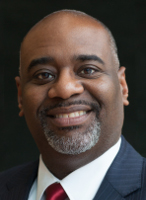
Jill KarofskyOne candidate accepted the invitation and spoke to our club about her background and plans for serving as Supreme Court Justice: Jill Karofsky. Having been a judge, a local and state prosecutor, and director of the state’s Office of Crime Victim Services, she has advocated for victims’ rights across every court in Wisconsin. She convincingly tells how she has the experience, values, and toughness to lead a legal system that works.
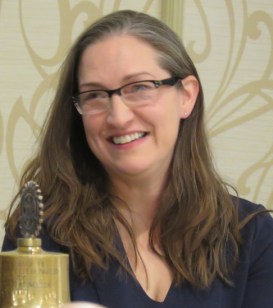
Supreme court cases have consequences for now and the future. To name a few, consider gerrymandering, women’s access to healthcare, and gun control. Whatever the case, following the rule of law is the bottom line, and Karofsky says her record of being fair and impartial is clear.

Her values include upholding laws to protect the environment. She is concerned about climate change but will follow the rule of law. She is strong on individual rights, attacking problems of racial disparity by informing policy makers of what she sees in the courtroom day after day. She says judges need to inform the legislature, have a dialogue with them, but are not there to legislate. More than anything, our courts are about constitutional rights and through the court systems she has fought for the needs of crime victims, stood up for racial justice and civil rights, and protected the right to marriage equality, never allowing for the rights of women to be rolled back. Her goal is to be collegiate on the court, to help pull all sides together under the rule of law. Right now she sees political forces seeking to roll back advances made in civil rights. We must not go backwards, she stresses.

As the Wisconsin Chief Justice is drawing up her budget, Karofsky is pushing for her to put treatment courts at the top of the list as opposed to a business court, which is essentially two courts – one for businesses and one for the rest of us.

When asked about the perception that she is a progressive candidate, she responds: “I am clear about my values, and I have support from Republicans and Independents. I ask for support as someone who follows the rule of law.”

Our thanks to WisconsinEye for videotaping our meeting this week.  You can watch the video here.

The Wisconsin Civics Games: An Important Competition

submitted by Larry Larrabee; photo by Mark Moody

Eve Galanter 3 4 2020

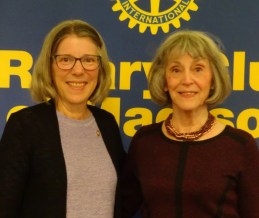
Eve Galanter (right) pictured here with Club President Andrea Kaminski

Eve Galanter told of why and how she founded The Civics Games, an annual competition among high school students from all regions of Wisconsin.  A few years ago, she became concerned when learning that research demonstrated the profound lack of knowledge of civics and the very poor level of participation in civic affairs among citizens of America.

Thirty-two percent of Americans cannot name the three branches of government.  A high percentage of elected offices at the local level are either uncontested or lack any candidate at all.

Because teens like competition and “to know more than their parents,” Ms. Galanter developed a contest similar to the old College Bowl television series.  Her approach to the Wisconsin Newpapers Association Foundation for sponsorship was met with enthusiastic approval.

For the first time, last February, students at all Wisconsin high schools were invited to form teams and compete at regional contests held at state universities throughout the state followed by the championship round at the State Capitol.  Each round consisted of teams competing to answer 100 questions.

To demonstrate, she provided Rotarians the opportunity to answer five questions from last year’s championship round.  If you were with us, you would know how we fared.  Let’s just say, it was not a slam dunk.  So as to include our honored ten spelling winners, she asked them to spell “emoluments,” a topic that will be addressed at this year’s Civics Games in April.

Most Rotarians were surprised to learn that civics is not required for graduation in Wisconsin, also true of most states.  However, Wisconsin does require all graduates to pass the naturalized citizenship test with a score of at least 60%.

For more information about the games, please go to www.wisconsincivicsgames.com.

If you missed our meeting this week, you can watch the video here.

HAMILTON: An American Musical

Sarah Marty 2 26 2020“Hamilton: The Musical is the biggest tour of a Broadway show to hit the road in years, maybe decades,” Sarah Marty, Producing Artistic Director of Four Seasons Theatre in Madison, told Rotarians on Wednesday, February 26. “Hamilton represents an entire industry, with ripple effects that go far beyond the lights of Broadway,” she said, adding that it had surpassed the reach of any other Broadway musical, including the phenomenal popularity of Oklahoma following its 1943 debut.
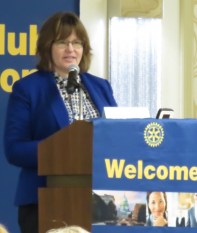
Locally, Madison’s Overture Center sold over 53,000 tickets to Hamilton, and Marty cited an estimated additional economic impact of $37.36 per person beyond the ticket price.  Both nationally and locally, Hamilton was hugely popular, inspiring people to stand in line for hours for tickets.  There are currently six productions of Hamilton touring all around the country, bringing in millions of dollars every week.

Beyond the economic impact of its huge success, though, Marty points to Hamilton’s other ripple effects, including increases in actors, producers and audiences of color.  Lin-Manuel Miranda’s Hamilton was inspired by Ron Chernow’s biography of Hamilton.  When Miranda picked up the hefty Chernow book in an airport and then read it, he immediately thought, “This is a hip-hop story,” calling an early version of the piece The Hamilton Mix Tape.  The elaborate musical production that eventually resulted is so complex that fans have put together a website at Genius.com to provide footnotes and links to all the many facts alluded to in the musical.

Marty cited the end of Hamilton as pointing to the importance of the work:  It causes us to think about “who lives, who dies, and who tells your story.”

If you missed our meeting this week, you can watch the video on our club’s YouTube Channel here.

Taking the 2020 Census

submitted by Jessika Kasten; photo by Mary Ellen O’Brien

Becky Schigiel 2 19 2020On February 19, 2020, Becky Schigiel, Sr. Partnership Specialist with the U.S. Census Bureau, spoke to Downtown Rotarians about the upcoming 2020 United States Census. Becky spoke to us about the three top reasons that the Census is so important: 1) It’s the basis of our democracy. The Constitution specifically calls out that everyone in the United States will be counted every ten years so that we can determine representation, 2) It the basis by which $675 billion dollars are distributed by the Government annually. Census data is used to determine the amount of funding for important things such as roads, school lunches, foster care, special education and much more. It’s estimated that for every person missed in Dane County, we lose about $2,000 annually for each of the next 10 years, and 3) Census data is heavily relied upon by leaders (community, faith, business) when making decisions that impact our local communities.
The three takeaways that Becky wanted us to take with us are that the Census is safe, easy and important. All household data is confidential, and the government has been working for years to ensure that the data gathered through the online process is secure and encrypted. In terms of being easy, the survey is available online, by phone, by mail – or in person once the door knocking campaign begins in May. The survey is also available in 13 languages and there are guides for many additional languages.

Mailings will begin in mid-March, encouraging people to start taking the census. Paper forms will arrive in April, and in-person door-to-door outreach will begin in May for anyone who has not responded. In 2010, Wisconsin had the highest response rate (83%), which we are looking to repeat in 2020.

Becky asked the group to help share census information with our connections/groups, especially those groups most likely to not self-report (children under the age of 5 were the most under-reported group in 2010), as well as to spread the message regarding employment opportunities. Dane County needs to recruit about 4,000 additional census takers over the next two months – a position which pays $22/hour.

For additional resources, or to apply for position, please visit 2020census.gov.

Rotary Friendship Exchange February 2020

submitted by Dick Fayram and Mark Moody

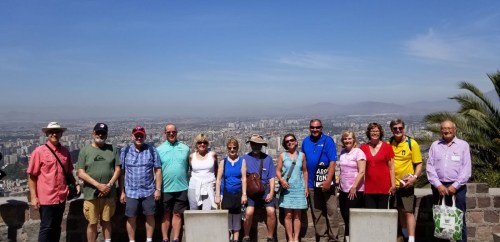
Saint Cristobal Hill Santiago

Eleven people have returned from a two-week Rotary Friendship Exchange with Rotary District 4340 in Central Chile. The group included Madison Rotarians Ted (& Joan) Ballweg, Dick (& Liz) Fayram, and Mark (& Candace) Moody, David & Inger Clemens from the Wisconsin Dells, former District 6250 Governor Chuck Hansen from La Crosse Downtown, Mark Etrheim from La Crosse Valley View, and Darla Leick from Marshfield Sunrise.

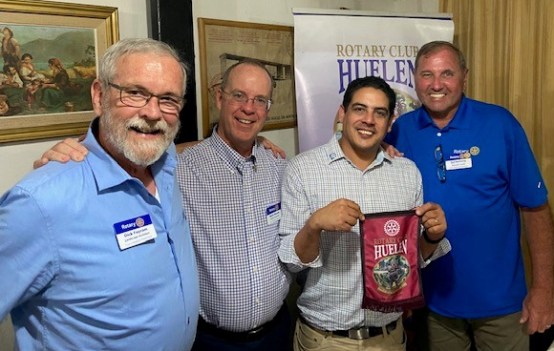
Huelen Rotary Santiago        Providencia Rotary Santiago

The group visited seven clubs in Santiago, Rancagua, and Santa Cruz. We learned about the wonderful service projects sponsored and supported by each of the clubs. The clubs are small, ranging from 10 to 30 members.  We were all inspired by the efforts of each club in their respective communities.

Santiago is a beautiful city of 8 million people with excellent road and other transit options.  The subway system and Uber sufficed for most of our transit needs. The news about the riots in Santiago were a concern to all of us before we left.  Students concerned about national academic testing and low-income people concerned about increases in transit costs were at the root of those issues.  It appeared to be about people talking past other groups of people and not really solving issues that need to be addressed.  Chile has reduced levels of poverty in an impressive way.  That does not resolve the fact that poor people are being driven further and further from their jobs by rapidly increasing housing costs.

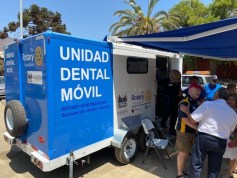
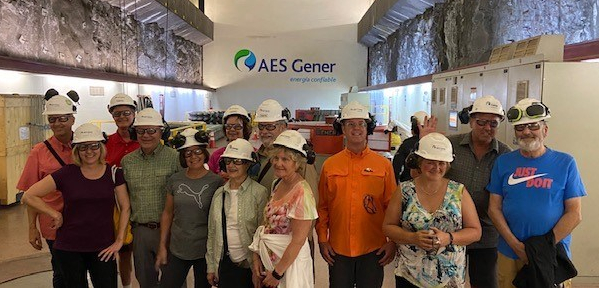
Mobile Dental Clinic 2 Hydroelectric Generating Station Andes Mts

Photo 1:  Mobil Dental Clinic; Photo 2:  Hydroelectric Generating Station in the Andes Mountains

Dick and Liz Fayram stayed with a family in Nueva, one of the communities that make up the larger city of Santiago.  It was a target of these demonstrations.  There were buildings that had been damaged and fires in the streets while we were there.  No one ever felt threatened in any real way.  This is part of the reality of Friendship Exchanges.

We visited a number of historic sites, markets and museums.  Rancuaga is a smaller historic city where the revolution for independence from Spain was fought.  We also visited wineries in Santa Cruz.  We enjoyed typical local cuisine and wonderful Chilean wines. Dinners were served with beef, pork, chicken and sausages piled high on platters.  We all thought it would be impossible to eat all of it in the beginning.  At the end of the meal, it was always gone.  Some of the group went white water rafting on the Maipo River and some went to the end of the road in the Andes Mountains.

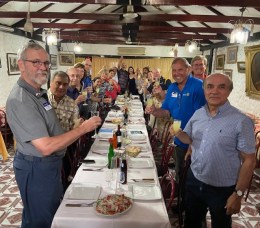
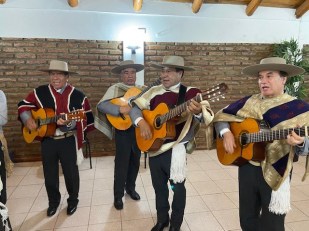
Our Chilean hosts made us feel very welcome at all times. They refused to let us pay for any of our meals, transportation, or entrance fees.  All of the clubs hosted a wonderful dinner meeting.  But the Santa Cruz Rotary Club had a group of twelve folk musicians perform tradition music and dancing.  This was a highlight of the trip.

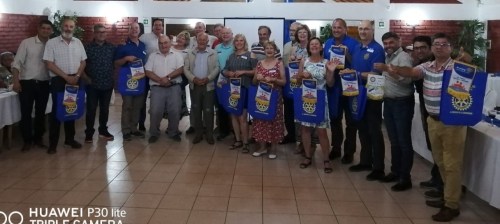
Farewell Dinner with Dist 4340    Santa Cruz Rotary Dinner 2

Rotarians who have not been on a Rotary Friendship Exchange are missing one of the great experiences that Rotary has to offer.   We were warned about Rotary Friendship Exchanges being physically challenging.  Some of our days had 18,000 steps in 90-degree weather.  These are not easy for anyone.  We encourage our fellow Rotarians to participate in this outstanding Rotary tradition whether in helping to host inbound Rotarians or traveling with an Outbound Friendship Exchange.

Santa Cruz Rotary Dinner 3

We expect 10 to 12 of our new Rotary friends from Chile to visit Wisconsin in late May and early June. We hope our club members will join us in welcoming them to Madison.  This will be a series of fun social events as they visit the participating clubs.   Join us for the fun!  If you are interested in helping to host the group, contact the Rotary office.