
submitted by Kevin Hoffman; photo by Margaret Murphy
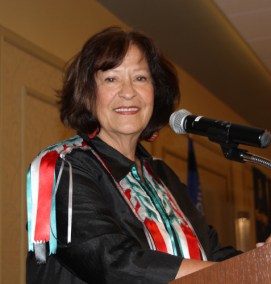
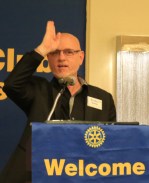
Patty Loew, Ph.D. is a well-known Wisconsin broadcast and print journalist, producer, educator, writer and proud member of the Bad River Band of the Lake Superior Ojibwe. After retiring as a professor from the University of Wisconsin, she accepted a position as the inaugural Director of the Center for Native American and Indigenous Research at Northwestern University in Evanston, IL.
When she accepted the position at Northwestern she wanted to change the paradigm that Native American studies had typically been carried out under; that is, in the framework and context of academic study and peer review, and then describing what eras and influences affected the life and culture of the Native American through history.
Dr. Loew’s concept was to build relationships and draw in related and disparate disciplines to bring a fresh perspective on contributions that Native American cultural knowledge brings to our understanding of the world.
In a convergence of science and cultural history the story was told of a fish warden that oversaw when spear fishing could be opened on certain lakes. He approached his task from a strictly scientific benchmark methodology: When the lake temperature hit 48 degrees it was time to open spearing season because spawning was about to begin. A Native American friend of his had a different method handed down from his ancestors: “Frogs chirp before spearfishing in the spring”. Over time he discovered the results were much better when he melded the two methodologies, but the real trigger was waiting until the frogs chirped!
Dr. Loew related that there are many other ecological heritage stories that have as much validity as western science methodologies. She has created a minor in Native American & Indigenous Studies to build on the knowledge of historical, scientific and cultural contributions of Native American populations. Learning in this context is expected to be experiential in nature by building relationships through tribal and Native American institutions. She also hopes to raise the visibility of Native American culture and language as indigenous cultures become increasingly rare and dormant.
If you missed our meeting this week, you can watch the video here.


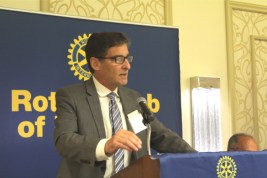 Tom Lynch, Director of Transportation for the City of Madison, began his presentation by acknowledging the significant contribution of 13-year Director of Metro Transit, Chuck Kamp, for his energy and foresight in bringing the system into the future. Mr. Lynch then shared important aspects of Madison’s transportation system and its future.
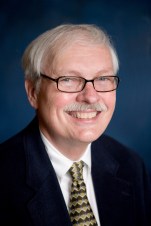 Who knew about early Wisconsin’s gay history? Really, no one. But now, thanks to Richard Wagner, this story is out of the closet with his new, scholarly, and extensively illustrated book, We’ve Been Here All Along (Wisconsin Historical Society Press).
 Brad got into swimming with sharks “by accident” — he was scuba diving in Stuart Cove, Nassau, Bahamas, and was asked to be a safety diver by the staff of the Discovery Channel who were there filming sharks in the area.

 Rotary Club of Madison, Wisconsin