Tag Archives: Rotary Club of Madison

Wine Fellowship – Pinot Noir Tasting on June 21

submitted by Mike Wilson
Wine June 21 2018 7

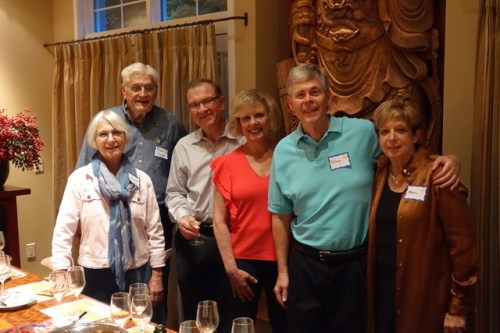
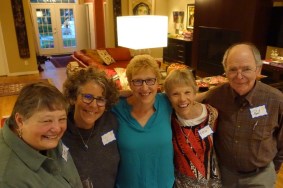
From left: Carolyn Casey, Mike Casey, Ray Bandziulis, Ann Cardinale, Steve Mixtacki & Meryl Mixtacki

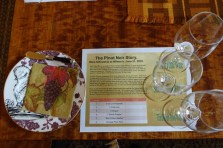
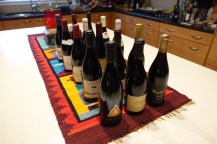
Our club’s Wine Fellowship met at the Wilson’s on Thursday, June 21, to taste Pinot Noir.  These wines had been selected from Mike Wilson’s cellar, and the tasting was divided into groups of three wines.  After a description of the Pinot Noir story that emphasized the really long history of Pinot Noir, one of the four oldest vinifera wines (there are said to have been 6000 Vitis Vinifera in the last 6000 years), and one of the most important.  This is emphasized as Pinot Noir was the first fruit and second food where the genome was mapped.  Pinot Noir is related to virtually 60% of wines used these days, being a sibling or parent of all of these wines.  In general the lighter colors, red brick rim seen on older pinots (we had a lot to sample in this tasting) and the fact that they age quite well (one wine was 41 years old – a Bouchard Le Corton, and we tasted three 1999 wines).
Wine June 21 2018 2  Wine June 21 2018 1  Wine June 21 2018 5

We tried great Red Burgundies (one Grand Cru and four premier Crus) the creme de la creme of Pinot Noir. These 5 wines represent the top 5% of Red Burgundies.  The first three wines were from the first ten years of this century, a 2002 Nuit St George and a Charmes Chambertin, and a 2007 Bouchard Beaune Marconnets.  We then tried three different Californian AVA’s (2010 Artesa, 2005 Flowers & Woodenhead) followed by three Oregon Pinots of the same period all from the Dundee Hills AVA (2007 Winderlea, and 2008 Lange & Scott Paul) so with good age on them. Next we tried three from the British Empire: two from NZ and one from the Okanagon Valley, and two of these wines were actually brought back from overseas.  These latter wines were still a little younger, being only 4-8 years old.
Wine June 21 2018 8  Wine June 21 2018 9

(Photo 1: from left: Patty Wilson, Cheryl Wittke, Becky Steinhoff, Ellie Schatz & Paul Schatz; Photo 2: from left: Julie Swenson, Peggy Lescrenier and Leslie Overton)

We then had three older wines: a 1999 Truchard from Sonoma, a 1999 Nuit St. George and 1977 Le Corton both from Burgundy.  We cleaned our palate with a Gruet Blanc de Noir (a white Methode Champenoise also made from Pinot Noir).  I had anticipated at least one of these three last century wines would be over the hill, but none were – a testament to Pinot Noir’s longevity.

Onee among the three wine groupings, a particular Pinot, was preferred only once. As all these wines were good, then the individual taster’s palate determined the most liked, i.e personal preference reigned supreme. The cheeses all went great with the wine and included a Compte, Gruyere, Mozzarella, White Cheddar and Cambazola, as did the breads and crackers. A good time was had by all.  A pity we will never be able to repeat this tasting.

Right-versus-Right………Toning Up our Ethical Fitness®

–submitted by Kay Schwichtenberg; photo by Mike Engelberger

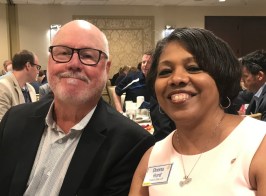
Anthony Gray 6 13 2018Fellow Rotarian Anthony Gray challenged and enlightened us on his life’s work in applied ethics.  While it can sound abstract, Gray brought us into the work of his team at the Institute for Global Ethics (IGE), the nation’s oldest think tank dedicated to bringing ethical decision making to our workplace and everyday lives. Gray is the President and CEO.
“Ethics” in Gray’s world is much more than the need to follow rules, guidelines and laws, or knowing right from wrong.  He calls these activities “compliance” not ethics.  Ethics, he said, are what you do when no one is looking, or resolving moral dilemmas that are not easy, straight forward or solely based on the law.  Ethical fitness is making good decisions when there are no rules or when something happens quickly and without warning.

In the training, IGE provides to individuals, corporations, schools, government organizations and other entities, emphasis is put on practical ways to get ethics into everyday decision making. Ethics is a skill set that can be acquired with proper training and personal practice.   Gray praised the “Rotary 4-way test of the things we think, say and do” by saying most organizations don’t include the word “think” in their ethical guidelines.   IGE helps people and organizations make effective decisions in difficult situations where two or more values are in dynamic tension — for example how do you choose between two right choices.

IGE’s international research into applied ethics has discovered five universal values: truth, respect, responsibility, equity and compassion.  These values can be the foundation for sound ethical decision making regardless of culture.

Gray is the incoming chair of the 2019 Rotary Ethics Symposium Committee.

Admittedly a meaty topic for a 20-minute presentation, you can find additional training and information at IGE’s website, www.globalethics.org.

Summerfest–Join Us for our 50th Anniversary Celebration!

submitted by Kevin Hoffman; photo by Jeff Burkhart

Bob Babisch 6 6 2018

Bob Babisch with Club President Donna Hurd

Bob Babisch, of Milwaukee’s famous Summerfest, shared the history and stories about the annual music festival held on Milwaukee’s lakefront park.  This year it runs for 11 days from June 27 to July 8 and is expected to draw 850,000, making it one of the largest music festivals in the world.

Summerfest started in July 1968 to bring Milwaukeeans together during a period of racial and civil strife and was modeled after the German Oktoberfest in Munich.  Initially, it was a city-wide event held at various public venues but was eventually consolidated at the current 75 acre lakefront site near downtown Milwaukee at a former Nike missile facility.  It is also the site of many ethnic festivals held during the summer.

Milwaukee World Festivals is the umbrella organization and has 43 full time and up to 2,500 seasonal staff.  Summerfest has gained a worldwide reputation for the excellence and variety of musical talent and performances.  The facilities have been consistently improved and upgraded to keep pace with the growing professionalism and standards of the live music performance industry.  Between 2005 and 2016 they invested $69.2 million in new stages, entry points, food venues, and facilities.

Mr. Babisch gave us a quick overview of the business model and economics of Summerfest and the facilities.  First, they have many corporate sponsors that support and upgrade the performance stages and venues.  Without this support they would not be able to have first-class amenities and keep the base one-day ticket price at $21.  Second, one might assume that ticket prices provide the bulk of revenue used to run the enterprise.  However, in order to attract and incent the best talent, the performers usually receive up to 90% of the net revenue with a guaranteed minimum.  Although this exposes Summerfest to some risk, it helps attract the best headliners.  The bulk of the revenue and profit that accrues to Summerfest comes from the ancillary sales of food, beer and other beverages.  Their goal is to make Summerfest a people’s festival by keeping entry costs affordable and the standards high.

So, with 11 days, 11 stages and 12 hours of non-stop entertainment each day there should be something for everyone!

If you missed our meeting this week, you can watch the video here.

The Latinx Story: How They Came to Wisconsin

submitted by Linn Roth; photo by John Bonsett-Veal

Sergio Gonzalez 5 30 2018

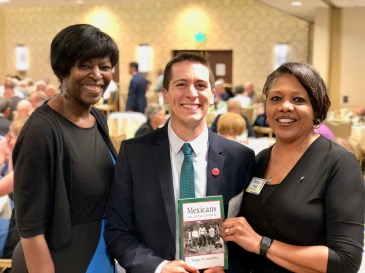
From left: Dawn Crim, Sergio Gonzalez and Club President Donna Hurd

Professor Sergio González of Marquette University gave a lively and informative presentation chronicling the growth and importance of the Mexican population in Wisconsin, using his family as one example of how that evolution took place.  The journey for this group of people – not an easy one – began in the 1920’s when laws were passed that limited immigration from Eastern Europe and resulted in an increased need for factory workers, particularly in and around Milwaukee.  These early Latino workers were considered “scabs,” and integration into the greater community was largely non-existent.

Subsequently, these immigrants established their own communities, which grew as the demand for agricultural and other workers increased.  In the 1940-1950’s, an average of 15,000 immigrants came to Wisconsin for each growing season, and, in the 1960’s and 1970’s, a much larger population began to unionize and advocate for basic rights in housing, schools and treatment by police.

By 1980, the population of Wisconsin residents of Latino descent was less than 70,000 but mushroomed to over 400,000 by 2010.  In 2016, state legislators proposed a law to tighten this immigration pattern, but their effort was met by large public protests and an outcry by Wisconsin’s dairy industry which was dependent on this Latino labor pool.

Today, Wisconsin’s Latino population is over 420,000, and contributes greatly to Wisconsin’s economy and culture.  Although many of them live with uncertainties created by the US’s fractured immigration policy, this vibrant community is critical to the future of Wisconsin and is doing everything possible so they can be considered “true Wisconsinites.”

If you missed our meeting this week, you can watch the video here.

An Update on Stretch Targets for Wisconsin

submitted by Rich Leffler; photo by John Bonsett-Veal

IMG_9701

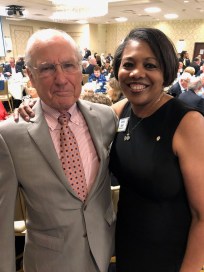
Dave Baskerville and Club President Donna Hurd

Fellow Rotarian Dave Baskerville spoke to Rotarians and guests about “Stretch Targets for Wisconsin,” an effort he heads dedicated to the proposition that this state can do much better economically than it has for the past forty years. It must set targets for ten years ahead and work to achieve them, just as new or struggling businesses do. Dave emphasized two areas: The economy and education. First he compared trends in Wisconsin to what has been happening in Minnesota. Thirty-eight years ago, the two states were virtually equivalent economically. In the years since, Minnesota has done far better in various important economic statistics, especially job growth and average wage growth. One difficulty, as both Dave and questioner Marv Levy pointed out, is that Wisconsin has had a hard time retaining its formerly great businesses, either because they relocate or the industry atrophies; and, as Dave indicated, Wisconsin has done a poor job of attracting new ones.

Education is an important element in this story. In math, science, and reading, the U.S. ranks 36th among the nations of the world; Wisconsin is better, but can do better. A goal would be to equal such national performers as Singapore, Japan, or Canada by 2038. Dave argued that it can be done, just as nations have arisen from destructive wars to become leaders. In 1993, Massachusetts and Wisconsin were about equal in achievement rates. Now, Massachusetts is in the top ten. It succeeded by establishing rigorous goals for teachers and students. Today, the poor in Massachusetts have the highest wages in the country. There are several schools in Milwaukee that have demonstrated great success despite the prevailing poverty of its children, including one high school that was rated the best in the country by US News.

Success in these Stretch goals can lead to progress in job skills, social mobility and justice, and national security. Wisconsin has great resources and people, and these have to be mobilized. The state’s white high school students currently rank 41st in reading, and its black students rate 49th. The state ranks 40th in average wages. But just as Vince Lombardi transformed the lowly 1958 Packers into the powerhouse teams of the 1960s, Wisconsin can achieve great things by setting goals and working to meet them.

Our thanks to WisconsinEye for videotaping our meeting this week, and you can watch the video here.

Alumni Park – A Must See on UW Campus

submitted by Andrea Kaminski; photo by John Bonsett-Veal

Paula Bonner 5 2 2018

From left: Regina Millner, Jeff Bartell, Roberta Gassman, President-Elect Jason Beren, Paula Bonner, Angela Bartell, Kristen Roman and Steve Wallman

Paula Bonner, former Wisconsin Alumni Association President and CEO, stepped out of retirement May 2 to talk to Rotarians about Alumni Park. This new lakefront gateway has had more than 21,000 visitors since it opened last October. Its purpose is to be a welcoming green space for students, alumni, faculty, staff and community members. It is not a big space but it features several distinctive and attractive exhibits that tell alumni stories. Bonner is particularly inspired by these in a challenging time for higher education.

The park is a gift to the University from its alumni and friends, Bonner said. More than 150 years after the University’s first campus master plan called for a green space in the area, the park completes the recent East Campus Mall development. It replaces an ugly surface parking lot between Memorial Union and the Red Gym. The land was initially part of the Ho Chunk Nation, which was recognized at the opening ceremony. Bonner thought of the development of the park as the reverse of the old Joni Mitchell song, Big Yellow Taxi, with lyrics that said, “They paved paradise and put in a parking lot” – and that became a marketing theme for the venture.

Approaching from Langdon Street, a visitor first sees the backlit granite fountain where water falls over ripples carved in stone. Then there’s the 80-foot long Badger Pride Wall depicting stories – some well-known and others quirky – from UW and state history. The Wall was designed by Nate Koehler and made in Green Bay. The Alumni Way exhibit has five 18-foot panels representing the five pillars of the Wisconsin Idea – service, discovery, tradition, leadership and progress. Alumnus William Harley (1908) is recognized with a sculpture of a vintage Harley Davidson motorcycle that visitors can “ride” for a photo. The multi-media Bucky Badger sculpture by artist Douwe Blumberg is contemplative yet still whimsical, said Bonner. At night it is lit from within.

The park is designed to celebrate Wisconsin. It has 75 trees and plantings of many native species. To the extent possible, the exhibits feature Wisconsin materials crafted by local artists. For example, Bonner recalled a cold February day when she went shopping up north for a big limestone slab, which was then carved by Madison’s Quarra Stone Company.

Information about the park, the exhibits, and upcoming educational and celebratory events can be found at www.alumnipark.com.

If you missed our meeting this week, you can watch the video here.