Tag Archives: Rotary Club of Madison

The Future is in the Hands of Young Women

–submitted by Linda Baldwin; photo by Mike Engelberger
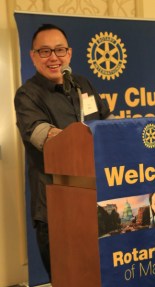
Tory Miller 1 24 2018Tory Miller, Madison’s most famous chef, loves rice crispy bars, started cooking as a child in his grandparents’ café in Racine and beat Iron Chef Bobby Flay in the Iron Chef Showdown last month.  What’s next?

Miller, co-owner and chef of some of Madison’s best restaurants (L’Etoile, Graze, Estrellon and Sujeo) sees a bright future for Madison’s food scene in the hands of young chefs who have a passion for local food and a willingness to work with the community.  He notes that a national magazine naming Madison the best foodie scene in the Midwest would certainly help raise the city’s culinary profile.

Raised in Racine, Miller went off to New York to study at the French Culinary Institute.  While stumbling at first, he found his way into the kitchens of many of the country’s best chefs.  Wanting to be closer to the food producers, he came back to Wisconsin and into Odessa Piper’s L’Etoile kitchen.  And so they say, the rest is history.  A James Beard Midwest Best Chef Award winner, Miller credits Piper for showing him that all people in the kitchen, in the house and guests should be respected and treated fairly.  In the past, women and folks on the lower rungs of the kitchen were not treated well, but today these folks are now running restaurants, leading chefs and a more respected part of the community.  Miller has also been instrumental in the start up Madison Area Chef’s Network (MASN) helping the community with food needs and helping each other to be more successful in an industry where cooperation was not the norm in the past.

So, what about Iron Chef Bobby Flay?   “The meat of it”, Miller laughs, “is that Bobby Flay is not super nice. Being on the show was nerve wracking, but I was happy with the way it turned out.  I’m weird and quirky, but we always want to be the best!”

If you missed our meeting this week, you can watch the video here.

Admissions and Recruitment at UW-Madison—How Does It Really Work?

–submitted by Carol Toussaint; photo by Valerie Renk

DSC00741As Director of Undergraduate Admissions and Recruitment at the University of Wisconsin-Madison, Andre Phillips has a key role in determining who will or will not become a student.  He described both the opportunities and obstacles to his Rotary audience Wednesday emphasizing that he works with a team in the Division of Enrollment Management in the Office of the Provost.  Several from this team were guests at the program.  Phillips came to Madison in 2011 after extensive experience in similar positions at the University of Chicago.
Phillips emphasized that he works with a “Wisconsin First” policy as directed by the Board of Regents of the UW System.  “Everything starts with Wisconsin” is the way to think about the job.  Phillips said that it is a big job which starts by being in touch with high schools in the state.  Assuring the audience that the team reads everything submitted with the application, he went through some of the requirements.  Acknowledging that high schools offer a variety of opportunities, he noted that they look to see what a student has done with what was offered.  The importance of organizing thoughts in response to questions asked on the application reinforced the value of writing with clarity.

“We want to know why the applicant wants the UW-Madison but we also need to learn why some of our top students aren’t applying here” was the opening for presenting information for what Phillips referred to as “Wisconsin Prime”.  Saying “we need to recruit more of our own” he described work that is being done starting with high school sophomores through visits to individual schools and bringing these students to the UW.   Outreach is also focused on first generation multi-cultural students.

Rotarians raised questions as to issues of affordability.  Phillips said he was not free to discuss some new plans we’d hear about fairly soon.  In fact, we were sworn to secrecy but without learning any details!

As the program concluded a number of Rotarians were heard commenting on whether or not they would be accepted under the high standards and competition of today.  Andre Phillips would probably respond that each of us should know that a lot is expected but each applicant is fairly judged.

If you missed our meeting this week, you can watch the video here.

Rowing Together in Madison and Dane County: Efforts to Improve Lives

–submitted by Andrea Kaminski

ANNA BURISH   Lynch_Richard  RENEE MOE

As Dane County continues to grow, approaching an estimated 600,000 population by 2040, the United Way of Dane County (UWDC) is working to ensure a high quality of life in which all residents thrive. Two UWDC leaders – Board Chair Anna Burish and President & CEO Renee Moe – updated Rotarians on current challenges facing our community and strategies for addressing them. Past UWDC Board Chair Rich Lynch described a “parallel effort” more sharply focused on housing and homelessness.

As the largest private funder in Dane County, the UWDC in 2005 adopted its Agenda for Change as a way to look at the community holistically, identify specific needs and establish a coordinated philanthropic approach to addressing them. Burish noted that such change management requires the same steps in the philanthropic sector as it does in other areas: pinpoint the needs; propose strategies to solve the problems; identify the desired impact, or goal; set metrics by which to measure success.

UWDC works with approximately 100 nonprofits, many of which on their own do not have the capacity to do this kind of planning or the resources to collect the needed data. Their expertise is in providing services. With a coordinated approach to philanthropy, UWDC helps them carry out their programs in a manner that advances the shared goals while gathering the needed data to measure progress.

Moe said there are 64,000 people living in poverty in Dane County, including 12,000 children. In addition, there are challenges related to shifts in the economy and workforce, technology, demographics, race relations, gender relations and the changing framing of social issues. She noted that the population of people over age 65 is expected to grow 130 percent in the next decade. There are also shifts affecting philanthropy including declines in public funding, changes in tax law related to charitable giving, local business trends, and more choice in how people give, including crowdfunding and designated project support.

Moe believes the “best change happens when you take the best of what people have built over almost 100 years and move it forward.” Working with nonprofits, school districts and government, UWDC is identifying new ways to tackle old problems and boost its ability to shift and allocate resources to address change. For example, as a result of a successful recent program, every health care organization in the county is conducting early childhood screening starting at 6 months in an effort to ensure that all Dane County children are prepared to go to kindergarten. The screening data are being collected in Epic software, so we can measure the success of various interventions. With a relatively small investment, more kids are on track for learning.

Lynch explained that, while UWDC carries out its holistic Agenda for Change, a group of volunteer leaders have created an Economic Stability Council, with representatives of businesses, foundations and government agencies, to launch the parallel, intensive effort aimed at reducing homelessness.

If you missed our meeting this week, you can watch it on our club’s YouTube channel here.

Making Dreams Come True–Rotary Scholar Event

–submitted by Mary Thompson; photos by Dennis Cooley

Photo 10  IMG_0702

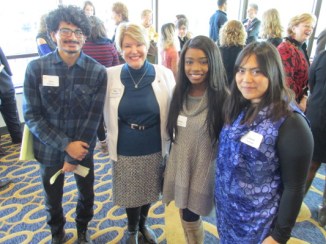
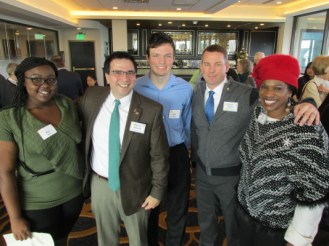
Photo 1: from left, Jose Rodriguez, Mary Thompson, Cynthia Maduka & Liliana Teniente; Photo 2: from left: Ryia Steps, Moses Altsech, Brett Stratton, Jason Beren & Teresa Holmes

With record attendance, over 60 Rotary Scholars and Mentors joined the Winter Mixer event on January 3, 2018.  While mentors and scholars swapped stories, I wanted to learn how the Rotary Scholar/Mentor program had influenced them.

The importance of relationships was the overarching theme.   Melanie Ramey’s scholar, Matida Bojang (UW–Milwaukee Pre-Pharmacy) shared that this program is making her dreams come true.  Ryia Steps (Alcorn State Psychology)  connected on many levels with her mentor, Teresa Holmes.  They love coffee and talk about everything.  Jose Rodriguez (UW Madison Psychology) has forged a relationship with Rob Van den Berg; Liliana Teniente’s (UW Madison Biology) mentor, Dennis Cooley gave her books to read such as “Grit–a Story in Perseverance.”  Donna Beestman’s scholar, Reyna Groff (UW Madison Art) shared she enjoys meeting with someone outside of school.   Rahim Ansari (UW Madison Chemical Engineering) met his mentor, Stan Kitson, through Memorial High School’s Interact program.  Stan commented that he can’t wait to see where he goes!  And my scholar, Cynthia Maduka (UW Milwaukee Communications) has been introduced to a Milwaukee newscaster to further Cynthia’s career in broadcasting.

IMG_0717  IMG_0701

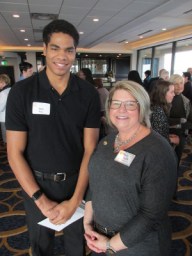
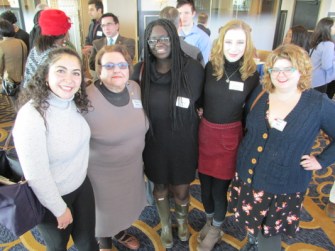
Photo 1: Dom Petty & Stacy Nemeth; Photo 2: from left: Leen Bnyat, Melanie Ramey, Matida Bojang, Hannah Kwiatkowski & Sarah Best

The highlight of the program occurred when co-chairs Cheryl Wittke and Ellie Schatz called for introductions.  It was an impressive group of scholars ranging in majors from STEM to the liberal arts and everything in between.  Teresita Torrence from Madison College explained the resources available to students in their student development center.  Bob Shumaker reminded everyone to follow the Madison Rotary Mentor-Scholar Facebook (FB) page; Linda Baldwin offered $10 tickets to the Overture Center for the Arts by signing up through the Club 10 link on the FB page; and Dean Nelson announced the Summer Picnic on July 1.

IMG_0705  IMG_0697

Photo 1: from left: Becky Steinhoff, Jana Hvorat & Joy Gander; Photo 2: from left: Tenzin Kunsel, Jim Christensen, Eddie Larson & Majid Sarmadi

The group adjourned to the Rotary meeting for more conversation and Charlie Sykes’ presentation.

For more photos, visit our Madison Rotary Mentor-Scholar Group on Facebook.

Our Madison Rotary Foundation awards college scholarship assistance to 25 students per year to assist them during their four years of college, so we have 100 scholars in college each year.  Nearly all of our scholars are connected to a Rotary member who serves as a mentor during their college years.  Since many students are on break this week, we invited scholars to attend our Rotary luncheon on January 3.  It was a great opportunity to check-in with our scholars, and they had a chance to connect with their Rotary mentors.  We enjoyed hosting our scholars and wish them all the best as they head back to college later this month.  Our thanks to Dean Nelson, Ellie Schatz and Cheryl Wittke for organizing this gathering of scholars and mentors just before our Rotary luncheon.

Charlie Sykes on How the Right Lost Its Mind

–submitted by Ben Hebebrand; photo by Valerie Renk

Charlie SykesSelf-identifying as the “Benedict Arnold of conservatism,” Wisconsin conservative radio talk show host and author of several books Charlie Sykes addressed members of the Rotary Club of Madison on Jan. 3 to promote his book “How the Right Lost its Mind.”
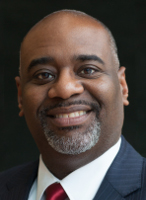
“I left (the conservative radio talk show circuit) on my own, but I have been excommunicated from the conservative movement,” remarked Sykes, who now works for MSNBC. But Sykes was rather firm in proclaiming that “I have not changed, but the Republican Party has,” indicating that conservative values are still very much part of who he is.

While the vast majority of Sykes’ comments centered on the performance and behavior of President Donald Trump, Sykes made it clear that “I am less bothered by Trump himself, but rather the normalization of his behavior.”

Sykes identified three specific current political thought movements afoot in our country. Firstly, there are those who are “horrified by everything – both the policies and the behaviors.” Secondly, there are the MAGA Republicans, those who want to Make America Great Again; and thirdly, there are what Sykes termed as “mainstream Republicans,” who are looking the other way as regards to the President’s behavior, since his policies represent wins. “You get what you want (in terms of policies), but the price is too high,” he said.

The price is too high because one has to ignore behaviors such as name-calling, bullying, withdrawal as a world power, or classifying the media as fake news, said Sykes. But the most important litmus test on whether the price is too high is that “we have to accept the indifference on our democracy by the Russians.”

Sykes included several other items one must ignore such as the endorsement of Roy Moore, the Republican Senate candidate from Alabama, as well as the President’s erratic behavior in regards to the escalation of the potential of a nuclear war in the showdown with North Korea.

“The bottom line is that we have to realize that our political culture is more fragile than we thought,” said Sykes. We could go down the path of other democracies,” said Sykes. He characterized Trump as a cause of our current situation, but also referred to the President as “a symptom of a pre-existing condition.” While Sykes did not directly identify the pre-existing condition, he implied that it is our current tribalism that is at the root of the current political climate. Disagreement has turned to hate, he said, resulting in a “binary, polarized culture.”

In offering a glimpse of improvement to the current political landscape, Sykes offered that the current modus operandi may lead to a revitalization of democratic norms. Potentially, a coalition of Center Right and Center Left could restore the norms.

Our thanks to WisconsinEye for videotaping our meeting this week.  You can watch the video here.

Listening to Latino Stories in Wisconsin

–submitted by Linn Roth; photo by Mike Engelberger

Armando Ibarra 12 6 2017

Professor Ibarra (center) pictured here with his wife, Veronica and Rotarian Pete Christianson

In his presentation “Listening to Their Stories: How Latinos Survive and Thrive in Rural and Urban Wisconsin,” Professor Armando Ibarra of UW Extension summarized data from his recent studies to illustrate how the state’s demographics have significantly changed over the last three decades and how they will continue to change in the future.  For example, Latinos are much more widely dispersed throughout Wisconsin today, and locally. Latinos now constitute 6.6% of Madison’s population and 20% of Fitchburg’s populace.

Over the last 25 years, Dane County’s Latino population has exploded from 5,000 to about 32,000, although that number is probably a substantial undercount due to the immigration status of many people.  More importantly, this growth will continue to occur, regardless of changes to immigration law or border control.

Yet, even with a strong work and family ethic, the Latino community has not enjoyed full integration into our economic, social and political culture.  However, given that the Latino community is now an integral part of the Wisconsin economy, e.g. 80% of our dairy products are handled by Latinos, that cultural integration will inexorably move forward.  As Professor Ibarra stressed, Latinos are essential to the economic and cultural prosperity of the US, and we should welcome all individuals, regardless of race or nationality, to contribute to and participate in the promise of our democracy.

If you missed our meeting this week, you can watch the video online.