
–submitted by Ben Hebebrand; photo by John Bonsett-Veal
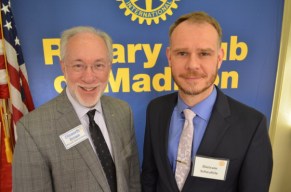 At the April 20 meeting of the Rotary Club of Madison, our guest speaker, UW-Madison Professor Dietram Scheufele (pictured here at right with Club President Ellsworth Brown) presented an interesting insight into how polarized opinions have become as a result of an increasingly greater tendency for like-minded segments of our population — tribes, if you will — to subscribe to the news and information that fits their ideology.
Under the title of “Is the U.S. Increasingly Anti-Science?” Professor Scheufele claims that about half the U.S. population agrees with global warming and the other half does not.
Among the primary reasons for this split in opinion is a tendency for humans to associate with those who think like us — a phenomenon that in recent times has led to our media becoming opinion-driven, as is evidenced by the rise of Fox News on one end of the spectrum and MSNBC on the other end.
Media outlets such as these “give people what they want to believe in,” said Scheufele, although the consumption of information and research should really be a non-partisan endeavor. Scheufele illustrated our nation’s increasing polarization with various examples, including a study of political blogs published on the Internet that feature tremendously high cross-referencing with like-minded political blogs, but hardly any crossover between different ideologies. “We don’t go by content; we go by category,” said Scheufele. Social media, Scheufele said, is based on a business model that gives the consumers what they want. He said steering Internet traffic to the opposite point of view or need or want “doesn’t sell.”
To break through this polarization, Scheufele suggested that one method to unite various constituents of our nation is to focus on bottom-line issues we can all agree on. In the case of global warming, Scheufele said it would be most likely that we could get behind the idea of investing in green energy so that we can export green energy technology to other nations. Global competitiveness, Scheufele said, is something we can agree on.
CLICK to watch the video on our YouTube Channel.
 Kathy Cramer is not your typical ivory tower professor. Instead of conducting research in libraries, she drives to small towns far from Madison and Milwaukee. She finds out where people meet for coffee—café’s, gas stations, and stores—and then just shows up. “Hi, I’m Kathy Cramer, I’m a professor from Madison and I study public opinion. May I join you?” Almost everyone she met during her impromptu visits were gracious, she told Rotarians on Wednesday. Then she passed out her business card—she’s a professor in the Department of Political Science—and got permission to turn on her recorder. “What issues concern you?” she asked. What she heard surprised her.
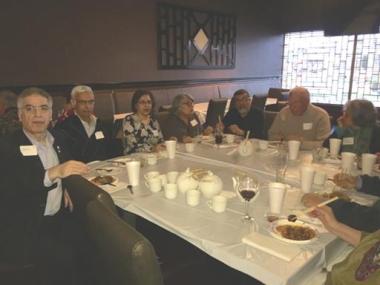 On April 7 the Cultural Awareness Fellowship Group met at VIP Asian Cuisine on Madison’s West side for a lively evening starting with a buffet dinner featuring several different dishes of Asian cuisine. Following a dessert of various ice cream choices ala Asian-style (this Rotarian sampled a delicious rendition of green tea ice cream), we pulled up chairs to enjoy an enlightening presentation about Chinese culture, Feng Shui and Chinese brush painting from Wei Dong, UW-Madison professor, artist and designer.
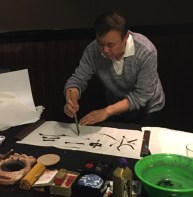 The piece de resistance of the evening came next. Professor Dong demonstated how he paints using more than one piece of rice paper layered on top of each other. This approach leaves much to the imagination on the back of the first sheet of paper as well as other layers. “Why draw everything?” he asked. “The Western way of drawing is more focused than Chinese art,” he noted. He showed that with examples of the same scene drawn from both the Chinese and western approach.
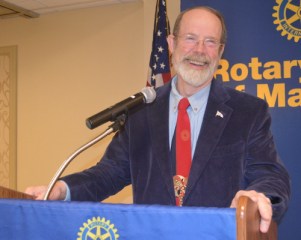 We Madisonians love our lakes, but often know little about them. Don Sanford, long time Lake Mendota sailor and iceboater, described to downtown Rotarians this week how he set out to correct that situation 11 years ago as he began to research On Fourth Lake: A Social History of Lake Mendota.
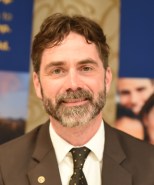 At our March 30 meeting, our very own Rotarian, Jeff Burkhart, described for us the scope of The Literacy Network of Dane County where he is the executive director. With 900 volunteers providing over 30,000 hours of help each year to those with impaired literacy skills at 28 locations in Dane county, the literacy network reaches out to the 55,000 with impaired literacy in the county.
 Rotary Club of Madison, Wisconsin