
–submitted by Bill Haight; photo by Stacy Nemeth
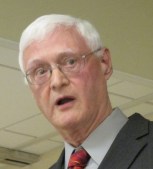 Academic freedom of speech, which dates to the time of Socrates, and faculty tenure, which is about 500 years old, were the subjects of UW-Madison Professor Donald Downs.
A couple of the basic changes in tenure that have occurred recently in Wisconsin include:
- Faculty dismissal is allowed beyond the original criteria of either “just cause” or critical financial cuts. Now other factors such as “program changes” can be considered which gives broader ability to dismiss, and could be misused, according to Downs.
- Shared governance of faculty, staff, and students has been demoted to more of an advisory role rather than a co-governance role with the administration.
A practical concern is that weakening of tenure policies at the UW puts the institution at a competitive disadvantage with other universities trying to attract quality faculty.
Tenure protection for faculty is a means to an end, the end being academic freedom, according to Downs.
Academic freedom, is defined by the famous statement adopted by the UW Board of Regents in 1894: “Whatever may be the limitations which trammel inquiry elsewhere, we believe that the great state University of Wisconsin should ever encourage that continual and fearless sifting and winnowing by which alone the truth can be found.”
Academic freedom and tenure, it is believed, is essential to the central mission of the University, which is pursuing truth, teaching and pushing the frontiers of knowledge.
A long-standing social contract allows academic freedom to take place with priority over politics, ideology, fashion or other social pressures. This does not allow, however, creation of absolute dogma or indoctrination. Defining what is not within that social contract is not always easy.
In the 1980’s many universities enacted policies against offensive speech by faculty or students. But in practice, these chilled intellectual honesty.
Downs related incidents of extreme speech codes, such as one from an eastern institution that prohibited “inappropriate laughter.” “Is anyone clairvoyant enough to be able to tell when laughter turns ‘inappropriate’?” asked Downs. Another policy urged campus members to report “discomforting” speech. “Isn’t much of learning somewhat discomforting?” asked Downs.
CLICK to watch the video.
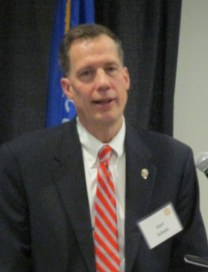 In a lively presentation, UW-Madison College of Letters & Science Dean John Karl Scholz made the case for a liberal arts education, especially when it comes from UW-Madison. However, he stressed that the University needs the input of employers and alumni to make it happen.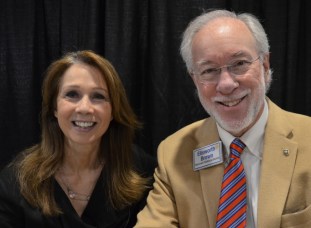
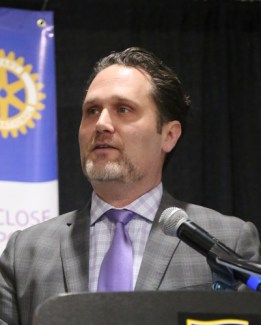 Zach Brandon, President of the Greater Madison Chamber of Commerce, addressed our Club regarding “Madison’s Business Climate,” citing four trends to explain where we are headed.




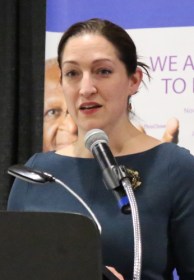 Sarah Marty, the Director of Arts programs at UW-Madison Continuing Studies, spoke to Rotarians about the vibrant arts program in the Madison and surrounding areas and the challenges they are facing. Sarah opened her remarks by sharing the lyrics to “No Business Like Show Business” and stating there is “no people like show people.” She proceeded to demonstrate how this is true by sharing information about the vibrant arts programs in Madison. Community theatre is made by, with and for the community and deploys local talent onstage and backstage and is responsive to the community in which it exists. Did you know:
 Rotary Club of Madison, Wisconsin