
–submitted by Linn Roth; photo by John Bonsett-Veal
 At our April 27 meeting, Dr. Noelle LoConte of the UW gave us some frightening, but also some hopeful information and a call to action during a presentation entitled Pancreatic Cancer Research: A Medical Oncology Perspective. As many know, often because of personal experience, pancreatic cancer is a particularly virulent disease, with a five year survival rate of less than 5%. With the exception of a rising incidence in the African American population, the incidence of this disease has remained relatively stable in our population. Nevertheless, pancreatic cancer is expected to be the second most common cause of cancer mortality by 2020. These numbers reflect the fact that there is no current method to screen for pancreatic cancer, and therefore, patients are typically diagnosed well into the disease process, when it is too late for effective surgical or drug intervention. In addition, the risk factors are not well established, although age is clearly the most important factor, with smoking, heavy alcohol consumption, and other contributors playing a role.
But the good news is that survival rates have slowly but surely been improving, and new methods to diagnose and treat the disease are in development. Dr. LoConte is a firm believer that more basic research is the key to defeating pancreatic cancer, and that the UW Pancreatic Cancer Task Force will be a major contributor to this national effort. As always, competition for funding and awareness is keen, but there are supportive events and direct means for individuals to help here in Madison. To learn more about this disease and UW’s efforts to combat it, and to provide support, visit http://www.uwhealth.org/uw-carbone-cancer-center/pancreatic-cancer/pancreas-cancer-task-force/38121.
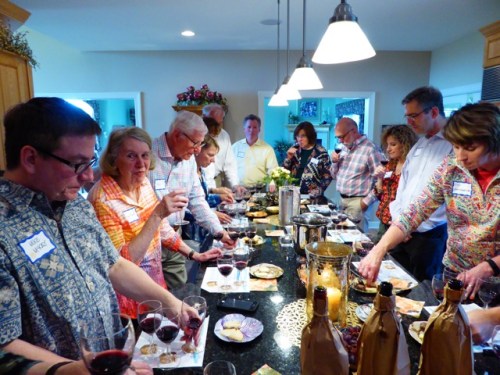


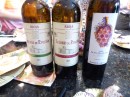 The next round was a red wine presentation of Spanish Wines. Two were Rioja’s and the other a Priorat, and these regions represent the only regional DO’s with quality (i.e. DOCa) as classified by Spain. Both represent regional blends with Rioja’s having ~60% Tempranillo with additional Garnacha, Carignan, Cabernet Sauvignon, Merlot, and Syrah. The Priorat has more Garnacha but no Tempranillo but with the other wines also. We tried a 2009 Rioja Crianza (1 year in oak) at $20 and a 2009 Reserva (at least one year in oak and another year in oak or in the bottle) at $28. Incidentally there is a Gran Reserva with at least 2 years in oak and 3 years in bottle before release. The Priorat which is from the Catalonia region was a 2008 example at $30. These wines were very good and represent some of the best from Spain. All were very nice with no clear winner as I recall.
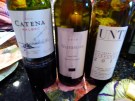 Lastly we tried 3 very different red wines – a 2013 Catena Malbec from Argentina ($15), a 2010 Napa Watermark Cabernet Sauvignon of great quality, and a 2013 Unti Zinfandel from California (~$30). The most impressive was the Watermark with ~2/3 of the group preferring that wine. Unfortunately this is not available for purchase locally.


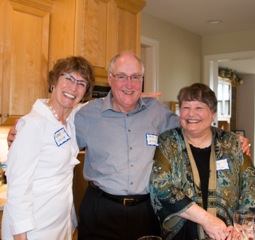
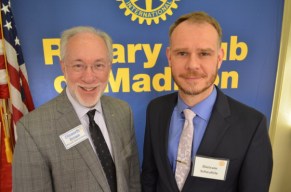 At the April 20 meeting of the Rotary Club of Madison, our guest speaker, UW-Madison Professor Dietram Scheufele (pictured here at right with Club President Ellsworth Brown) presented an interesting insight into how polarized opinions have become as a result of an increasingly greater tendency for like-minded segments of our population — tribes, if you will — to subscribe to the news and information that fits their ideology.
 Kathy Cramer is not your typical ivory tower professor. Instead of conducting research in libraries, she drives to small towns far from Madison and Milwaukee. She finds out where people meet for coffee—café’s, gas stations, and stores—and then just shows up. “Hi, I’m Kathy Cramer, I’m a professor from Madison and I study public opinion. May I join you?” Almost everyone she met during her impromptu visits were gracious, she told Rotarians on Wednesday. Then she passed out her business card—she’s a professor in the Department of Political Science—and got permission to turn on her recorder. “What issues concern you?” she asked. What she heard surprised her.
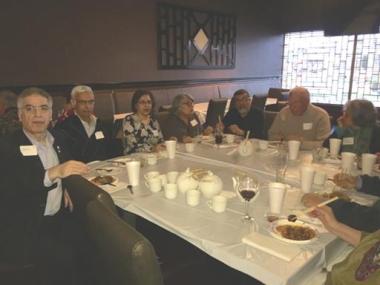 On April 7 the Cultural Awareness Fellowship Group met at VIP Asian Cuisine on Madison’s West side for a lively evening starting with a buffet dinner featuring several different dishes of Asian cuisine. Following a dessert of various ice cream choices ala Asian-style (this Rotarian sampled a delicious rendition of green tea ice cream), we pulled up chairs to enjoy an enlightening presentation about Chinese culture, Feng Shui and Chinese brush painting from Wei Dong, UW-Madison professor, artist and designer.
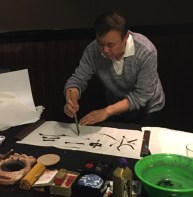 The piece de resistance of the evening came next. Professor Dong demonstated how he paints using more than one piece of rice paper layered on top of each other. This approach leaves much to the imagination on the back of the first sheet of paper as well as other layers. “Why draw everything?” he asked. “The Western way of drawing is more focused than Chinese art,” he noted. He showed that with examples of the same scene drawn from both the Chinese and western approach.

 Rotary Club of Madison, Wisconsin