Steve Vavrus, Director of the Wisconsin Climatology Office, shared numerous fascinating, but critical, facts about our state’s changing climate. He summarized his message as “warmer and wetter.” Significant increases in costs for major weather events have climbed as the state went from an average of two such events per year into the 1980’s to 2 events per month. Winter has seen the most increase in temperatures, especially in northwest Wisconsin. Dr. Vavrus said we can expect more heat waves and for winters to be even wetter with increased amounts of rain in single events.
Ecologist Jeb Barzen shared the remarkable recovery of bald eagles in Wisconsin. In 1973, there were only 108 nesting birds, but following the elimination of DDT, this number increased to 1,684 by 2019. Research shows that eagles are dynamic birds, moving based on food availability. More ice on rivers results in fewer nesting eagles in that particular area during winter. Considering various needs and perspectives is key to achieving win-win outcomes in ecological issues. To reach solutions, Barzen emphasized the importance of a common vision, iterative collaboration to build trust, and approaching outcomes with an open mind.
Our Member Recruitment Team continues to encourage all of us to think about individuals in our circle of friends, work colleagues and family members who would make good additions to our Rotary Club.
The committee created an award in 2014 to recognize a member who is excelling at sponsoring new members into our club. The award is named after Rotarian Mitch Javid Award as a way to honor him for holding the club’s record for sponsoring the highest number of new members. We annually recognize the member who has served as the primary sponsor to the most new members for the past 3 years–and who are still in our club.
Mitch Javid was a member our club from 1968 until his death in 2021. Mitch sponsored 56 members and co-sponsored another 10 members. This distinguished and very busy member who was chairman of the UW Department of Neurosurgery said, “I love Rotary. It is very dear to me. I believe in it and so I want to share it with other good people.”
This year’s recipient is long-time member and past president Susan Schmitz who continues to be a champion of our club and promoting membership and has received this award three times previously since 2014.
Susan has been part of our Rotary Club since 1989 and retired in 2018 from Downtown Madison, Inc. She was our club president in 1995-96 and continues to be incredibly active in our club. She has served as our Member Experience Team Leader since 2022. She also serves as our fellowship group coordinator among a number of other continuing committee roles
Susan has served as the primary sponsor to 10 new members since 2021: Dave Bornstein, Chris Campbell, Kyle Geissler, Mark Guthier, Eric Krieghoff, Erin McCombs. Rich Oliver, Paul Rider, Peter Welch and Lindsey Yoder.
Congratulations, Susan, on receiving this year’s Mitch Javid Award!
Is it fair to all concerned? No, this is not about our Rotary Club.
Gavin Luter, club member and Director of the University Alliance, and Tim Swadley, Mayor of Stoughton, explained that their combined efforts advanced the Wisconsin Idea as representatives of a program identified as the UniverCity initiative.
The UniverCity initiative trades on two assumptions, first that as strong as a college education is, it is inherently still limited, often to whatever a teacher and classroom can provide; and second, cities and towns in Wisconsin have unmet needs—e.g. analysis, ideas, planning—which they can’t afford and for which they do not have the resources to manage themselves.
Consultants can provide objective viewpoints, cost analysis, and surveys, for example, and selected groups of students can provide these and other services, advancing community development as well as their own skills and teamwork experience. This arrangement is directed as virtually any project that the community selects, fulfilling assistance in whatever way the client—the town or city—has identified: tourism, parks, roadways and crossings, affordable housing, surveys, health and well-being, solutions to the opioid crisis. . . all ideas can be considered.
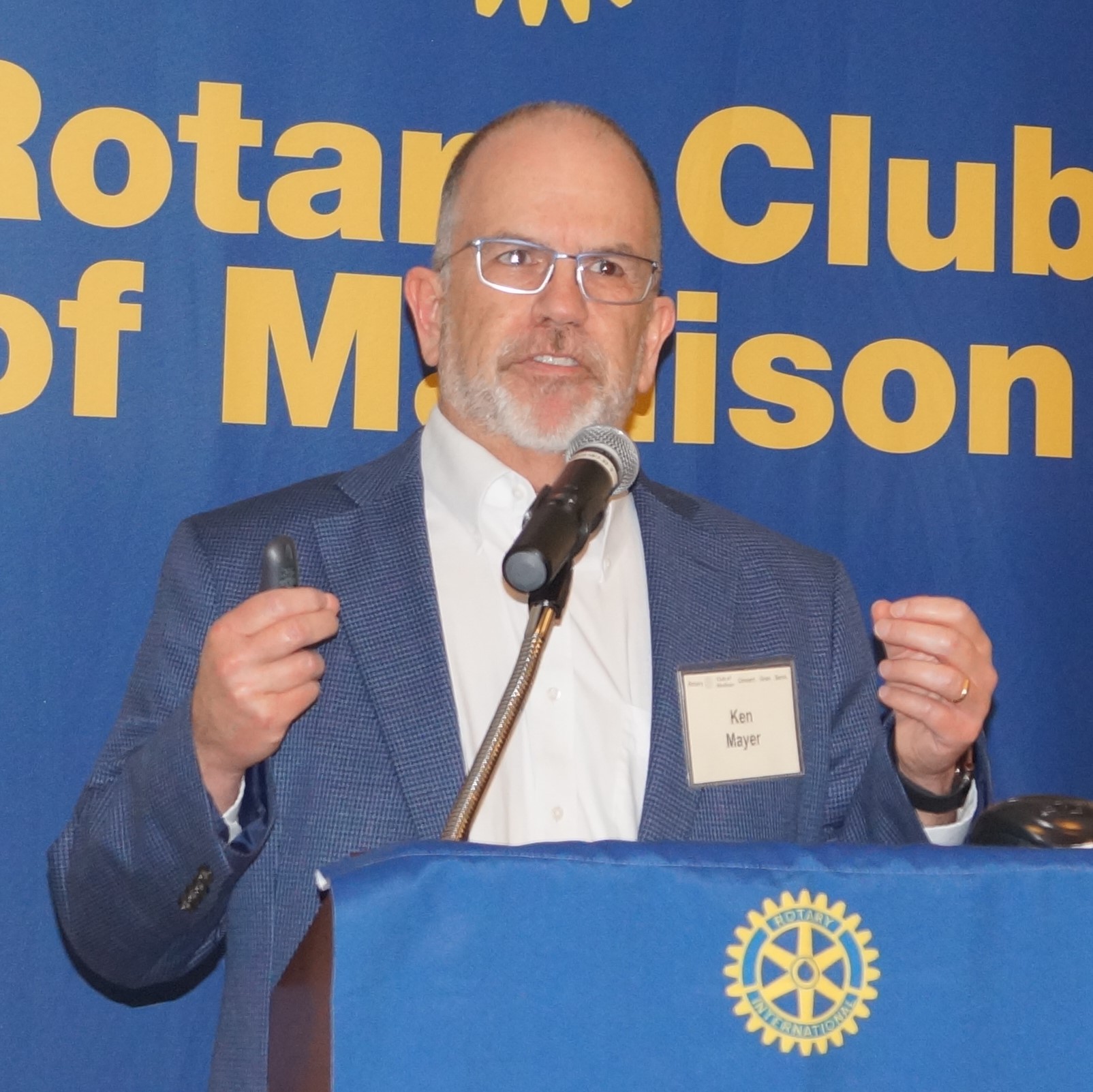
“Nobody knows who will win,” said Professor Ken Mayer in anticipation of the universal question. Thus, he provided a framework for understanding the current presidential campaign.
Once, United States politics honored democratic systems relying on a public ethos of virtue. This “democratic bargain” honored the winner but has succumbed to a new ecosystem fueled by unlimited and unregulated social mediums, falsehoods, AI, punishment in defeat, loss of regulatory structure, and asymmetric polarization.
The forecasting model, however, depends on stable inputs and outputs, so . . . nobody knows.
If you missed our meeting this week, you can watch it here: https://youtu.be/zemNwK94qj8. We’d also like to thank WisEYE for livestreaming and videotaping our guest speaker this week.
From left: Michael Johnson, Alan Branch, Club President Charles McLimans and John McKenzie
Rotarians heard from the key leaders in the Boys and Girls Club of Dane County’s new McKenzie Regional Workforce Development Center that just celebrated its grand opening on July 15. The center was created to address the labor shortage in the skilled trades industry. John McKenzie, owner of the McKenzie Apartment Company and donor to the project, approached BGCDC president and CEO Michael Johnson when he realized the only way to meet the demand was to diversify the workforce – which is largely male, white, and aging. McKenzie says the center will be good for the economy, business, and the social fabric of the community. Johnson says the $30-million project is the largest workforce training center in Boys and Girls Club history and has spurred similar efforts in 20 other communities. Alan Branch, the vice president of workforce development for BGCDC, says it is important to interest children between the ages of 9 and 13 in the skilled trades before they eliminate them as a career choice. The McKenzie Center will offer some participants an alternative to college and a path directly from high school to a job. There will also be opportunities for apprenticeships, education about wealth management, entrepreneurship, and post-secondary education.




 Rotary Club of Madison, Wisconsin