Nic Mink, an academic and entrepreneur, was looking to open a pizza restaurant when a completely different opportunity presented itself. Nic came upon an old cheese factory on the banks of the Sugar River, and through many conversations and research, moved his focus to honoring and preserving the building’s important history. Mink is in the process of restoring the building, which he has named Seven Acre Dairy Company. The complex features a restaurant, café, boutique hotel, micro-dairy plant and outdoor space. Nic is hopeful the building will be as relevant today as it was for generations of the past.
Dr. Niraj Nijhawan’s presentation, Brain Science Discoveries to Boost Resilience and Character, revealed the role brain neurology plays in communication of “the lower brain,” largely the limbic system and “the higher brain,” largely the orbital prefrontal cortex, i.e., our selfish side and our better character side.
He described how the Life Ecology Organization (LEO) teaches individuals in groups “Hope Narratives” that can control or limit the effects of the “Destructive Narratives” we get from our “lower brain.” Data was presented showing the positive effect of LEO with adults and teens in the areas of meaning, love and purpose, while significantly reducing suicidality, anger and selfishness.
In speaking to the Madison Rotary Club November 16, Professor Barry Burden offered an important overview and political narrative pertaining to the 2022 mid-term elections.
“There were a complicated set of stories intersecting this year,” he noted.
Nationwide, the mid-terms brought out 40 percent of voters, one of the highest numbers in several years. In Wisconsin, known for strong voter turnouts, 60 percent of registered voters turned out to vote.
Interestingly, Burden pointed out some candidates who lost races might have won if it weren’t for their lack of experience or funding.
Concerns about the mid-terms were abundant before the election. They ranged from worries about keeping the integrity of democracy nationwide, possible violence in the streets, or election losers’ failures to concede. “None of that happened,” said Burden.
There had also been concerns that redistricting would shake things up, but across the country that didn’t appear to make a dent in the results.
Historically, it’s true that during midterm elections seats are typically lost within the party of the current president. “You pay a price for being the guy in the White House,” Burden said.
In tabulating votes in Wisconsin’s 72 counties, Governor Tony Evers was elected by a larger margin than projected while Senator Ron Johnson won by a smaller margin than expected.
One of things anticipated prior to the election was a “red (Republican) wave” of victories across the country. But Burden concurred with the amusingly proffered result offered by a Washington Post article that called it more of a “red puddle.”
Burden explained there was less shifting back and forth of voters of party preferences this time around because there are fewer blocks of swing voters as there were among hotly contested swing states in previous elections.
Many topics brought people to the polls to cast their ballots. A vote against Trump was one, along the pro-choice movement. In Wisconsin abortion and inflation were important voting motivators.
But at the end of the day, it appeared, at least by Wisconsin’s large voter turnout, people simply wanted to get involved and have their choices counted-a good sign of democracy in the works.
UW-Madison Chancellor Jennifer Mnookin (center) pictured here with Music Committee members Darin Harris and Elaine Mischler
After just about three months on the job UW-Madison Chancellor Jennifer Mnookin says she’s been meeting with as many stakeholders as possible.
She got input from the Rotarians present by using an app (www.menti.com) that allowed her to gather responses to the question “What word or words come to mind when you think of UW-Madison?” Rotarians answered on their phones. Two of the most prominent were “Bucky” and “Research”.
“’Research’ is music to my Chancellor ears,” she said, and “Bucky, this mischievous, loving mascot, gives people a warm feeling about this university and that is a not insignificant.”
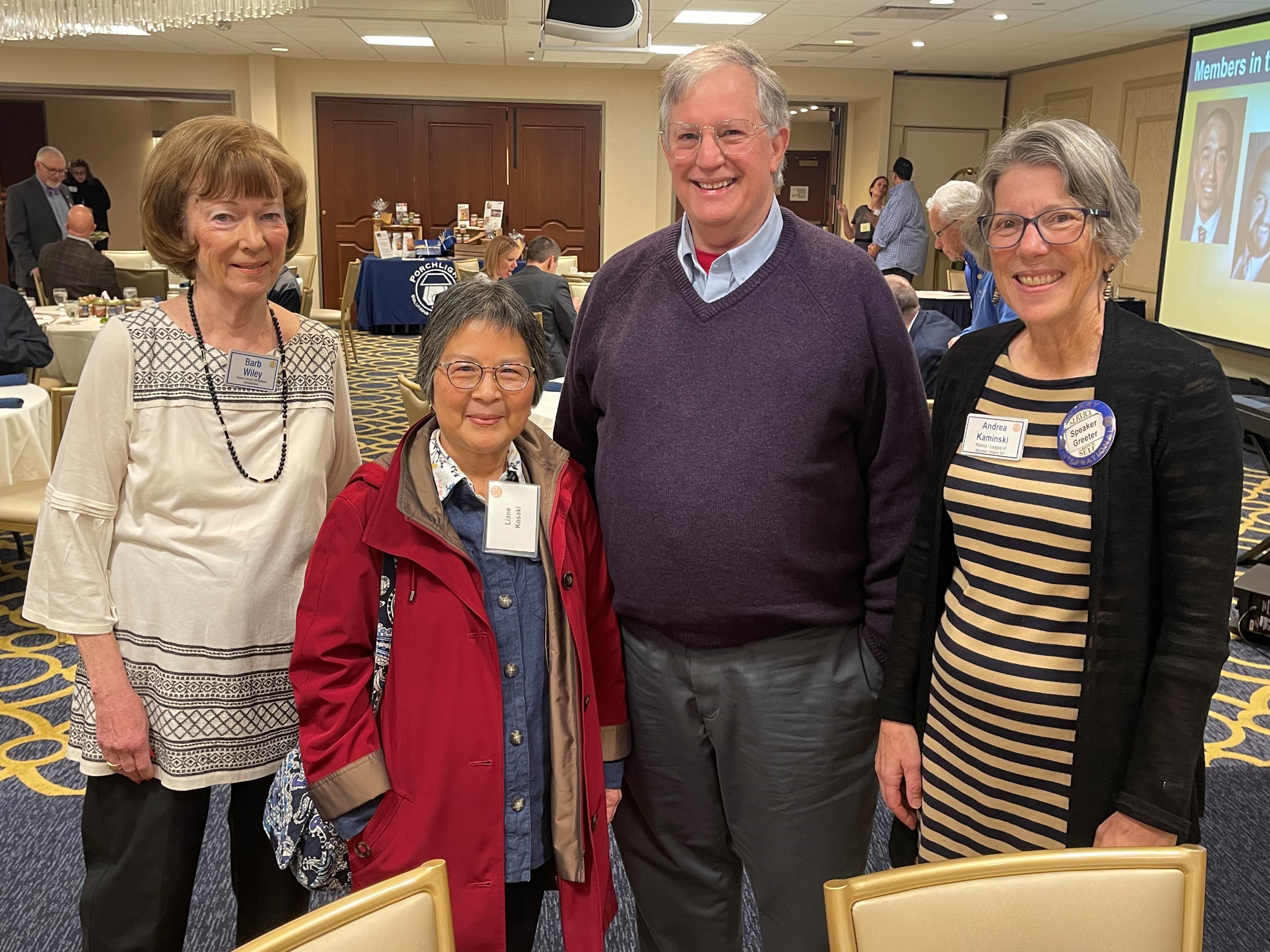
From left: Barb Wiley, Liane Kosaki, Charles Franklin and Andrea Kaminski
The race for Wisconsin Governor between Democratic Governor Tony Evers and his Republican challenger Tim Michels has tightened and is now considered a tossup according to the latest Marquette Law School Poll. Poll director Charles Franklin says among likely voters 47% support Evers and 46% support Michels. Michels gained support since the September poll mainly from independent voters.
The race for US Senate between Republican Senator Ron Johnson and his Democratic challenger Lt. Governor Mandela Barnes has widened since the last poll. Franklin say Johnson now as a six point edge over Barnes, 52% to 46%. Once again, independent voters are trending toward Johnson.
Professor Franklin says the close races show how important voter turnout will be on November 8.
The final Marquette poll for this election cycle will be released on November 2.
Why did you join Rotary? Why do you stay in Rotary? And what is needed for Rotary’s future?
District Governor Ben Bauer got us thinking and moving at the October 5 meeting by asking us to answer these questions and move to different parts of the room representing four important components of Rotary membership: Giving, Service, Fellowship, and Networking. The audience participation portion of the program was a fun way to illustrate what Rotary means to all of us as individuals and how we all might unite to take Rotary to the next level. Perhaps not surprisingly, we ended up with a large group in the middle of the room where all four benefits of Rotary membership intersected.
He also presented the club with a Rotary Citation for 2021-22 year for achieving the required number of goals chosen from a list of a possible 25. He encouraged us all to keep acting on our dreams.




 Rotary Club of Madison, Wisconsin