
submitted by Valerie Renk
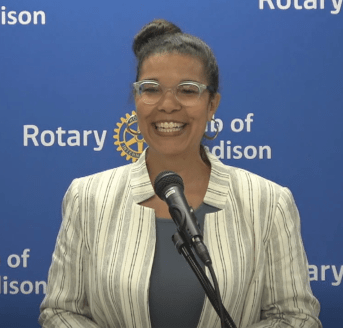 Rotarians were challenged July 15 by Annette Miller to be part of the equity solution.
“We have historically denied racism existed and that we were personally accountable,” Miller said. “But we have the capacity to learn and now unlearn racist behavior. People may doubt what you say but they will always believe what you do.
Miller suggested we think about what is the work for you? What do you need to learn to unlearn old habits? How do we deconstruct old systems based on people’s looks or zip codes whether they rent for example? We can grow together without the lens of racism.
What can Rotary do? “Look to the four-way test,” Miller outlines:
- Truth: Are we offering all truths? The truth is when white people call the police they respond. When people of color interact with police, outcomes are not always good.
- What’s the difference between fair and equitable? Fair is everyone getting the same. Equitable means offering what they need.
- Push yourself to meet new types of people, learn their stories. Move from fear zone to learning zone such as how the GI Bill benefited 8 million primarily white veterans with education, unemployment insurance and housing but didn’t benefit millions of veterans of color. Redlining is another devastating disparity example.
- Be prepared to be in the growth zone; it’s ok to make mistakes as long as you try. Use your influence at work, Rotary, with family…especially your kids…to find out what they know and how we can be better.
“We are all in this together,” Miller closed with.
Miller lives in Madison with life partner, Mike, and their three children. Annette launched EQT By Design focusing on developing diverse, inclusive, sustainable strategies in public engagement, equitable community development projects and organizational cultural change management. Annette obtained her BA from UW-Madison in 1992, and MS in 2017 from Edgewood College.
Our thanks to Annette Miller for her presentation this week and to Valerie Renk for preparing this review article. If you missed our meeting this week, you can watch it here: https://youtu.be/eV–yUaCnLg.
Here is a link to key slides from Annette’s presentation: https://drive.google.com/file/d/1ChdhqYzOfeyquRXgqBbjs7ZUUGlCNinF/view?usp=sharing and a link to additional resources: https://docs.google.com/document/d/1ygjl79fR3PN99MROmCWCSyO_UtDJ7MSOOiF5Wbawu5E/edit.
 This week, UW-Madison School of Journalism Professor Michael Wagner spoke to the Downtown Rotarians on Pandemic Voting: Information, Geography and Polarization in the 2020 Elections. The J-School has done a lot of research on the impacts of media and voting and has tracked the polarization of Wisconsin voters since 1996. Since that time, we’ve seen a decline in local newspapers and local news reporting, a rise in talk radio and social media, as well as a stark rise in the amount of political advertising in our state. The School of Journalism has done a lot of research on the impact of changing information channels and has found that the broader your media diet, the more likely you are to vote outside of party lines. As an example, those who viewed a wide range of information sources were 50% more likely to split-ticket vote in an election (i.e., choose candidates from more than one party on the same ballot). Those who consumed a narrower range of media had nearly no likelihood of splitting a ticket.
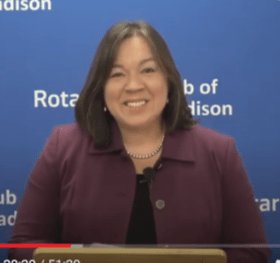 Renee Moe challenged Rotarians June 10 to improve race relations by being more willing to talk about the issue. Moe is President and CEO of United Way of Dane County, where she has held a variety of positions. She shared some of her personal challenges growing up bi-racial in rural Wisconsin. She said, “At 12, I remember praying to be killed, but as a teenager, thankfully, I knew it could be different from my early years abroad. Please know people are hurting because of how society comes together.”
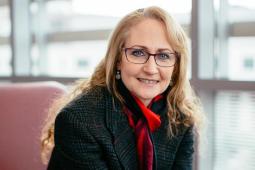 This week, UW-Madison Professor Jo Handelsman talked virtually with the Downtown Rotary about a project she began while working at Yale University in 2012 called Tiny Earth. This important project was developed to increase the number of students pursuing STEM degrees as well as address the growing antibiotic crisis. Researchers estimate that unless we do something soon, by 2050 the leading cause of death will be related to bacteria-related illness.
 On May 20, 2020, VA Secretary Mary Kolar gave an insightful presentation regarding the significance of Memorial Day. She first offered information regarding the Wisconsin Department of Veterans Affairs and the services and benefits provided for service members in Wisconsin, where 345,000 veterans reside. The WDVA works hard each day to ensure that veterans have access to all benefits available to them. The programs the WDVA oversees extend from administering the Wisconsin Veterans Museum (a Smithsonian affiliate that welcomes 90,000+ visitors each year), where it continuously educates the public with unique stories and histories of Wisconsin’s veterans, to veterans’ cemeteries where our veterans receive honorable burials, to providing access to mental health and housing assistance.
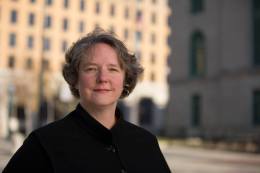 In Rotary’s first live Zoom meeting, Mayor Satya Rhodes-Conway, against a backdrop of red tulips and the capitol dome, provided a comprehensive 30-minute overview of Madison’s responses to COVID-19.
 Rotary Club of Madison, Wisconsin