
submitted by Ellsworth Brown
 Sometimes it’s better to begin at the end, in this case with Professor Christine Whelan’s personal May 6, 2020, Pandemic Purpose Statement:
“Because I value relationships, perseverance and creativity, I will use my gifts for translating research, making connections and organization to positively impact the lives of my children, my students and the broader public. I accept my fears and anxieties about not being perfect enough, not being helpful enough and fear for the future and still today make conscious, purpose-based commitments to make a fun baked potato bar tonight, take a bike ride with the kids and check in with my students.”
During this pandemic, we all feel the push of pain (including physical, financial, stress and more), the pull of possibilities, or most likely both. This push-pull can manifest itself as either ego or “eco.” Achieving the latter is the goal because it affirms the reality that institutions and people are inherently interconnected and always in change, though more so at this time.
So how is “eco” achieved?
Whelan’s statement embodies combining an individual’s selection of three elements within each of three virtually infinite areas: core values (e.g. happiness, independence, peace) strengths or gifts; and impact (e.g. upon groups, individuals, organizations). It also requires that one accept (though perhaps not let go of) fears and anxiety and dare to go forward anyway.
A daily pandemic purpose statement can relieve pressure, contribute to better health and increase happiness. Even those at greater risk can find that accepting help is itself a gift to a helper, illustrating that the holistic practice of “eco”—purpose—is by definition pro-social.
Professor Whelan, we’re all coming over for the potato bar tonight.
Our thanks to Dr. Christine Whelan for her online presentation this week and to Ellsworth Brown for preparing this review article. If you missed our meeting this week, you can watch the video here.
 Dr. Jesslyn Hollar is an Edgewood College Professor, and she teaches education courses, “a teacher educator.” She is well qualified to talk about engaging kids in learning amidst COVID-19 school closures as she is the mother of a 6-year-old and a 2-year-old. Her roles of parent and teacher educator are no longer separate but overlapping.
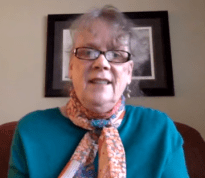 ellow Rotarian Lynn Brady, who is President and CEO of Journey Mental Health Center, shared her insights on “Dealing with Mental Health in the Time of the Coronavirus, a Unique National Emergency!” Brady’s presentation to the club through a virtual meeting platform on Wednesday, April 15, 2020, was an immediate reminder of the significant disruption that all of us are facing in our daily routines. Brady reflected that we are social creatures, and so this required isolation is inevitably going to have an impact. We feel uncertainty about when things will return to normal. In Brady’s work, she says that they are not currently seeing a lot of calls. Rather, people are asking for tips on dealing with stress; how to talk to children about the issue; and how they might reach out in the future to a mental health professional. The mental health professionals that she works with also need a chance to talk through the issues.
 Rotarians heard online April 8 from Benjamin Eithun how Madison is part of several networks to plan for medical emergencies. Eithun is Director of Pediatric Trauma, Surgery, Injury Prevention and Child Protection at American Family Children’s Hospital.
 Dr. Ankur Desai, professor of climate, people and environment at UW-Madison, addressed the first ever virtual meeting of the Club on the effect of climate change on local weather. He stated that climate is personality, and weather is mood.
 One candidate accepted the invitation and spoke to our club about her background and plans for serving as Supreme Court Justice: Jill Karofsky. Having been a judge, a local and state prosecutor, and director of the state’s Office of Crime Victim Services, she has advocated for victims’ rights across every court in Wisconsin. She convincingly tells how she has the experience, values, and toughness to lead a legal system that works.
 Rotary Club of Madison, Wisconsin