
submitted by Larry Larrabee; photo by Mark Moody
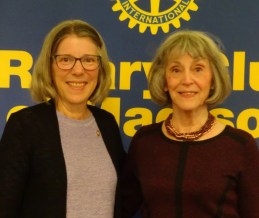
Eve Galanter (right) pictured here with Club President Andrea Kaminski
Eve Galanter told of why and how she founded The Civics Games, an annual competition among high school students from all regions of Wisconsin. A few years ago, she became concerned when learning that research demonstrated the profound lack of knowledge of civics and the very poor level of participation in civic affairs among citizens of America.
Thirty-two percent of Americans cannot name the three branches of government. A high percentage of elected offices at the local level are either uncontested or lack any candidate at all.
Because teens like competition and “to know more than their parents,” Ms. Galanter developed a contest similar to the old College Bowl television series. Her approach to the Wisconsin Newpapers Association Foundation for sponsorship was met with enthusiastic approval.
For the first time, last February, students at all Wisconsin high schools were invited to form teams and compete at regional contests held at state universities throughout the state followed by the championship round at the State Capitol. Each round consisted of teams competing to answer 100 questions.
To demonstrate, she provided Rotarians the opportunity to answer five questions from last year’s championship round. If you were with us, you would know how we fared. Let’s just say, it was not a slam dunk. So as to include our honored ten spelling winners, she asked them to spell “emoluments,” a topic that will be addressed at this year’s Civics Games in April.
Most Rotarians were surprised to learn that civics is not required for graduation in Wisconsin, also true of most states. However, Wisconsin does require all graduates to pass the naturalized citizenship test with a score of at least 60%.
For more information about the games, please go to www.wisconsincivicsgames.com.
If you missed our meeting this week, you can watch the video here.
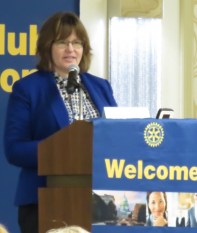 On February 19, 2020, Becky Schigiel, Sr. Partnership Specialist with the U.S. Census Bureau, spoke to Downtown Rotarians about the upcoming 2020 United States Census. Becky spoke to us about the three top reasons that the Census is so important: 1) It’s the basis of our democracy. The Constitution specifically calls out that everyone in the United States will be counted every ten years so that we can determine representation, 2) It the basis by which $675 billion dollars are distributed by the Government annually. Census data is used to determine the amount of funding for important things such as roads, school lunches, foster care, special education and much more. It’s estimated that for every person missed in Dane County, we lose about $2,000 annually for each of the next 10 years, and 3) Census data is heavily relied upon by leaders (community, faith, business) when making decisions that impact our local communities.
 At this week’s Rotary meeting, we heard from Dr. Joshua Mezrich and how he creates life from loss, transplanting organs from one body to another. He spoke about his desire to write a book, a little about the process to write a non-fiction book and some tips his famous author brother gave him. His book was released last year, When Death Becomes Life: Notes From a Transplant Surgeon, and in it he illuminates this extraordinary field of transplantation that enables this kind of miracle to happen every day.
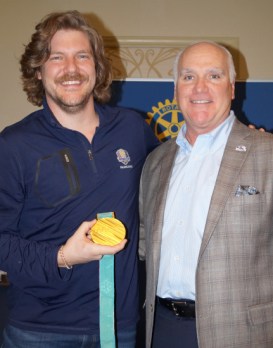 On January 22, USA Curling Interim CEO Rich Lepping and Olympic Gold Medal Curler Matt Hamilton spoke to the group about the sport of curling and Matt’s experiences as an Olympian. USA Curling was established in 1958 and is a non-for-profit headquartered in Stevens Point, WI. The organization consists of nearly 200 clubs and 26,000 members. After the Gold Medal Games, the organization saw a rise in membership and interest, resulting in a 12% increase in membership. USA Curling is already beginning to think about the Beijing 2022 Olympic Games and is starting trials. The USA Olympic Curling Teams will be chosen about a year in advance.
 Kurt Paulsen, UW Associate Professor of Urban Planning, reviewed the issues regarding the workforce housing shortage in Dane County and its impact on the economy. Currently, Dane County’s population is increasing 1.3% a year, with job creation at 1.7%, and new housing units at 1.1%, so housing is not keeping up with population demand. In addition, rents are rising faster than income, so many are excluded from living in Madison. Presently, more than 100,000 workers live outside Dane County, which means that they have long commutes.
 Rotary Club of Madison, Wisconsin