Category Archives: Rotary Club of Madison Guest Speaker

StartingBlock: Imagine the Opportunity

submitted by Kevin Hoffman; photo by Margaret Murphy
Chandra Miller Fienen 9 5 2018

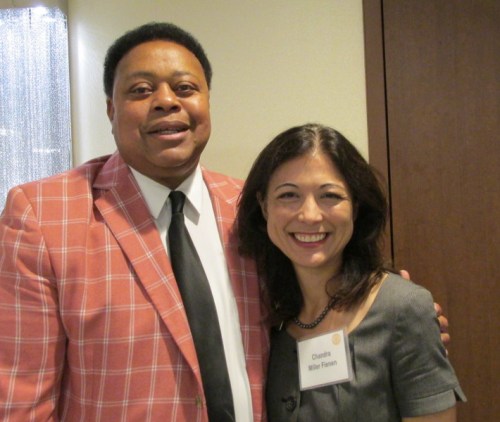
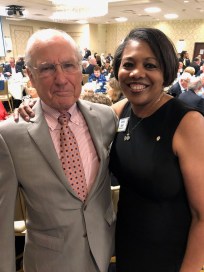
Chandra Miller Fienen pictured here with club member Charles Tubbs

Chandra Miller Fienen, Director of Operations & Programs at StartingBlock Madison, spoke to Downtown Rotary about what StartingBlock is and how it helps support and foster innovation entrepreneurs.

Recently opened in June 2018, StartingBlock Madison is supported by Madison Gas & Electric, American Family Insurance and the City of Madison.  In collaboration with the University of Wisconsin, StartingBlock Madison seeks to launch early-stage companies by creating a home base for innovation entrepreneurs.  Resources provided include affordable and flexible workspace, speakers on relevant topics, introduction to the startup scene, mentorships, and refining sales and marketing messages.

StartingBlock also helps fledgling companies grow by assisting with finding talent through an onsite recruiter, matching students for internships and paid positions, connecting with professional advisors and mentors, and workshops on financing and operating a business.  There are currently 20 companies, 7 partner organizations, and two venture capital funds involved with StartingBlock.

Innovation is further fostered by showcasing new ideas, collaboration with members of StartingBlock, connecting with investors and advisors, and working with experienced entrepreneurs to bring ideas to reality.

Last, StartingBlock seeks to cultivate a sense of giving back by encouraging supportive practices for employees and the community, staying in Madison once they are successful, and having a positive social conscience and impact.

Summing it all up, StartingBlock Madison’s vision statement is:  Creating intersections that cultivate entrepreneurs, build innovative companies, and drive ideas into reality.

If you missed our meeting, you can watch the video here.

Madison to Launch Professional Soccer Team

submitted by Bill Haight; photo by Karl Wellensiek

DSC_8192

Peter Wilt, managing director of Madison’s newly forming professional soccer team told Rotarians why Madison is ready for its own pro team.

Soccer is popular with young people and approximately 50% of Madison’s population is under the age of 30. Soccer has become the second most popular sport among the 12-24 age range and 4th among all ages. The Madison area has 40 youth soccer clubs and 20,000 registered participants.

People who began playing soccer in the 1980’s when youth soccer began to take off in the U.S. are now among community leaders and decision makers. A sustainable pro team will need passionate fans, a tribal culture, and community pride, said Wilt. Madison is ready.

The team’s name and head coach will be named very shortly and the team’s first of 14 regular home games is planned for April, 2019. The new team will be part of a Tier III division, with teams from mid-sized cities such as Tucson and Toronto.

The team is owned by Big Top Events, which operates the Madison Mallards baseball team and concerts at Breese Stevens Field, also the home of the new soccer team.

Investment in Breese Stevens by the City of Madison and Big Top Events will eventually bring capacity to 5,000 and add suites, upgraded restrooms, club seating, a rooftop deck and enhanced food and beverage options. A season ticket will be in the neighborhood of $274, with game tickets comparable to movie prices, noted Wilt.

Players are being recruited internationally and will also feature local and state players, said Wilt. The new team’s players will be mostly in the 21-25 age range and will be full-time Madison residents, unlike Mallard players who stay with local housing hosts during the season.

The sizable and growing Madison soccer fan base is finally getting a hometown team of its own.

If you missed our meeting this week, you can watch the video here.

TR Loon Brings Fun & Games to Rotary

submitted by Ben Hebebrand; photo by Mike Engelberger

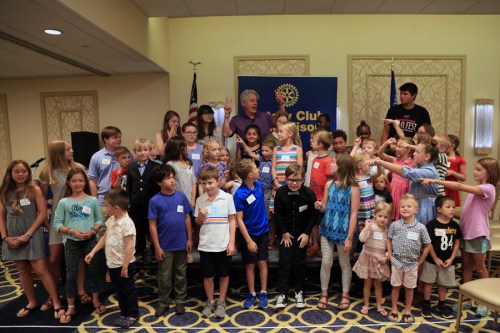
HO7A6660The Rotary Club of Madison treated its membership at its August 15 Club meeting to fun and games – highly appropriate in that the day represented the Club’s annual Bring-Your-Child or Grandchild to Rotary Day.

Sitting up front and center, about 50 Rotary children were treated to the wacky magic of TR Loon – The Truly Remarkable Loon, also known as the “Juggler from Madison.”

In a highly engaging performance, TR Loon held kids captive and adults entertained by completing the incredible feat of spinning ten plates or as TR Loon reminded the audience “simultaneously at the same time.”

In inviting the kids to help him count the number of plates spinning, he reminded the audience that “there are three kinds of jugglers – those who can count and those who cannot.”

Humor aside, TR Loon indeed had ten plates spinning simultaneously, all the while receiving help from the kids, who alerted him when any one of the plates appeared to be at the brink of no longer spinning and thus crashing. The absolute highlight, however, was when TR Loon invited the kids in the audience and a few fun-loving adults to launch flying monkeys to bring the ten spinning plates down. The image of spinning plates being brought down by flying monkeys represented to this fun-loving news reporter our Club’s finest moment, and elicited a comment from a Club member that the scene was not much unlike what happens at the State Capitol.

At the end of TR Loon’s presentation, Stephanie Richards, CEO of the Madison Circus Space, informed members that her organization is in the midst of a capital campaign to build a new center in Madison. Circus Space promotes the circus arts as an important art form by teaching interested children and adults on various circus arts such as juggling or aerial stunts.

National Parks – The Joy Trip Project; “Closing the Gap” & Ensuring Access to Our Parks by Diverse Populations

–submitted by Andrea Kaminski

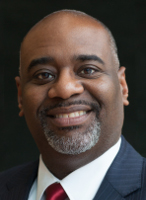
James Edward MillsAugust 1 guest speaker James Edward Mills grew up in a family steeped in the civil rights movement in Los Angeles. His father, who served on the city council and was called the “de facto Mayor of LA” for a time, was an advisor to Martin Luther King, Jr. His parents strove to make it possible for children of color in their community to achieve, excel and become anything they wanted. They supported James in what he wanted, which was to excel in outdoors adventure.
Right out of college Mills took a backpacking trip from the rim to the floor of the Grand Canyon. He explored Yosemite National Park and climbed the tallest mountain in California, Mount Whitney. He couldn’t help but notice that there were not many adventurers in these places who looked like him.

It’s true. African Americans make up only two percent of the visitors to the National Parks and an even smaller percentage of those who participate in more strenuous adventures. Mills wanted to change that. In 2012 he was part of an expedition of six men and three women who were the first all African American team to climb Denali. In 2016 he won the lottery – that is, the lottery to have a permit to raft through the Grand Canyon. On that adventure the guide told Mills that he was the first African American to join one of his rafting trips in his 40 years on the Colorado River.

As a freelance journalist who has worked in several roles in the outdoor industry since 1989, Mills wants to change the narrative. He learned from documentarian Ken Burns, who produced the series “The National Parks: America’s Best Idea,” that African Americans have long been engaged in the preservation of natural areas. For example, the “Buffalo Soldiers” were members of peacetime all-black regiments of the U.S. Army in the early 20th century. Burns said they were, in effect, the first national park rangers, and they were instrumental in preserving the giant redwoods in California.

Mills figured that if he had not heard that story before, most other people had not heard it either. He launched a blog called The Joy Trip Project (joytripproject.org) to document stories of African Americans engaged in outdoors adventure. Mills also is the author of a new book, “The Adventure Gap: Changing the Face of the Outdoors.”

Mills believes that if equality means you can do anything, that includes climbing mountain peaks. He takes literally the words in Martin Luther King’s iconic “I Have a Dream” speech: “Let freedom ring from the mighty mountains of New York… from the heightening Alleghenies of Pennsylvania… from the snowcapped Rockies of Colorado… from the curvaceous slopes of California!”

But you don’t have to go to one of these spectacular places to change the narrative, Mills said. He lauded places in Madison, such as Troy Gardens, the Ice Age Trail and the Aldo Leopold Nature Center, which are making intentional efforts to show a broad diversity of people who enjoy natural areas and work to preserve their beauty. He said children need to be introduced to nature from a science perspective, not just for recreation.

“Nature isn’t just the national parks,” Mills said. “Every time you enjoy a sip of water, a fresh salad or a breath of clean air, you benefit from the preservation of natural areas and resources.”

“Bring Back Civics Education!”

submitted by Rich Leffler; photo by Pete Christianson

Luke Fuszard 7 18 2018

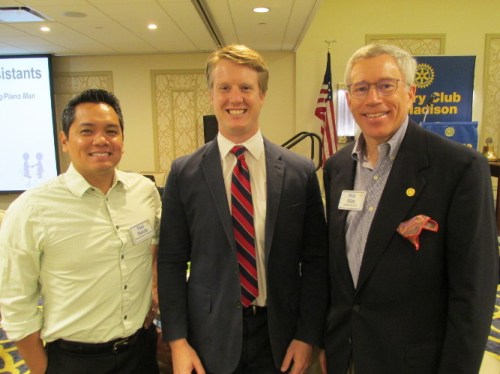
From left: Paul Ranola, Luke Fuszard and Rick Kiley

Luke Fuszard spoke to us this week on the decline of civics education, which he says places democracy at risk. Luke is a software engineer and has an MBA.  No civics background. But he does have two children, and he is concerned about the decline in civics education.

In 1954 Kentucky required three years of history and civics, and students had to pass a very tough statewide exam. Only nine states today require any such education, and Wisconsin is not one of them. The result is a predictable widespread ignorance. Ninety-seven percent of immigrants taking the [relatively easy] citizenship exam pass it. Thirty-three percent of native citizens who take the same test fail it. For most of American history, it was generally believed that solid civics and history knowledge was needed for people to be good citizens. That seems no longer to be the case.

Two occasions seem to have sped this decline in interest: (1) Sputnik in 1957; (2) the 1983 report, “A Nation at Risk.” Both incentivized the teaching of math and science, and as these expanded, history and civics courses were reduced. Middleton and Wausau still have robust civics programs. Wisconsin has recently adopted a statewide civics exam, but it is online and can be taken multiple times. And in 2012, all federal funds were shifted away from civics or history to math and science.

Why are civics and history important? Many math majors will never be mathematicians. Many science majors will never be scientists. But everyone will eventually be a member of the body politic. Since 1776, hundreds of thousands of people have given their lives in defense of our freedom and our democracy. The least we can do is to lobby our legislators to support civics education. Much civic behavior is learned in childhood: We should pass on to our children our belief in the importance of being an educated citizen, able to make informed political decisions.

Our thanks to Wisconsin Eye for videotaping our meeting this week.  You can watch the video here.

An Update on Stretch Targets for Wisconsin

submitted by Rich Leffler; photo by John Bonsett-Veal

IMG_9701

Dave Baskerville and Club President Donna Hurd

Fellow Rotarian Dave Baskerville spoke to Rotarians and guests about “Stretch Targets for Wisconsin,” an effort he heads dedicated to the proposition that this state can do much better economically than it has for the past forty years. It must set targets for ten years ahead and work to achieve them, just as new or struggling businesses do. Dave emphasized two areas: The economy and education. First he compared trends in Wisconsin to what has been happening in Minnesota. Thirty-eight years ago, the two states were virtually equivalent economically. In the years since, Minnesota has done far better in various important economic statistics, especially job growth and average wage growth. One difficulty, as both Dave and questioner Marv Levy pointed out, is that Wisconsin has had a hard time retaining its formerly great businesses, either because they relocate or the industry atrophies; and, as Dave indicated, Wisconsin has done a poor job of attracting new ones.

Education is an important element in this story. In math, science, and reading, the U.S. ranks 36th among the nations of the world; Wisconsin is better, but can do better. A goal would be to equal such national performers as Singapore, Japan, or Canada by 2038. Dave argued that it can be done, just as nations have arisen from destructive wars to become leaders. In 1993, Massachusetts and Wisconsin were about equal in achievement rates. Now, Massachusetts is in the top ten. It succeeded by establishing rigorous goals for teachers and students. Today, the poor in Massachusetts have the highest wages in the country. There are several schools in Milwaukee that have demonstrated great success despite the prevailing poverty of its children, including one high school that was rated the best in the country by US News.

Success in these Stretch goals can lead to progress in job skills, social mobility and justice, and national security. Wisconsin has great resources and people, and these have to be mobilized. The state’s white high school students currently rank 41st in reading, and its black students rate 49th. The state ranks 40th in average wages. But just as Vince Lombardi transformed the lowly 1958 Packers into the powerhouse teams of the 1960s, Wisconsin can achieve great things by setting goals and working to meet them.

Our thanks to WisconsinEye for videotaping our meeting this week, and you can watch the video here.