
Category Archives: Rotary Club of Madison

Can Wisconsin Transform the Lives of Black Women and Their Families?

submitted by Emily Gruenewald
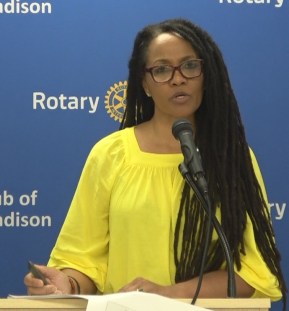
Lisa Peyton Caire 8 5 2020Lisa Peyton-Caire is the Founding CEO and President of The Foundation for Black Women’s Wellness (FFBWW), a Wisconsin based organization committed to eliminating health disparities and other barriers impacting Black women, their families and communities.

When Lisa’s mother passed away from heart disease in 2006 at the age of 64, she reflected on the number of black women in her life who had died in middle age. She realized her mother’s death wasn’t an anomaly and began researching the broader influences on Black women’s health. Since forming FWBBW in 2012, the Foundation now serves over 5,000 women and girls each year through direct health education, wellness programming, leadership development and advocacy while mobilizing women and community partners to be change agents in advancing health equity.

Wisconsin is number one in the nation for: racial inequities, economic inequities, health disparities, birth disparities, educational disparities, Black child poverty and over-incarceration. These disparities and inequities create a constant stress on daily life that negatively impacts overall health and wellness for Black women and their families. Lisa encourages us to read the “Saving Our Babies Report” (http://ffbww.org/savingourbabies/) to understand the significant health crisis Black women and children face in Dane County, and the initiatives to advance maternal, child and family wellbeing.

When asked what we can do to help transform the systems impacting Black women’s health to take Wisconsin from being the worst place to raise a Black child to one of the best, Lisa said, “Don’t assume you have the answers.”  She encourages us to, “Go directly to those who are impacted and ask, ‘What do you need to build the infrastructure to make these changes?’” Call FFBWW to start a conversation to learn more deeply about the issues. Become an advocate in your network and support initiatives that will transform Wisconsin into a leader in health equality.

If you missed our meeting this week, you can watch it here: https://youtu.be/PazT9BZNoKc.

The Future of Restaurants – A Challenge

submitted by Linn Roth

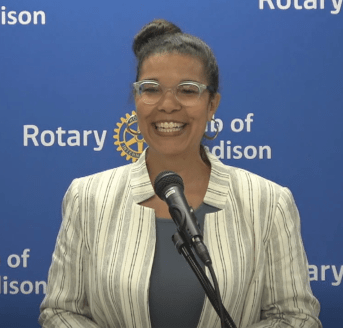
Greg Frank 7 29 20Greg Frank, a co-owner of the Food Fight Restaurant Group in Madison and current Treasurer of our club, gave an overview of the history of restaurants, their current status and future challenges facing the industry during these uncertain Covid-times.  Most recognize that the restaurant business can be quite difficult, and operations must survive on very low margins, typically less than 5%.  Nevertheless, restaurants are an integral part of virtually every community, and have been so since the late 18th century when the first restaurant opened in France.  The first American restaurant established, Delmonico’s in New York City, was established in 1830, and restaurants throughout the world have evolved in a variety of formats over the years.
Since 1970, restaurant sales in the US have grown from $43 billion to approximately $900 billion, with over 17 million employees working in the industry.  However, that was before the Covid crisis struck and severely impacted virtually all types of restaurants.   The situation in Madison is no different than any other area in the country.  Restaurants are struggling to change their business models and survive until the crisis has ended.   Unfortunately, lay-offs have been rampant, and other common changes include a focus on delivery and curb-side pickup, as well as outside dining whenever possible.

Regardless of when the health crisis ends, it seems likely that restaurants will be making a considerable number of changes to survive and prosper in the future, and Greg touched on several of these that we could expect to see.  For example, establishments might become smaller to reduce capital costs, incorporate new technologies (e.g. wireless links and digital menus) to improve efficiency, offer limited gourmet dining, provide prepackaged meals and drive-through pickup, and even use “ghost kitchens” that provide food to a number of establishments utilizing a single, centralized kitchen.

Certainly this industry will change significantly over the near and longer-term future, but it behooves all of us to support our local restaurants in order to enable this essential component of our community to evolve and prosper.

If you missed our meeting this week, you can watch it here: https://youtu.be/dD1t2pI3MuY.

Racial Justice: Then, Now and Forward

submitted by Valerie Renk

Annette Miller 7 15 20Rotarians were challenged July 15 by Annette Miller to be part of the equity solution.

“We have historically denied racism existed and that we were personally accountable,” Miller said. “But we have the capacity to learn and now unlearn racist behavior.  People may doubt what you say but they will always believe what you do.

Miller suggested we think about what is the work for you? What do you need to learn to unlearn old habits?  How do we deconstruct old systems based on people’s looks or zip codes whether they rent for example?  We can grow together without the lens of racism.

What can Rotary do?  “Look to the four-way test,” Miller outlines:

  1. Truth: Are we offering all truths? The truth is when white people call the police they respond. When people of color interact with police, outcomes are not always good.
  2. What’s the difference between fair and equitable? Fair is everyone getting the same. Equitable means offering what they need.
  3. Push yourself to meet new types of people, learn their stories. Move from fear zone to learning zone such as how the GI Bill benefited 8 million primarily white veterans with education, unemployment insurance and housing but didn’t benefit millions of veterans of color. Redlining is another devastating disparity example.
  4. Be prepared to be in the growth zone; it’s ok to make mistakes as long as you try. Use your influence at work, Rotary, with family…especially your kids…to find out what they know and how we can be better.

“We are all in this together,” Miller closed with.

Miller lives in Madison with life partner, Mike, and their three children. Annette launched EQT By Design focusing on developing diverse, inclusive, sustainable strategies in public engagement, equitable community development projects and organizational cultural change management. Annette obtained her BA from UW-Madison in 1992, and MS in 2017 from Edgewood College.

Our thanks to Annette Miller for her presentation this week and to Valerie Renk for preparing this review article.  If you missed our meeting this week, you can watch it here:  https://youtu.be/eV–yUaCnLg

  Here is a link to key slides from Annette’s presentation:  https://drive.google.com/file/d/1ChdhqYzOfeyquRXgqBbjs7ZUUGlCNinF/view?usp=sharing and a link to additional resources:  https://docs.google.com/document/d/1ygjl79fR3PN99MROmCWCSyO_UtDJ7MSOOiF5Wbawu5E/edit.

Andrea Kaminski’s Reflections on Year as Rotary President

Kaminski Picture1The past year has been a whirlwind of challenge and of change, starting with my unexpected appointment as club President and ending with our Rotary Club poised to transition back to in-person meetings as the pandemic continues. It has been my honor to be club President through this time. I’ve had the opportunity to experience firsthand our Rotary Club as a place where members CONNECT, SERVE and GROW.
Since I joined Rotary in 2013, I have valued the many new CONNECTIONS and friendships that have enhanced my life, whether through committee work, the hiking/skiing fellowship, community service projects, or my time on the board and as President. I’ve found that the more engaged I’ve been, and the more people I’ve worked, sung, chatted and laughed with, the more I’ve been able to learn and grow.

In my SERVICE to the club, I’ve learned that in Rotary you never have to meet a new challenge alone. As soon as I became President, several Past Presidents stepped up and offered their support. I would have been lost without the assistance, in particular, of Jason Beren and Pat Jenkins. And I want to give a special shout-out to Stacy Nemeth for setting the stage for this Rotary year through her diligent strategic planning work last year as President-Elect. Club service is a great way to get to know people and to help make our club a better place for a diversity of community leaders to connect, serve and grow.

I have GROWN through Rotary, especially in this past year. Here are some things I had to learn as President:

  • I’ve learned that you need to hit the wider bottom part of the Rotary bell, not the narrow top part, if you want people to hear it. Not a big deal — it was just embarrassing!
  • I’ve learned there are two strong stances represented in our club membership regarding singing at Rotary. I became President just when it was decided to try cutting back on our music. I hope we have arrived at a compromise that all members enjoy.
  • The same goes for the Question & Answer periods with our speakers. That was a hot topic last summer, but I hope members are comfortable with our current approach.
  • I’ve learned some technology, in particular how to pre-record my portion of the weekly meetings, so we could continue to meet online through the pandemic. Brian Basken and Jason Beren have done yeoman’s work to develop the technology needed to uphold the professional standards our weekly meetings are known for. This month Brian and Jason moved to live-streaming the meeting from Pearson Engineering, where they work. Next month we plan to live-stream our meetings with a limited number of members attending in person, abiding by good social distancing, while all others may participate from home.
  • I’ve also learned from Teresa Holmes, Charles Tubbs and others about complex racial justice issues facing our community. I’ve learned from Karen Kendrick-Hands and Larry Hands about environmental sustainability. These are important issues we must address, and I value the opportunity to connect with people who know far more than I do.

Going forward, I believe the most important goal for our Rotary Club is that of striving to be more actively welcoming to all leaders in our community. In a few minutes you’ll hear from the Racial Equity and Inclusion committee that our intentional efforts in that area are working.  To continue that progress, we need to accept that what has been comfortable in the past is not — and was not — comfortable for everyone. Good intentions are not enough. I’ve learned that we need to actively educate ourselves and speak out when we see injustice or hate. For white Rotarians like me who have benefited all our lives from the privilege of our race, this requires some humility to understand that there is a lot we don’t understand. The hard work is still ahead of us, and it’s good that we’ll have the steady leadership and vision of Jorge Hidalgo and then Mark Moody in the years to come.

With intention, patience and kindness as we work toward change, we will come closer to the Rotary Four-Way Test and build a club that is fair, that builds goodwill and better friendships, and is beneficial to all concerned.  Thank you.

Wrapping Up Our Rotary Year – Virtually!

submitted by Ellsworth Brown

Thump5Well!  This was quite a meeting.

It was more of an elegant hand-off than the usual changing of the guard from President Andrea Kaminski to new President Jorge Hidalgo, featuring inspiring reports of accomplishments well-earned by the Club and well-directed by President Andrea.

But first . . . this recap only suggests the substance of the meeting, which was recorded and is available at https://youtu.be/MoH8PYLW__E.

President Andrea began with an uplifting recital of six new members and their credentials:  LaVar Charleston, U. W. Madison; Sara Eskrich, Democracy Found; Amy Griffin, Madison Museum of Contemporary Art; Rob Roquitte, eCIO, Inc; and Angela Trevino, UW Health and Clinics.  It was especially nice to see the swelling stream of welcoming messages in the presentation’s adjacent comments box.

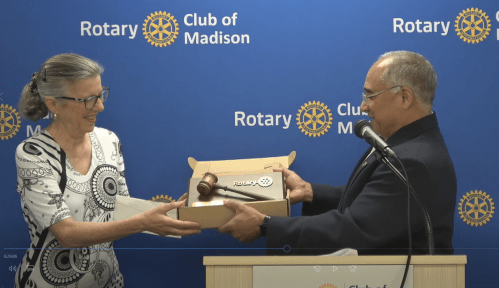
The second opening order of business was the presentation our Rotary Club’s International Service Award—pin and plaque—to Joyce Bromley for her engagement in international service projects of the club.  Congratulations, Joyce!

In her formal closing remarks, President Andrea recognized the continuing tech work of Brian Basken and Jason Beren, who silently present what we view each week.  She also listed a series of personal take-aways from her presidential year, among them “hit the bell at the bottom, not the top, to make it ring,” how to compromise on matters of music and program Q&A, how to master tech from home, and especially how much her presidential experience has given her joy and broad connections.

Many were thanked, reinforcing her primary revelation that willing help was always available.  Please read President Andrea’s remarks for a list of key people for the past year.

Also read Jorge’s remarks, which were constructive, thoughtful and clear.  They were preceded, direct from Florida, by unexpected comments and congratulations to the club’s first Latino President by former member Dora Zuniga, who asked Jorge to join the club six years ago.

President Jorge (sounds great, doesn’t it, Jorge?) introduced himself—born in the Dominican Republic, a West Point economics graduate who served in the Army for eleven years, a resident of New York City and now the well-known owner of an award-winning Honda Dealership.  Only President Jorge could make this list of achievements sound humble!  He pledged to try new things, further the consideration of large questions before us all now, ensure a wide variety of programs, and move through the coming year on the platform of respect for the individual.  This platform is linked to Jorge’s assertion that in addition to club members’ immediate work, we bring a vast array of additional experiences, knowledge and achievement that should also be shared.

Other reports included Mary Thompson’s PowerPoint presentation of our very important membership satisfaction survey; and Bog Sorge’s presentation of the membership development committee, which has introduced several new ideas and a comprehensive concept of how to gain new members from a position of strength (great video, Paul Ranola, who created the video, and you can view it at the same link above.

Of course, the meeting included the usual array of past presidents, pin presentations, and a very nice gift certificate to Andrea (sorry, no longer president . . . but “didn’t I see you on the Internet?”) for the Madison Museum of Contemporary Art store.

Oh, and Melanie Ramey spoke about things she has learned during the pandemic . . . NOW will you connect to the link above?

Well done, Andrea and Jorge!

Our thanks to past president Ellsworth Brown for preparing this review article and if you missed our meeting this week, you can watch the video here:  https://youtu.be/MoH8PYLW__E.

The Impact of the COVID-19 Pandemic on the 2020 Elections

submitted by Jessika Kasten

Michael WagnerThis week, UW-Madison School of Journalism Professor Michael Wagner spoke to the Downtown Rotarians on Pandemic Voting: Information, Geography and Polarization in the 2020 Elections. The J-School has done a lot of research on the impacts of media and voting and has tracked the polarization of Wisconsin voters since 1996. Since that time, we’ve seen a decline in local newspapers and local news reporting, a rise in talk radio and social media, as well as a stark rise in the amount of political advertising in our state. The School of Journalism has done a lot of research on the impact of changing information channels and has found that the broader your media diet, the more likely you are to vote outside of party lines. As an example, those who viewed a wide range of information sources were 50% more likely to split-ticket vote in an election (i.e., choose candidates from more than one party on the same ballot). Those who consumed a narrower range of media had nearly no likelihood of splitting a ticket.
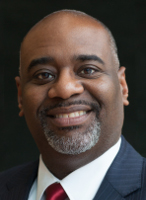
The researchers also wanted to compare whether Wisconsinites were move divided on politics from other swing states like North Carolina, Pennsylvania, Michigan and Ohio. The results were true that Wisconsinites’ attitudes around politics and social trust were more divided than other swing states. One researcher felt that those in rural and suburban areas of Wisconsin had long felt neglected and under-represented. Governor Walker’s campaign spoke to those people by denouncing Madison and Milwaukee influences, which could have had an impact in the attitudes of those outside the more metropolitan areas.

Ultimately, Professor Wagner summarized his talk by saying that Wisconsin remains divided due to partisanship, geography and the information we consume. He also made clear that these divides fracture our political and personal relationships in many cases. The good news is that a varied and wide media diet can influence these views and offer opportunities to work across party lines.

If you missed our meeting this week, you can watch the video here.