
submitted by Rich Leffler; photo by Pete Christianson
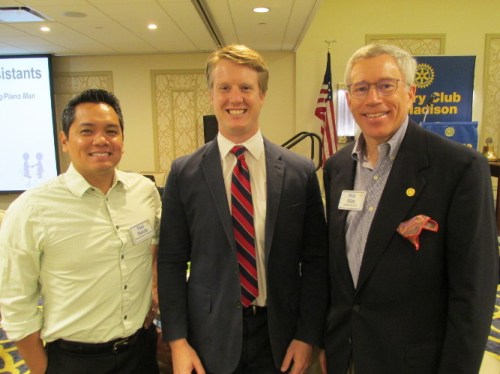
From left: Paul Ranola, Luke Fuszard and Rick Kiley
Luke Fuszard spoke to us this week on the decline of civics education, which he says places democracy at risk. Luke is a software engineer and has an MBA. No civics background. But he does have two children, and he is concerned about the decline in civics education.
In 1954 Kentucky required three years of history and civics, and students had to pass a very tough statewide exam. Only nine states today require any such education, and Wisconsin is not one of them. The result is a predictable widespread ignorance. Ninety-seven percent of immigrants taking the [relatively easy] citizenship exam pass it. Thirty-three percent of native citizens who take the same test fail it. For most of American history, it was generally believed that solid civics and history knowledge was needed for people to be good citizens. That seems no longer to be the case.
Two occasions seem to have sped this decline in interest: (1) Sputnik in 1957; (2) the 1983 report, “A Nation at Risk.” Both incentivized the teaching of math and science, and as these expanded, history and civics courses were reduced. Middleton and Wausau still have robust civics programs. Wisconsin has recently adopted a statewide civics exam, but it is online and can be taken multiple times. And in 2012, all federal funds were shifted away from civics or history to math and science.
Why are civics and history important? Many math majors will never be mathematicians. Many science majors will never be scientists. But everyone will eventually be a member of the body politic. Since 1776, hundreds of thousands of people have given their lives in defense of our freedom and our democracy. The least we can do is to lobby our legislators to support civics education. Much civic behavior is learned in childhood: We should pass on to our children our belief in the importance of being an educated citizen, able to make informed political decisions.
Our thanks to Wisconsin Eye for videotaping our meeting this week. You can watch the video here.
 What will it take for Wisconsin to win the battle for economic growth fueled by entrepreneurship? Rotarians and their many guests left the Wednesday lunch with some specific ideas presented by Kevin Conroy, Chairman and CEO of Exact Science.


 Interviewed club members declared they knew their oath verbatim. Yet it was admitted that even longtime members might still need an occasional prompt to assure they didn’t stumble. For example, Boris Frank could not easily repeat the test by heart, but he pointed out the truth–that words were being held up, off camera, for his reference.

 Other parts of the property belong to the Wisconsin Department of Natural Resources and the USDA Dairy Forage Research Center. Meine took us to sites on the DNR land, where there is public access. Volunteers have put in trails, and they are working on prairie restoration. One section is a beautiful hillside of lightly forested grassland. Meine said it took 15-20 volunteers, mostly working with hand tools, about three hours to beat back the thicket of invasive shrubs to expose this native Wisconsin oak savanna.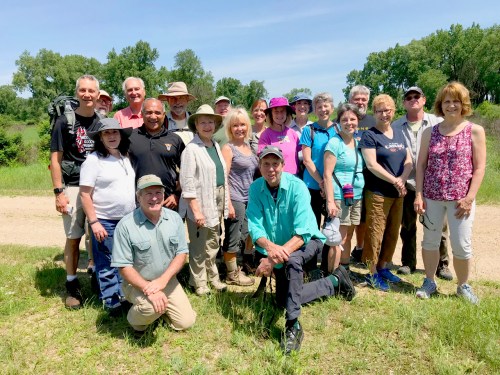






 Rotary Club of Madison, Wisconsin