
–submitted by Dave Mollenhoff; photo by Valerie Johnson
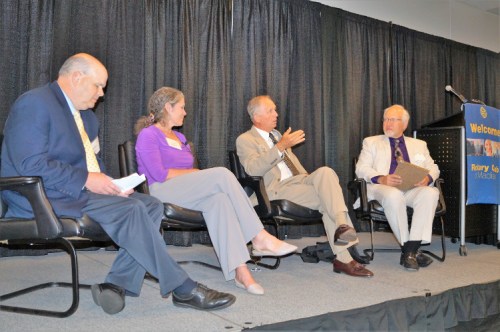
[Pictured here from left: Mike Barry, Natalie Erdman, Dan Thompson and Steve Walters]
Few Wisconsin voters understand what tax incremental financing (TIF) is, but since its introduction in 1975, it has proved to be one of the most powerful and effective urban development tools in Wisconsin’s history. On Wednesday members were privileged to hear a panel explain this poorly understood topic. Speakers were: Dan Thompson, former executive director of the Wisconsin League of Municipalities; Natalie Erdman, Director of the Madison Department of Planning, Community and Economic Development; and Mike Barry, Assistant Superintendent for Business Services for the Madison Metropolitan School District. The panel was artfully moderated by Steve Walters, with WisconsinEye.
Thompson reminded the audience that by the 1970s the suburbanization of homes and factories left huge swatches of once valuable central city land vacant and blighted. City leaders sought financial incentives to revitalize downtowns and closed-in neighborhoods. This was why Governor Patrick Lucey encouraged the legislature to approve a TIF law for Wisconsin.
Erdman explained how the law works by using Tax Incremental District #36, known as the Capital East District. She noted how this sprawling area along East Washington Avenue from Blair Street to the Yahara River, long known for its car dealerships, had great potential. However, developers could not undertake projects there because squishy soil required expensive foundations and contamination from old factories had to be remediated. When the City created TID 36 its real estate was assessed at $75 million.
To realize the district’s extraordinary potential, the City developed a comprehensive plan. Projects included expensive high-rise mixed use projects such as The Constellation and the Galaxie, the renovation of Breese Stevens Field, street improvements, and Central Park refinements.
By 2015 assessed values of land and improvements in TID 36 had soared to $132 million and many more large projects are about to break ground and are being planned. This huge increase in real estate values caused an additional $1.5 million to flow into the city treasury every year. Under tax incremental financing these increased taxes are used to pay back the City’s front-end development costs.
During the district’s life—typically about 13 years in Madison—taxes continue to get collected and distributed to all taxing jurisdictions, but at level of the district before redevelopment. Then when the district is terminated, all taxing jurisdictions start getting the bonus taxes created by the increased values.
Barry explained how school districts and cities work together to enjoy the increases in real estate taxes generated by tax incremental districts.
“Thank God for tax incremental districts,” exclaimed Rotarian Bob Miller who is also mayor of the city of Monona. “Without it we would be in a sorry state.” Miller explained how his suburb was able to use TIF to do a $20 million upgrade to Monona Avenue.
Special appreciation goes to Carol Toussaint and Roth Judd for fomenting and producing this exceptionally informative program.
For more information on TIF visit this link: https://www.revenue.wi.gov/slf/tif.html
Our thanks to Michael Barry, Natalie Erdman and Dan Thompson for serving on this TIF panel with Steve Walters of WisconsinEye moderating. We also thank Dave Mollenhoff for preparing this review article and WisconsinEye for videotaping. CLICK to watch the video.
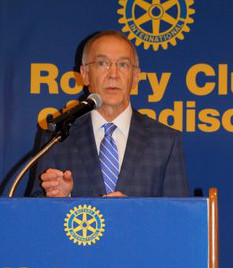 Dr. Edward Coffey, President & CEO of the Menninger Clinic, as well as Professor of Psychiatry, Behavioral Sciences & Neurology at Baylor College of Medicine, was in Madison June 7-8 for a collaborative meeting of 150 health and other community organizations to discuss treatment of depression and the goal of zero suicide. He spoke at our meeting of June 8th about his work in this field.
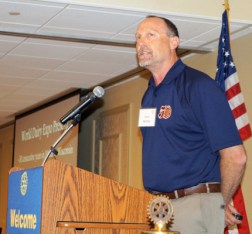 If you consider Wisconsin’s $44 billion dairy business to be all about big business, you might be surprised to find out that 96 percent of all of Wisconsin’s dairy farms are actually family-owned.
 At our April 27 meeting, Dr. Noelle LoConte of the UW gave us some frightening, but also some hopeful information and a call to action during a presentation entitled Pancreatic Cancer Research: A Medical Oncology Perspective. As many know, often because of personal experience, pancreatic cancer is a particularly virulent disease, with a five year survival rate of less than 5%. With the exception of a rising incidence in the African American population, the incidence of this disease has remained relatively stable in our population. Nevertheless, pancreatic cancer is expected to be the second most common cause of cancer mortality by 2020. These numbers reflect the fact that there is no current method to screen for pancreatic cancer, and therefore, patients are typically diagnosed well into the disease process, when it is too late for effective surgical or drug intervention. In addition, the risk factors are not well established, although age is clearly the most important factor, with smoking, heavy alcohol consumption, and other contributors playing a role.
 Kathy Cramer is not your typical ivory tower professor. Instead of conducting research in libraries, she drives to small towns far from Madison and Milwaukee. She finds out where people meet for coffee—café’s, gas stations, and stores—and then just shows up. “Hi, I’m Kathy Cramer, I’m a professor from Madison and I study public opinion. May I join you?” Almost everyone she met during her impromptu visits were gracious, she told Rotarians on Wednesday. Then she passed out her business card—she’s a professor in the Department of Political Science—and got permission to turn on her recorder. “What issues concern you?” she asked. What she heard surprised her.

 Rotary Club of Madison, Wisconsin