
–submitted by Sharyn Alden; photos by Donna Beestman
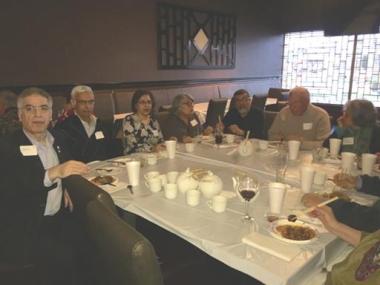 On April 7 the Cultural Awareness Fellowship Group met at VIP Asian Cuisine on Madison’s West side for a lively evening starting with a buffet dinner featuring several different dishes of Asian cuisine. Following a dessert of various ice cream choices ala Asian-style (this Rotarian sampled a delicious rendition of green tea ice cream), we pulled up chairs to enjoy an enlightening presentation about Chinese culture, Feng Shui and Chinese brush painting from Wei Dong, UW-Madison professor, artist and designer.
Professor Dong, who has been in the U.S. for 30 years and became a Professor a UW-Madison in 2000, heads the Design Studies Department of the School of Human Ecology. Within the first 2 weeks of being in the Midwest he visited Frank Lloyd’s masterpiece, Fallingwater” in Mill Run, Pennsylvania. He gravitated to the Midwest, and especially Madison because of his strong interest in the design elements of the architects, I.M. Pei and Frank Lloyd Wright.
“I was greatly influenced by them in my constant search of learning how opposite elements connect in combination with balance, nature and harmony,” Professor Dong said. “Everything has two opposites,” he said. “I look at everything this way –how elements construct and deconstruct each other. This is a philosophical life approach.”
He continued his presentation by talking about the concept of opposites in ying and yang the affect it has in Feng Shui. Summing up the complexity of invisible energy and balance, he said, “You can teach Feng Shui in 5 minutes but it takes 50 years to practice.”
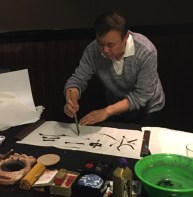 The piece de resistance of the evening came next. Professor Dong demonstated how he paints using more than one piece of rice paper layered on top of each other. This approach leaves much to the imagination on the back of the first sheet of paper as well as other layers. “Why draw everything?” he asked. “The Western way of drawing is more focused than Chinese art,” he noted. He showed that with examples of the same scene drawn from both the Chinese and western approach.
He added that drawing on both sides of the paper is the ying and yang approach. Then he provided examples of how Chinese paintings allow for spaces between various design elements instead of focuses on every detail. The point, he said is to intrigue the imagination.
For those who have not discovered the beauty of Professor Dong’s inspirational art, you can experience it at the Madison Museum of Contemporary Art (MMOCA) during a one-of-a-kind design showcase April 30-May 8 featuring a collection of exciting work from top designers. The exhibit is free and open to the public.
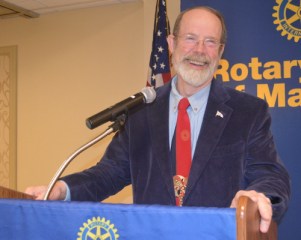 We Madisonians love our lakes, but often know little about them. Don Sanford, long time Lake Mendota sailor and iceboater, described to downtown Rotarians this week how he set out to correct that situation 11 years ago as he began to research On Fourth Lake: A Social History of Lake Mendota.
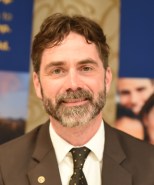 At our March 30 meeting, our very own Rotarian, Jeff Burkhart, described for us the scope of The Literacy Network of Dane County where he is the executive director. With 900 volunteers providing over 30,000 hours of help each year to those with impaired literacy skills at 28 locations in Dane county, the literacy network reaches out to the 55,000 with impaired literacy in the county.
 This week’s Rotary program featured State Supreme Court candidates, Justice Rebecca Bradley and Judge JoAnne Kloppenburg. Rotary Club of Madison partnered with WisconsinEye to produce this forum. WisconsinEye reporter Steve Walters moderated the forum and the broadcast was livestreamed to WisconsinEye viewers using computers or mobile devices.
 Rotarians heard from David M. Gamm, Associate Professor of Ophthalmology and Visual Sciences at the University of Wisconsin–Madison, how new research in gene and stem cell based therapies are helping cure blindness.

 Rotary Club of Madison, Wisconsin