Category Archives: Rotary Club of Madison

Wine Fellowship Event March 7

–submitted by Mike Wilson

Table Wine 6   Table Wine 7  Table Wine 8

On the 7th of March The Downtown Rotary Club Wine fellowship visited Table Wine, a new wine bar and wine shop that specializes in wines of modest cost.  The Fellowship was introduced to the Wine Table through Cheryl Wittke, and a wonderful event was held.

Table Wine 5

Joy Gander & Cheryl Wittke

Seventeen Wine Fellowshippers met at 6:30 pm, and we had a Floral and Spicy Wine Tasting. The theme is interesting, and similar to the oldworld/newworld concept.  The wines were certainly spicy or floral, and were excellent.

Five wines were rated by me as particularly good, and these were the five best by the group as a whole.  In the Spicy White group the Elena Walch Italian Gurwurtztraminer (2013 @ $19.99) and Matchbook “The Arsonist” Chardonnay were equally adored by the Fellowship (2013 @$21.99), while in the other three categories there were “Clear Winners” receiving >70% of the vote as the best of the group classification.

The individual group “winners” were Le Masciare Fiano de Avellino 2013 @ $16.99 (Floral White), a Shotfire Shiraz (therefore Australian) Spicy Red 2013 @ $19.99, and Luzon Altos de luzon 2010 Spanish blend (Monastrell, Tempranillo and Cab. Sauv. 50/25/25 blend) as the Floral Red.  Each of these wines were clearly the most preferred wines in these categories.

Table Wine1  Table Wine 3  Table Wine 4

Photo 1: Ben Hebebrand & Joy Dawson; Photo 2: Candace & Mark Moody; Photo 3: Steve & Meryl Mixtacki

So if anyone wants to try good reasonably priced wines, consider these wines available at Table Wine.  All in all, a wonderful time was had by all with great wines tasted. Thank you very much Molly Moran, owner of Table Wine (2045 Attwood Avenue).

Seventh Generation Land Ethics

–submitted by Stan Inhorn; photo by Karl Wellensiek

Patty Loew

Past President Tim Stadelman and Patty Loew

Patty Loew, an Ojibwe scholar and UW Professor, described insights developed over many years of study of Native practices and beliefs regarding the land on which they live. These insights are common to members from all 12 Wisconsin Native nations. The unifying theme of land stewardship is that there is a spiritual connection with the land, the waters, the animals and the plants. They live close to the land, so they can be the first to recognize changes resulting from human practices and industry.

Christians, Moslems and Jews regard holy places such as churches as sacred, but they also have portable holy items such the Rosary or the Star of David. These followers of the Abrahamic religions have a disconnect in identifying certain bodies of water or wild rice as being sacred. The  entire society of the Ojibwe and Menomonee nations recognize that wild rice lasts forever and is therefore a super food when other sources are not available. In essence, Native peoples pray for sacred spaces that are necessary for assuring the continuation of life on earth.

When Europeans landed in America, it was necessary for treaties to be negotiated in order to preserve the right to hunt and fish. Restricted to Reservations of limited acreage, Natives knew that the Reservation would not sustain the people, so that hunting and fishing outside the boundaries would  be required. In recent years, other more dangerous intrusions have threatened the Natives existence. One example is the proposal for large open-pit taconite mines. The processing of this low-grade iron ore would result in sulfuric acid flowing into wild rice fields and potentially even into Lake Superior. The long-range vision of the Native religion considers how any decision would affect the seventh generation in the future.

The Ho-Chunk Nation in particular is concerned that Frac-Sand Mining is contaminating the air, the land and the water — all of which are considered sacred sites. Lung disease has been attributed to this form of mining. The Red Cliff Ojibwe are concerned that large industrial animal installations possess a real threat of manure contamination of land and streams.  The latest proposed legislation dealing with commercial land development that disturbs the Ho-Chunk nation regards the authority to excavate sacred burial mounds to determine if human skeletons are truly present. Unless one recognizes the religious beliefs and ethics of Native Americans, one cannot appreciate their viewpoint in opposing legislation that affects not only their interests but the welfare of the environment that includes all of us.

If you missed our meeting this week, you can watch the video here.

The Athletic Training Students for Brain Safety

–submitted by Andrea Kaminski; photo by Stacy Nemeth
Winterstein

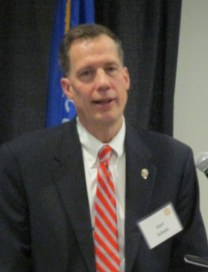
From left: Emily Campbell, Erin McQuillan, Bailey Lanser, Andrew Winterstein and Club President Ellsworth Brown

Dr. Andrew Winterstein, director of the UW Athletic Training Education program and clinical professor of Kinesiology at UW-Madison, brought three student leaders to speak to Rotary about their work to raise awareness about brain injuries.

The Athletic Training Program prepares students for careers in athletic training. According to Winterstein, these students go on to work not only for athletic teams, but also health providers, industrial workplaces, schools and other settings. He showed a video in which students and faculty of this well-rated program lauded its small class sizes, high quality of instructors, practical clinical learning opportunities, top notch professors and strong science foundation.

Winterstein called injury “the unwelcome houseguest of physical activity.” Injury is inevitable, and it is a public health issue. It is important to consider the true cost of injury, he said. For example, what are the consequences at age 50 of having sustained an ankle injury at age 20? Ankle sprains are the most common musculoskeletal injury, and they are linked with an increased risk of osteoarthritis, a decreased level of physical activity and a lower overall quality of life. Winterstein noted that one million adolescent athletes suffer ankle injuries annually in basketball alone, with an estimated $2 billion in total costs.

Winterstein stressed that ankle injuries are preventable with exercises and the use of braces, yet many Wisconsin high school coaches are not aware of how to apply these resources. It is critical to get information to high school coaches and others.

Sports-related concussions have been a hot topic in the news recently because of some high-profile NFL cases and a link with traumatic encephalopathy. Winterstein notes there are an estimated 300,000 sports-related concussions in high school boys and girls annually in the United States. The majority are in football, but they also occur in other sports. Winterstein called for more research to better understand the causes and impact of concussions.

Winterstein then introduced three students who are active in Athletic Training Students for Brain Safety (ATSBS), a campus group that educates the UW campus and Madison communities on the short-term and long-term consequences of brain injuries including concussions. Formed in 2012 the group focuses on prevention, recognition and management of brain injuries.   Emily Campbell, Bailey Lanser and Erin McQuillan described recent accomplishments of the ATSBS group:

  • Applied for and received a Baldwin Grant to promote a statewide network of campus-based chapters;
  • Created and installed Renny’s Corner, an informational station at Wisconsin Institutes for Discovery;
  • Made presentations to high school anatomy and health science classes to inform students about brain injuries and promote Athletic Training as a career;
  • Held Children’s Safety Night at Wisconsin Institutes for Discovery to inform children and parents about the signs and symptoms of head injury and concussion, as well as how to prevent them.
  • Held a Brain Safety Symposium which featured distinguished speakers – some of them alumni of the program – from Madison and beyond.

The group is talking to campus groups interested in creating chapters at Concordia University, Marquette University and the UW campuses in Eau Claire, La Crosse and Stevens Point. They hope eventually to make ATSBS a regional presence at campuses around the Midwest.

Did you miss our meeting this week?  CLICK to watch the video.

Freedom of Speech and Faculty Tenure

–submitted by Bill Haight; photo by Stacy Nemeth

Donald Downs (2)Academic freedom of speech, which dates to the time of Socrates, and faculty tenure, which is about 500 years old, were the subjects of UW-Madison Professor Donald Downs.

A couple of the basic changes in tenure that have occurred recently in Wisconsin include:

  • Faculty dismissal is allowed beyond the original criteria of either “just cause” or critical financial cuts. Now other factors such as “program changes” can be considered which gives broader ability to dismiss, and could be misused, according to Downs.
  • Shared governance of faculty, staff, and students has been demoted to more of an advisory role rather than a co-governance role with the administration.

A practical concern is that weakening of tenure policies at the UW puts the institution at a competitive disadvantage with other universities trying to attract quality faculty.

Tenure protection for faculty is a means to an end, the end being academic freedom, according to Downs.

Academic freedom, is defined by the famous statement adopted by the UW Board of Regents in 1894: “Whatever may be the limitations which trammel inquiry elsewhere, we believe that the great state University of Wisconsin should ever encourage that continual and fearless sifting and winnowing by which alone the truth can be found.”

Academic freedom and tenure, it is believed, is essential to the central mission of the University, which is pursuing truth, teaching and pushing the frontiers of knowledge.

A long-standing social contract allows academic freedom to take place with priority over politics, ideology, fashion or other social pressures. This does not allow, however, creation of absolute dogma or indoctrination. Defining what is not within that social contract is not always easy.

In the 1980’s many universities enacted policies against offensive speech by faculty or students. But in practice, these chilled intellectual honesty.

Downs related incidents of extreme speech codes, such as one from an eastern institution that prohibited “inappropriate laughter.” “Is anyone clairvoyant enough to be able to tell when laughter turns ‘inappropriate’?” asked Downs. Another policy urged campus members to report “discomforting” speech. “Isn’t much of learning somewhat discomforting?” asked Downs.

CLICK to watch the video.

What is the Value of a Liberal Arts Education?

–submitted by Andrea Kaminski; photo by Stacy Nemeth

Scholz KarlIn a lively presentation, UW-Madison College of Letters & Science Dean John Karl Scholz made the case for a liberal arts education, especially when it comes from UW-Madison. However, he stressed that the University needs the input of employers and alumni to make it happen.

According to the Bureau of Labor Statistics, the average weekly earnings of people with less than a four-year degree dropped between 1979 and 2014, while those of people with a bachelor’s degree or higher rose 14.1 percent. Scholz was proud to report that the median student graduating from UW-Madison has no student debt. The almost 50 percent who do have student loans graduate with an average of $27,000 in debt. While that can be a significant factor in a new graduate’s life for several years, Scholz (an economist) compared it to an average return on investment of $500,000 to $1 million in additional earnings over a lifetime.

There are 35 departments in the College of Arts & Letters, encompassing the physical sciences, social sciences and humanities. The College offers nearly 60 percent of all credit hours at UW-Madison, according to Scholz. He noted that employers are looking for the skills and qualities that students gain in the College: a broad knowledge base, problem-solving skills, communication skills, especially writing, and critical thinking.

A recent survey of alumni who are one year out of college, or eight to ten years out, found that in general they have been successful in getting jobs. Their earnings are good, and 90 percent said they use their liberal arts education in their professional work. Scholz highlighted two recent graduates who have excelled: one becoming a Rhodes Scholar and the other a Marshall Scholar.

Outstanding research in Letters & Science includes the discovery of a new species of humans in our evolutionary history, and research projects examining the origins of the universe and international humanities. Scholz also noted that the UW Geology Museum is a gem which is visited by more than 50,000 school children per year.

Metrics for student success are good, including an average time-to-degree completion rate of 4.13 years and a 95.8 percent retention of freshmen. UW-Madison is rated ninth in the nation for best value for students.

But academic triumph has to be matched with cultivation of job and life skills in order to make students successful in their careers, particularly for first generation college students. That is why the College has launched the Letters & Science Career Initiative, which applies dedicated faculty and staff to work with alumni, employers and students. A new course for sophomores will help them reflect on their skills, define their aspirations and build on their strengths. Students will learn how to write a top-notch resume and build a professional network.

Another program, Career Kickstart, will create an immersive, residential learning community for 600 sophomores, with onsite academic advising and mentoring.

Scholz noted that no one is in a better position to help students build their professional network and succeed in a career than past graduates of UW-Madison who have done just that.  Alumni will be active in mentoring, doing informational interviews and offering internships. Scholz envisions that, through outreach and partnerships with employers, there will be more opportunities for students. UW Letters & Sciences seeks to be a “go-to place” for talent in the job marketplace.

Scholz was asked what we, as Rotarians, can do to help, and he asked us to help project the University’s success story throughout the state and beyond. He noted that state legislators will take note if they hear positive news about the university from “unexpected sources,” i.e., not university administrators.

CLICK to watch the video on our YouTube channel.

Is Your Business Ready for the X’ers?

–submitted by Donna Hurd; photo by John Bonsett-Veal

Seeger Debbie

Debbie Seeger, (pictured here with club president Ellsworth Brown) in her presentation entitled “Shift Happens,” provided a futuristic view of the incoming workforce, the ensuing competition to attract and retain talent, and how to prepare for the inevitable.

By the numbers: Baby Boomers represent one of the largest generations in history (78 million) and we are aging.  The succeeding generation, Gen X, represents just over half of the baby boomer population.  Clearly, the laws of supply and demand indicate the supply of available workers will not sufficiently meet the potential demand of employers.  The repercussions of poor planning or absence of planning will prove detrimental to a business’s viability.  Defining the gaps in knowledge with the loss of boomers will be an integral part of assessing the needs of the business in its attempt to successfully move from one generation of workers to the next.

Technologically astute, this up and coming generation knows what they want and are not afraid to ask for it.  Unlike their predecessors, X’ers will continue to seek employment opportunities that align with the way they want to work and value their contributions.  Blind loyalty will not be afforded to businesses that have not done their homework.  Understanding what motivates this group is integral to drawing, engaging and retaining this talent.  Enticing this limited resource with money only will prove to be a losing strategy.  Emotional compensation (the feeling of being valued) has to be part of the package.  Determining the right blend of financial and emotional compensation will be a recipe for success for both employer and employee.

Aligning their mission, vision, and values with their recruitment, development and retention strategies businesses are sure to have an advantage over those that do not.  Trust is the foundation that will support the shifting paradigm in order to engender loyalty from the incoming talent pool.

CLICK to watch the video on our club’s YouTube channel.