Category Archives: Rotary Club of Madison

LARGE-IMPACT SERVICE PROJECT PROGRESS

LARGE-IMPACT SERVICE PROJECT PROGRESS
–submitted by Renee Moe, Chair of Large-Impact Service Project Task Force 

Five years ago, our Board of Directors charged the Club with identifying four areas of service. For the past two years, the Club has been engaged in planning and member engagement around our large-impact service project, including member surveys, visioning session, and other meetings.

Last year, our Service Committee Chairs cataloged our existing service into three areas: Basic Needs, Education and Mentoring and Civic Leadership. This year, the Club has embarked on identifying a large-impact service project utilizing additional member input and engagement.

The Board has asked an ad hoc large-impact service committee to make a recommendation for the June Board meeting, aligning around the charge: Rotary Club of Madison shall become a LEADER in building a strong, diverse but unified, and sustainable Madison community.

Through a series of meetings, the Equity Ad Hoc Committee made a project recommendation which focuses on adult employment and mentoring which was accepted by the Large Impact Project Ad Hoc Committee. The Committee would also like consideration of a youth/education/mentoring/internship component. Both will allow our Club to become a leader in building a strong, diverse but unified, and sustainable Madison community, AND provide many opportunities for a large number of Rotarians to be directly involved in service.

There are many details to be worked out, including defining scope and scale; communicating with and hearing from members to foster Club-wide engagement in the education/volunteerism/operations of the project; learning more about what is currently happening in the community in these areas; getting feedback from external stakeholder groups also working in these areas (so we can be complimentary and supportive of community-wide initiatives); identifying measures of success/timelines/committee support; and more.

This blog post is to update you and the larger community about our progress, and to thank you very much for your participation in our all-member surveys, many meetings, and Centennial vision session. We are making progress! There will be more opportunities to learn about and influence our large-impact service in the coming weeks and months! Thank you for your Service Above Self.


Bradley vs Daley

–submitted by Mark Stover;  photo by Mike Engelberger 

Bradley AW  Daley J

On April 7, Wisconsin will do what it has been doing since 1848: hold an election where the people of the state choose who will sit on the State Supreme Court.  This election is between James Daley of Janesville and Justice Ann Walsh Bradley of Wausau.  Justice Bradley is the incumbent and has been on the Supreme Court for 20 years.  Judge Daley, the challenger, has been a judge for 26 years.  Both are natives of Wisconsin.

Through a series of opening statements, structured questions, and closing statements, Rotary Club members got a chance to understand more about the positions of each of the candidates.  When asked what qualities distinguish each candidate, Judge Daley mentioned he was a Vietnam-era veteran.  He retired as a Brigadier General from the Wisconsin National Guard.  He helped start the first veterans’ court in the state.

Justice Bradley pointed to her dedication to protecting a fair and impartial judiciary.  She noted her concern that out of state money funding media supporting one candidate over another introduces a dangerous potential for questioning impartiality of the judiciary.  Justice Bradley suggested that what is needed most in a judge these days is the courage to act independently.

The candidates agreed with each other that transparency of process in the Court’s administrative hearings should increase making those hearings more open to the public.  They also opposed the idea of appointing Supreme Court Justices, each agreeing that the election process was the better route.  Justice Bradley believes the election system should continue to be improved to be the best it can be.  Judge Daley argued that elections should extend to the election of the Chief Justice by the other Justices.

In closing, Judge Daley said he was running because he was unhappy with the decisions made by Justice Bradley over the last 20 years.  He cited cases that he said put roadblocks in the way of law enforcement and made it harder to do business in the State of Wisconsin.  Justice Bradley argued that Chiefs of Police, Sheriffs, and District Attorneys support her because of her work in support of law enforcement.  She again raised her concerns about the apparently increasing partisanship on the Supreme Court and the effect it has on the perception of fairness and independence of the state’s highest court.

In the end, you and your friends, family and professional colleagues will have the final say – as Wisconsinites have been voicing since the state’s founding.  Please vote on April 7.

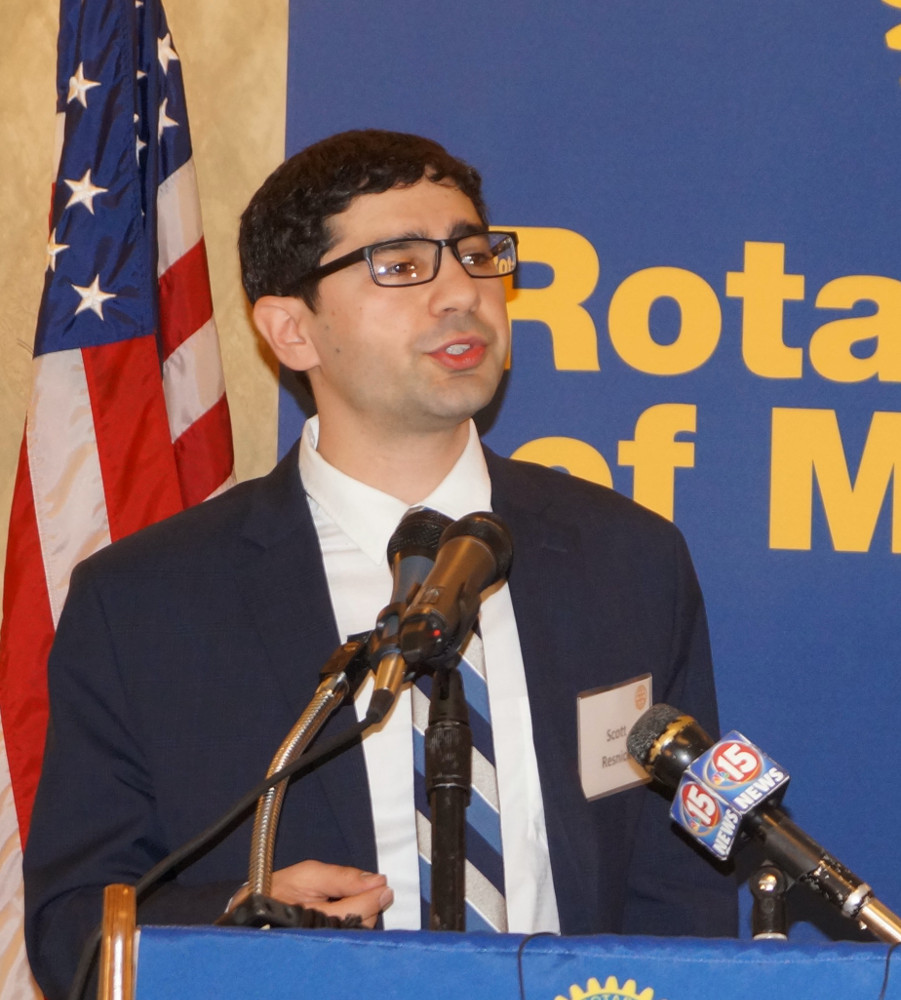
Soglin and Resnick Debate Madison Issues

–submitted by Kay Schwichtenberg; photos by Valerie Johnson

Soglin               Resnick

With the general election on April 7, the Rotary Club of Madison was given a special view of the candidates and the issues for the Madison mayoral election.  The format was a debate with each candidate given the topics when they arrived at the meeting.  Both candidates were given a question and time to respond.  Short rebuttals were allowed.

Paul Soglin is a longtime Madison resident and has served as mayor 1973-79, 1989-97 and 2011 to present.  He lives in the Hoyt Park neighborhood with his wife Sara, and has three daughters.

Scott Resnick is the COO and co-founder of Hardin Design and Development, and is serving his second term on Madison’s City Council, most recently serving as President Pro Tempore.  He lives downtown with his wife, Kelly.

Question 1: Madison is in the midst of a downtown building boom.  Are you concerned about the rapid increase in density? What about high-rise developments such as The Hub on Gilman and Frances Streets?  What about historic preservation?  How much is too much?

  • Soglin cited the tight housing vacancy rates that were driving up prices and sprawl from four years ago and said the new city plan addressed those issues and encouraged the construction that is currently underway. Preserving State Street’s image that Madisonians know, protecting historic districts and design are critical features of how Soglin said the city should manage its growth.
  • Resnick, who represents the campus district, wants to keep the downtown area vital and affordable for those who are starting careers and life in Madison. He promotes having a downtown area that is safe and welcoming to all.

Question 2: On one hand growth is the long-term lifeblood of any economy.  On the other hand, we hear of cities such as Austin, Texas, which looked a lot like Madison 40 years ago, that now wonder whether such substantial growth may have been a mistake.

  • Resnick said economic growth is about jobs. To get them, he believes the city needs to create an environment that encourages entrepreneurs and fosters new business development.  He believes that Madison has the resources to make that commitment.  He wants the city to be a community that supports strong innovation where there is economic growth for all.
  • Soglin answered that Austin’s problems were caused by a lack of planning. However, Madison and the mayor’s office have worked to rewrite its downtown and zoning plans, which will help manage sensible growth.  He touted his willingness to make tough decisions, such as supporting the controversial Judge Doyle Square which he sees as a strong source of job creation.

Question 3: By one reckoning, the share of Madison people living in poverty has increased 50% during the past decade.  Seventy-five percent of African American families are below the poverty level.  It appears that what we’re doing to reduce poverty is not working.

  • Soglin strongly disagreed with the veracity of the data in the question. Emphasizing that poverty in Madison is not at an acceptable level, he says the current 2013 data shows a reduction from 75% to 58% for African American poverty in Madison. He believes that Madison is closing all of the gaps and outpacing the rest of Wisconsin and the U.S.
  • Resnick says that the solutions to poverty are education, safe housing, strong transportation and equitable forms of financing. Investments must be made in early childhood education, affordable child care and Internet and computer literacy and access.

Question 4: There is a lot of criticism of the City about race equity with regard to arrests, incarceration and treatment by the police, particularly with respect to our African American and Hispanic communities.  Do we have a law-enforcement race-equity problem?

  • Resnick said that we “have issues of trust throughout city government” and that the court system cannot solve this issue. We need jobs and equity.
  • Soglin believes that as we create success in schools and employment, we will ‘end the classroom-to-prison’ pipeline. He insists that we respect the police departments.  He said the Madison Police Department is not racist, and focus should not be on that department as representing all of the ills of society.

Question 5:  Our Madison lakes are a sad reflection of what they once were.  What can the City do to substantially improve them?

  • Resnick believes that we should not be the only one at the table citing that we should be in partnerships with experts that address the run-off issues. Only broad-scale collaboration will solve challenges facing the lakes.
  • Soglin believes that we need comprehensive solutions that require collaboration with the farmer, and local, county and federal governments. He cited the $35 million that is being spent with the Madison Sanitation district to filter out phosphorus that is making its way into the watershed.

   Question 6:  In 1980, Ronald Reagan gave us all a laugh when he said that he wouldn’t politically exploit Walter Mondale’s youth.  Mr. Resnick, some must wonder if you are too inexperienced to lead City Hall.  Mr. Soglin, Madison’s challenges have not diminished on your watch, in four years you will be the same age as Reagan when that question was asked.

  • Soglin said “age has nothing to do with the election.” He has been called gray, bland and tired to everyone’s laughter.  Government can’t do it all but he will not shy away from the tough decisions and is not afraid to offend when it is in the best interest of the city and it citizens.
  • Resnick said he has the experience to be mayor, and pointed to his knowledge of technology, innovation and job creation based on his personal business experience. He also cited his leadership positions in the City Council as valuable experience. Those are the leadership qualities that he brings to the table. He said we can do a lot when we all work together.

Closing

  • Resnick believes that we must make investments in the city that will make the city a great place to live 40 years from now. He said the city must work to ensure that all the city’s voices are heard.
  • Soglin said the city must spend more effort to address poverty and equity, and in building the city’s economy, which will facilitate progress in those areas. In applying the city’s limited financial resources to those areas, Soglin said we need to make inspired decisions on resourcing’ that will require clever collaboration.

For more information about the candidates and their positions on the issues, go to: www.soglinformayor.com and www.resnickformayor.com.

So, Rotarians……it is time to go to vote.

We would like to thank Madison City Channel for videotaping our meeting this week.  You can watch it on the WEB.

The Edgewater

Supple Amy1

“Why do we call it ‘The Edgewater,’ not ‘the Edgewater Hotel’? Because we look at it as a unique destination.” The hotel rooms are just part of the draw, along with ice skating, unique restaurants, public spaces, and lakefront access, explained Amy Supple, Chief Operating Officer.

A strategic plan was begun in 2007. It called for recognizing the location’s civic connection, recreating a prime downtown asset while acknowledging the history of the out-of-date Edgewater, filling Madison’s need for a variety of hotel rooms, and creating a community asset accessible to the public 365 days a year.

Supple noted that the Faulkner family, who formerly owned and managed the hotel, kept an extensive scrapbook of photos and clippings. Much of that material, along with the black-and-white celebrity photos that decorated the old Cove Lounge, now either hang in the new bar or are displayed digitally on the mixed media wall near the new Statehouse Restaurant.

Many in the room had their own personal remembrances of the old Edgewater and questions of Supple reflected that.

“How are the floors numbered?” Answer: Unlike the old Edgewater with the lobby labeled Floor One and the lakefront down on Floor Seven, the new numbering system starts with lake level as Floor One.

“When will the pier open?” Answer: Construction on the pier, with 40 boat slips open to the public, will begin after fish spawning season for a grand opening on July Fourth.

Once the pier is open, a water taxi will be available to pick up people around Lake Mendota, and drop them at The Edgewater for a meal or a stroll to other downtown destinations.

The meeting concluded with a tour of the property for those interested.

Our thanks to Amy Supple for her presentation to our club this week; to Bill Haight for preparing this review article and to Valerie Johnson for this photo.

Joe Parisi Describes Action Plan to Break Down Barriers in Dane County

–submitted by Roger Phelps; photo by Mike Engelberger

Joe ParisiJoe Parisi offered a down-to-earth pragmatic approach to some of the recurring problems of unequal access to key services.  Many of these approaches transcend the single agency or single resource access.  Instead, Joe offers a “partnership model” for addressing problems that plague our youth, minorities, poor and underprivileged communities and other segments that are finding themselves increasingly cutoff from traditional means of accessing services.  A few examples:


  • Early Childhood Zones – partnership with schools, parents and United Way designed to stabilize vulnerable families and better prepare young children prior to 4K.
  • Mental Health Issues in Schools – partnership with schools, parents, mental health professionals and Catholic Charities to build bridges and provide help to schools struggling to deal with individual mental health crisis among its students.  The goal is to provide staff and parents with options other than calling law enforcement – options to de-escalate a crisis and stabilize it to help minimize future crises.
  • Driver’s License Program – a program to increase Drivers Training for job seekers who find it difficult even to drive to an employment interview.  There are currently extreme inequities in driver’s license ownership by white and minority communities.  This is a major factor in inequities in employment rates in Dane County.

Joe Parisi’s general approach to the above and other problems is to map out the problem, identify the choke-points and then form a partnership between public and private stakeholders who can provide a combined solution.

Thank you, Joe, for enlightening Rotarians at today’s meeting and for showing us how we can all be part of real-world solutions to some of our county’s problems.  Let’s roll up our sleeves and get to work on these issues.

The 15th Annual Rotary Ethics Symposium Expands Students’ Bandwidth for Ethical Decision Making!

–submitted by Maggie Peterman; photos by Donna Beestman and John Bonsett-Veal
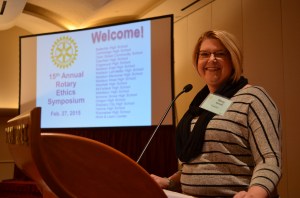
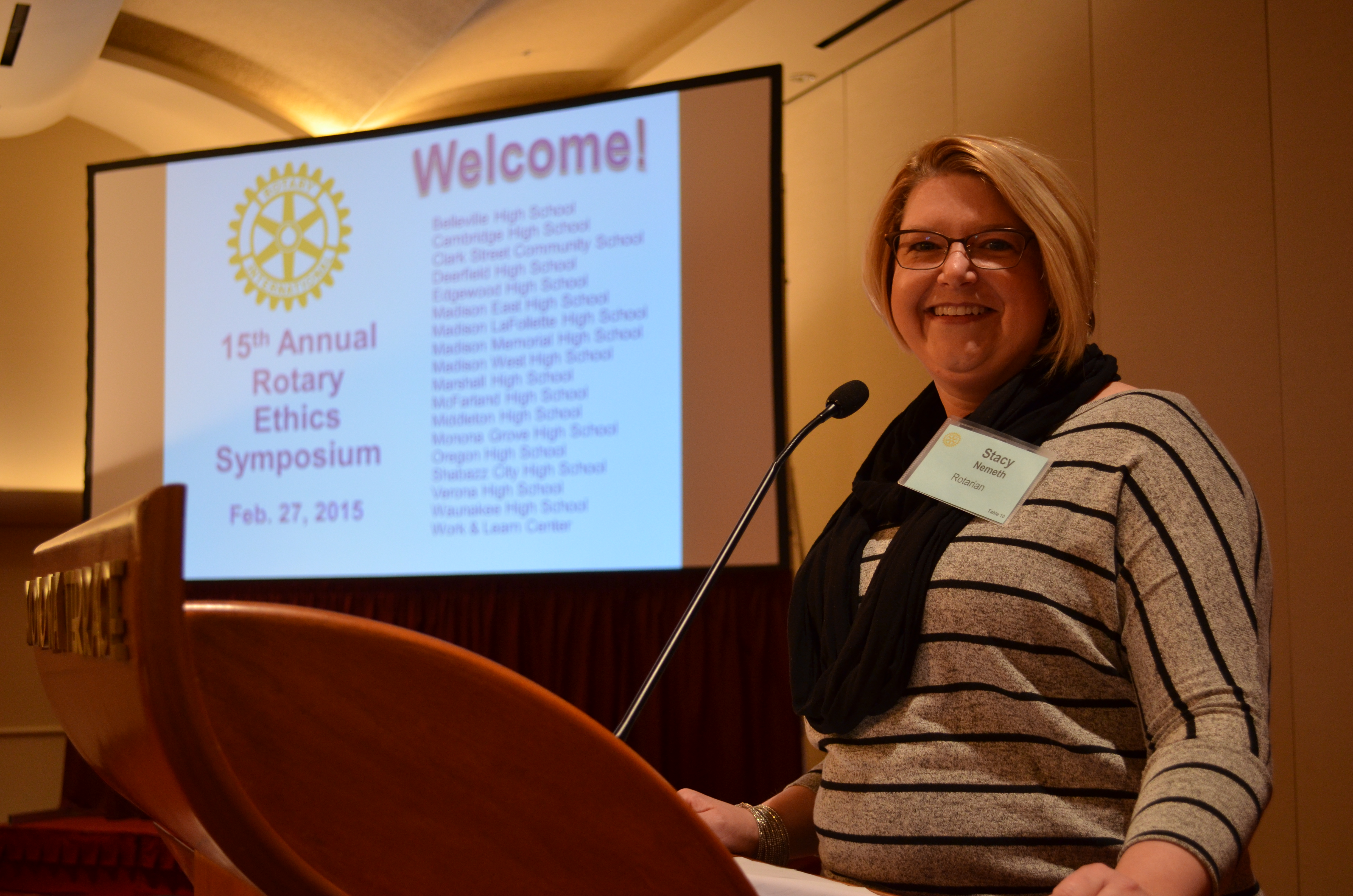
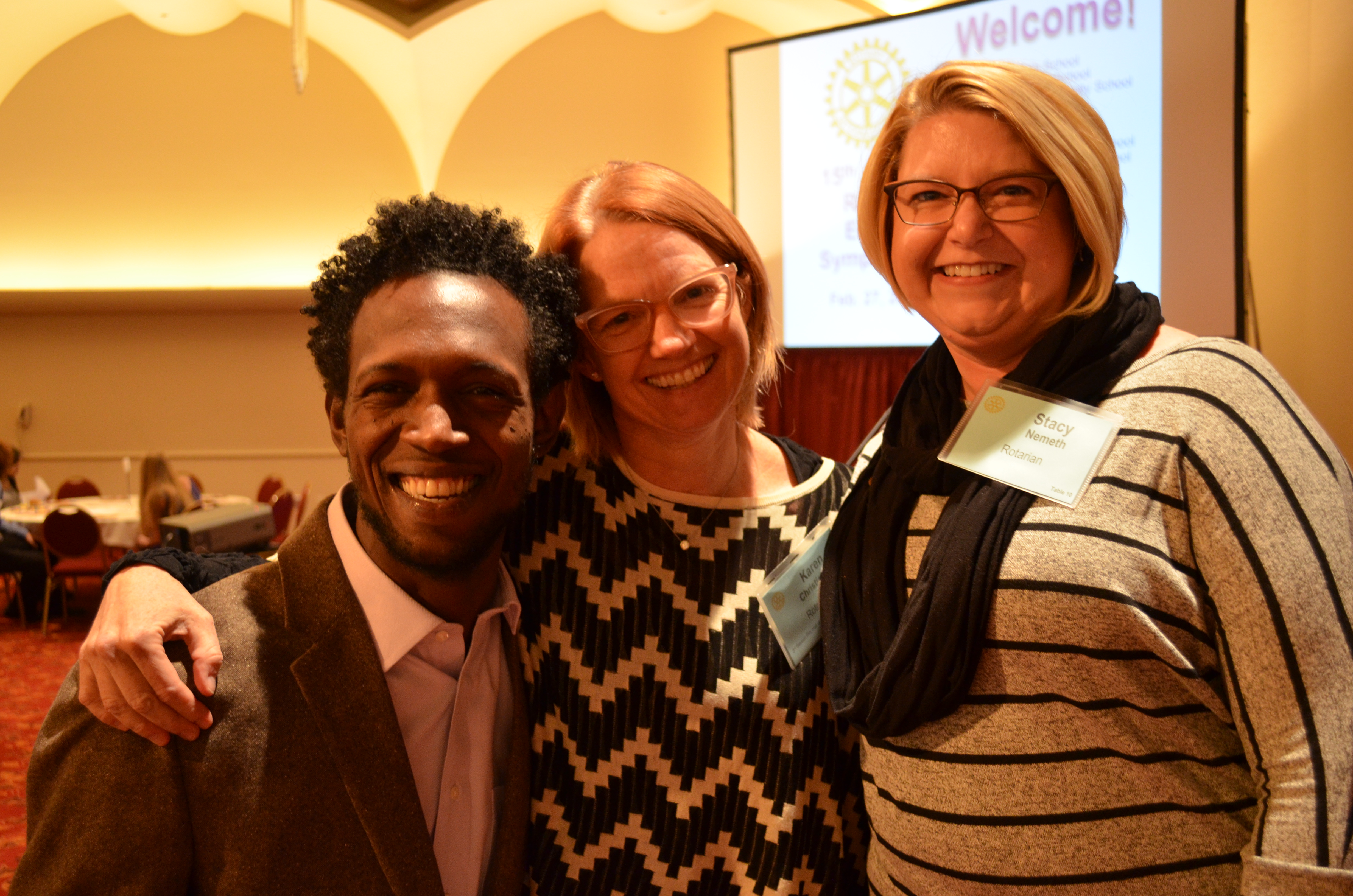
Stacy Nemeth, Chair of 2015 Ethics Symposium Committee

Stacy Nemeth, Chair of 2015 Ethics Symposium Committee

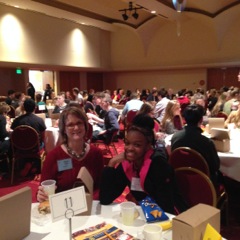
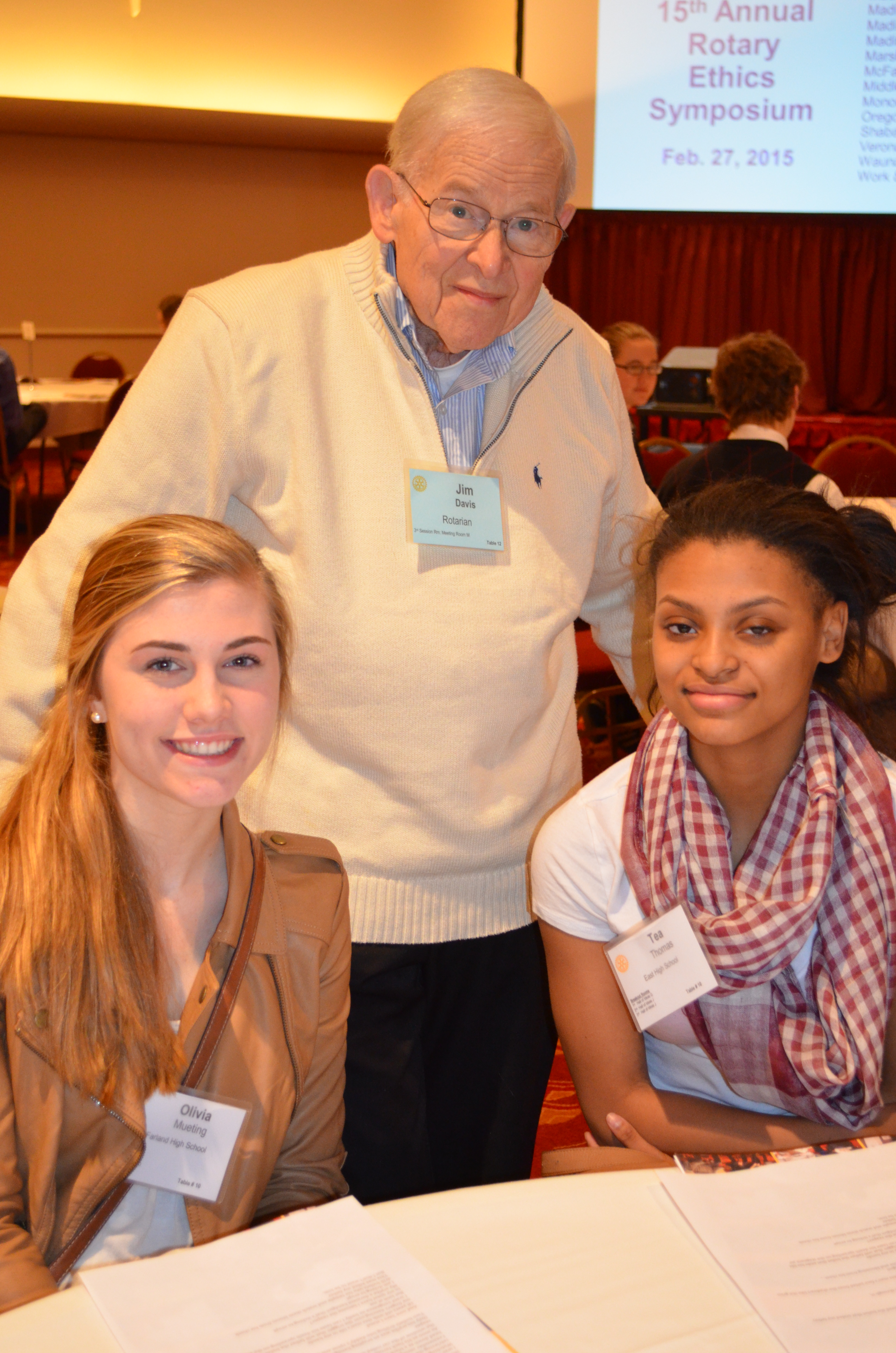
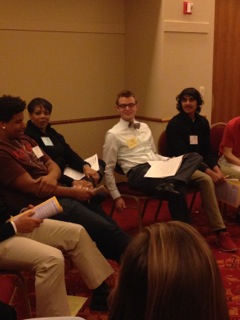
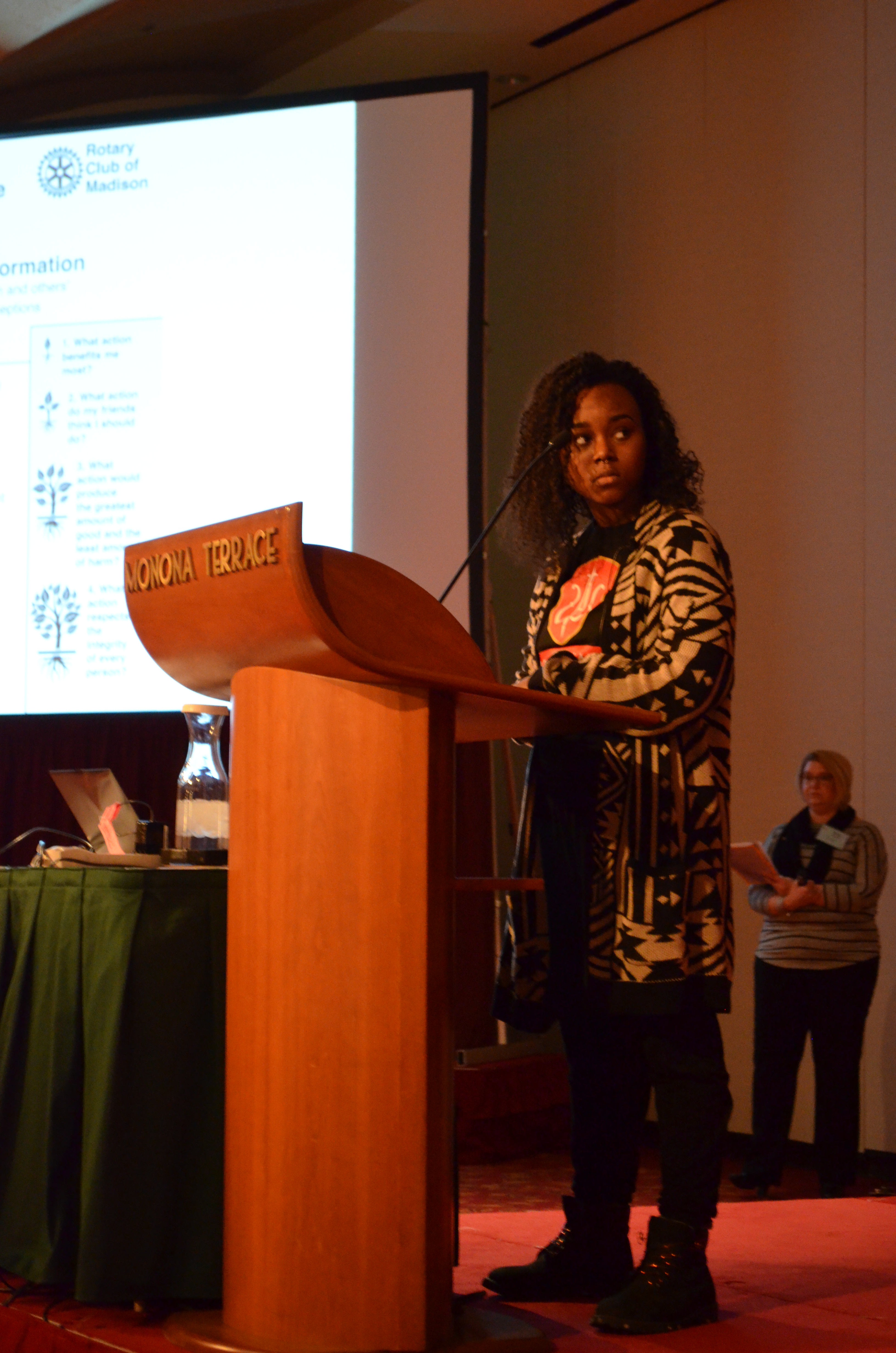
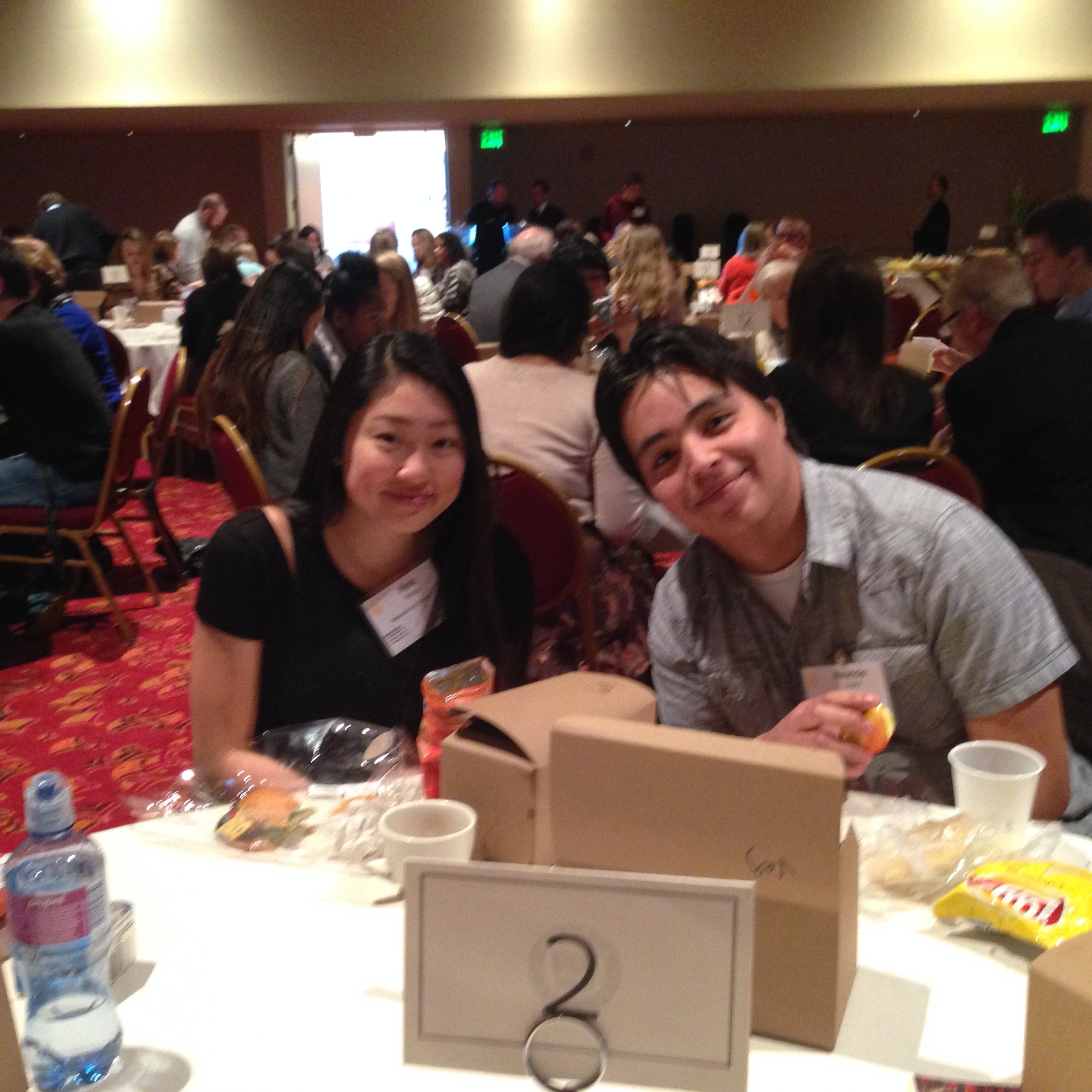
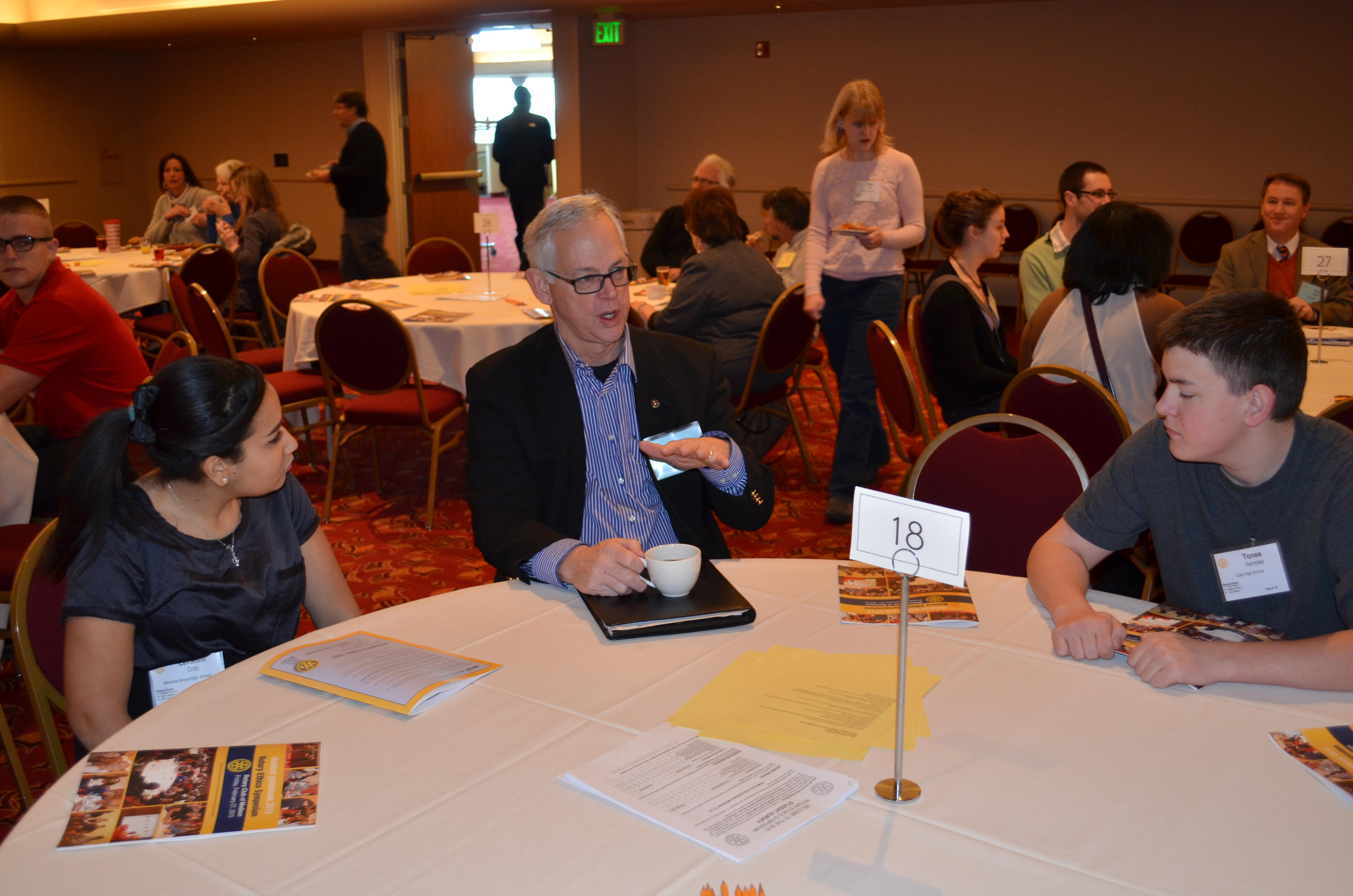
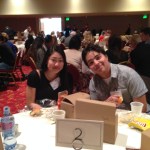
More than 200 students from 18 Dane County high schools were challenged to examine the decisions they make every day in a new way Friday, February 27, at the 15th annual Rotary Ethics Symposium at Monona Terrace.

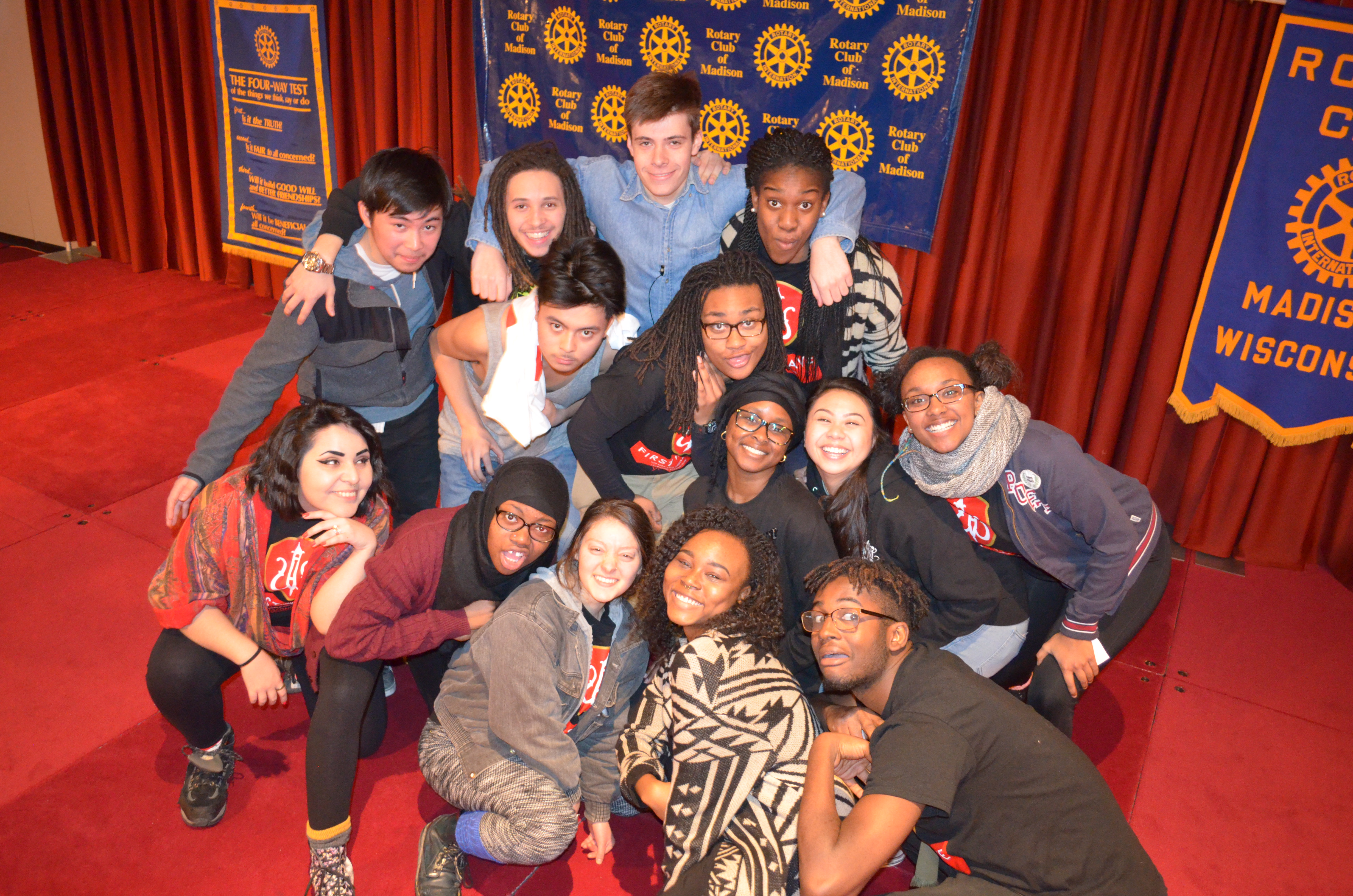
With dramatic performances on edgy teenage issues – teenage pregnancy and a father confronting his adolescent son about drug use – members of the UW-Madison First Wave Hip Hop Theater, a cosmopolitan multicultural artistic program, set the stage for high school students.

DSC_0072

And First Wave led the students through the R-O-T-A-R-Y Framework for Ethical Decision Making, which is a six-step process of thinking through a dilemma and making a decision.

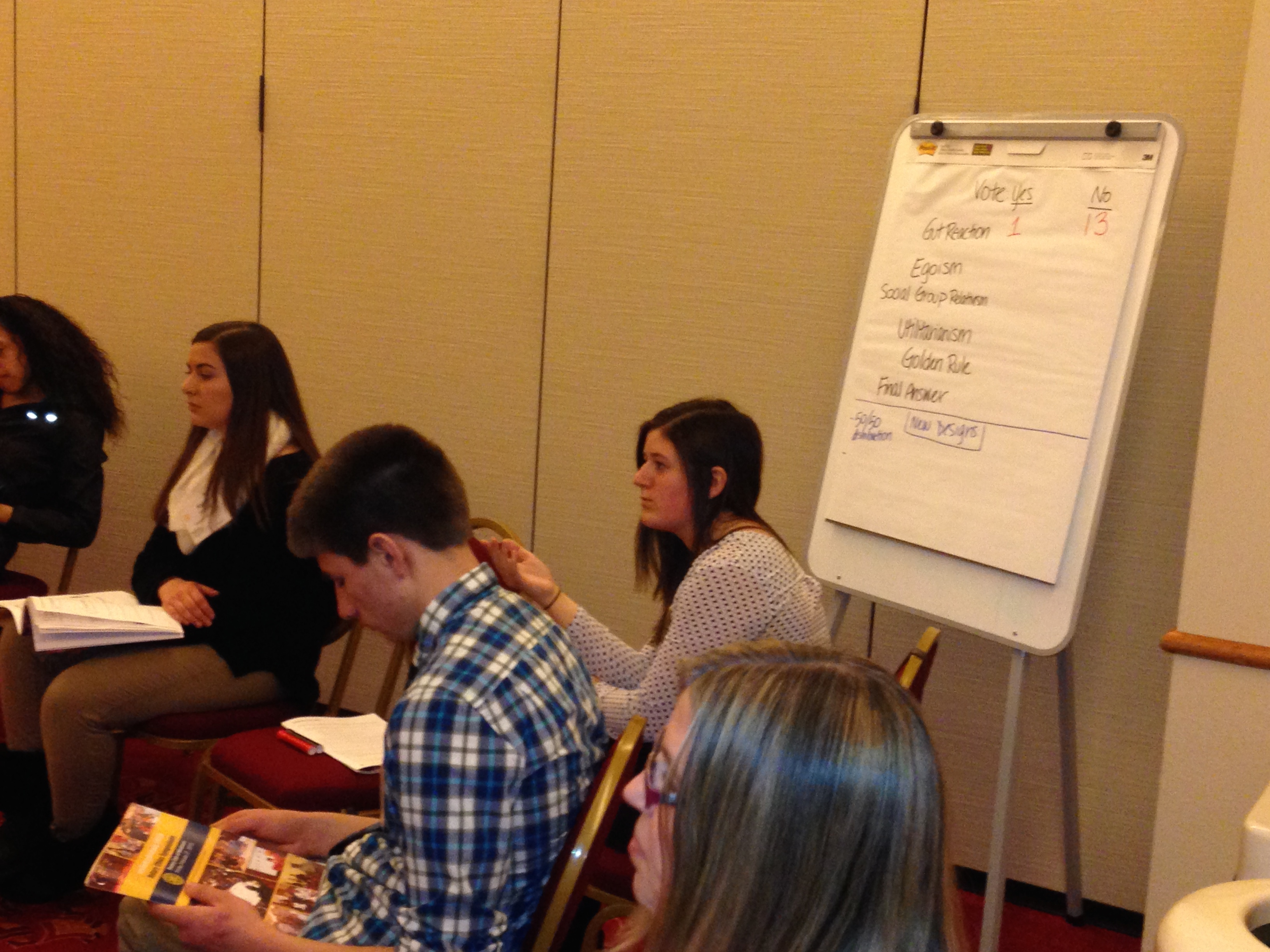
Then the high schoolers went to work. They were confronted with two dilemmas: Hostile Messages and an Affirmative Action Proposal.

“It was fun to be able to discuss realistic problems,” said Desmond Lawrence, 17, a junior at Madison’s Memorial High School, following the workshop. “I like that they (Rotarians) want us to reach out to our own high schools to get these (workshops) going.”

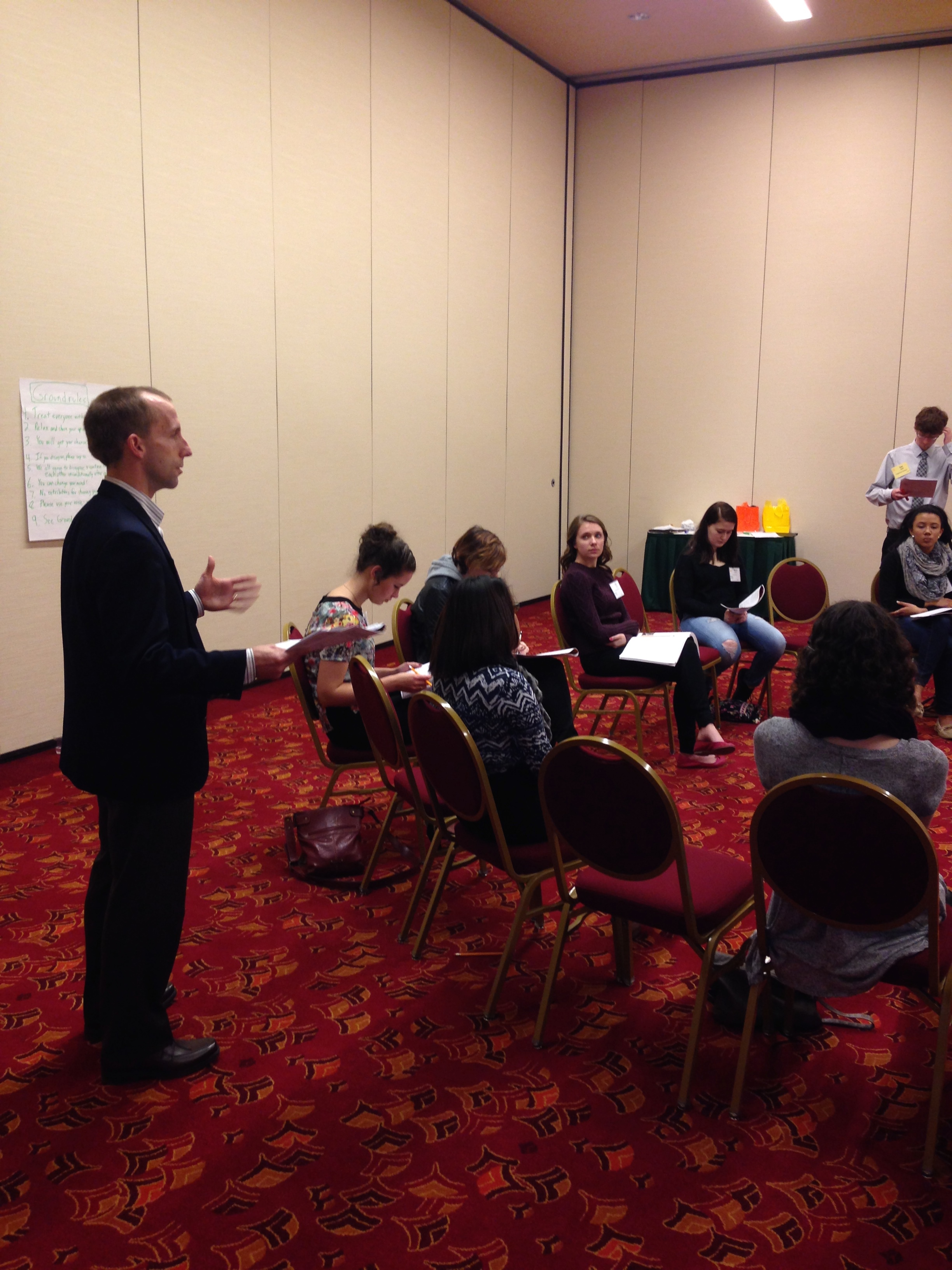
Rotary members along with participants from Rotaract clubs at UW-Madison and Edgewood College led the workshops. Students learned the ground rules, which emphasized: “Treat every single person in the room with complete and unconditional respect.”

Photo10  Photo5  Photo 11

“I liked that whatever you had to say, you were going to be respected,” noted a student from Belleville High School. “It was nice to see that my friends had a serious side.”

“The coolest thing of all,” said a student from Monona Grove High School, “someone from my school and I, we had different opinions and we still like each other.”

The ROTARY Framework for Ethical Decision Making is as follows:

R = Recognize an ethical issue
O = Obtain information about the situation and others’ interests and perceptions
T = Test alternative actions from various perspectives
A= Act consistently with your best judgment
R = Reflect on your decision after acting
Y = Yield to your ethical judgments

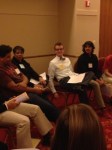
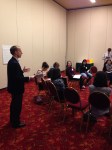
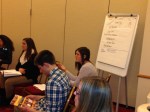
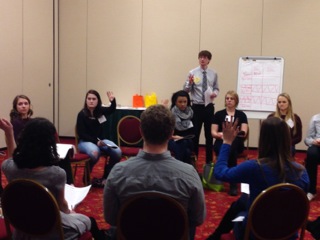
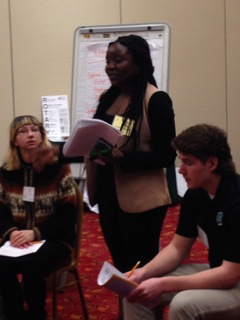
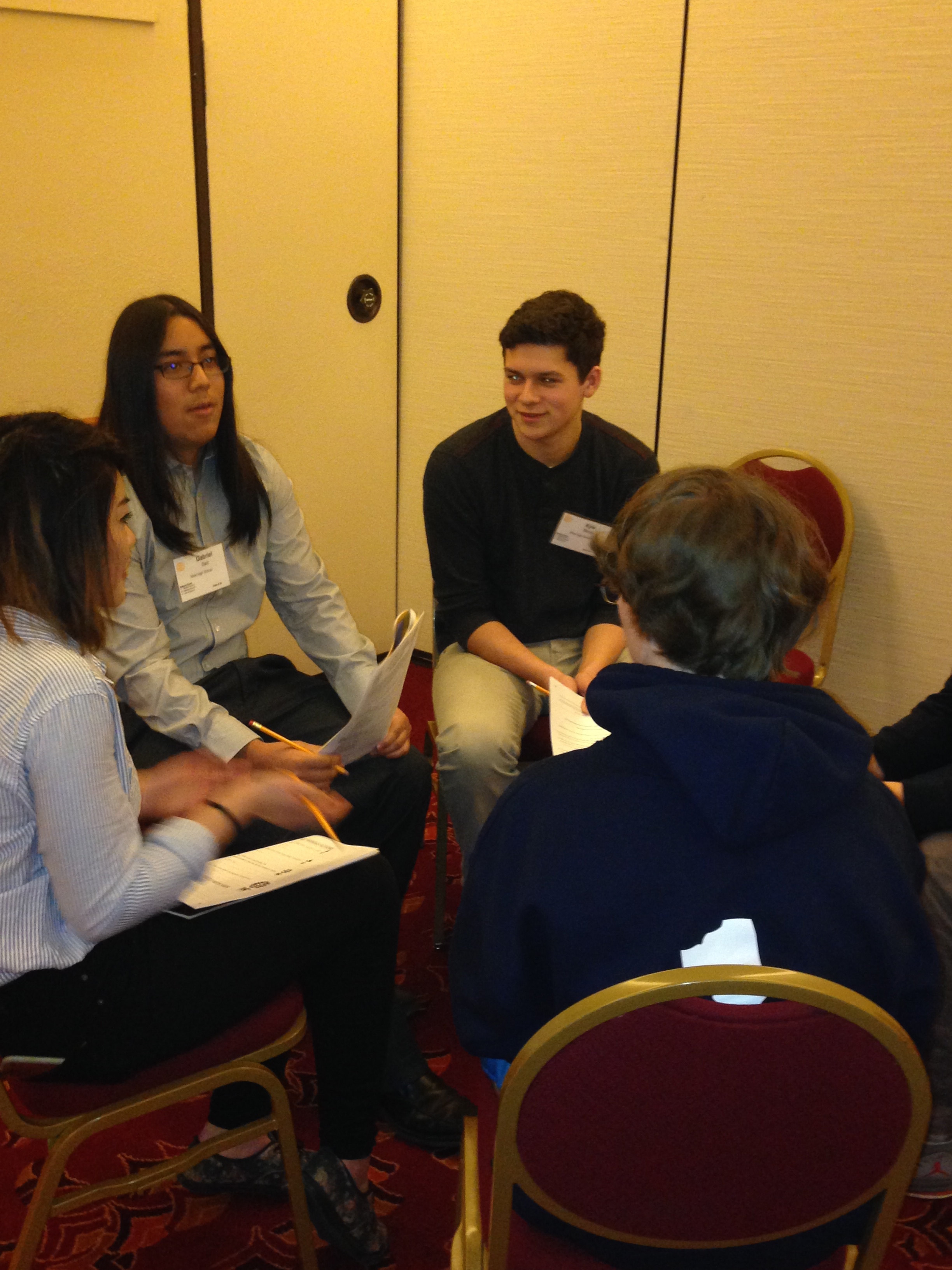
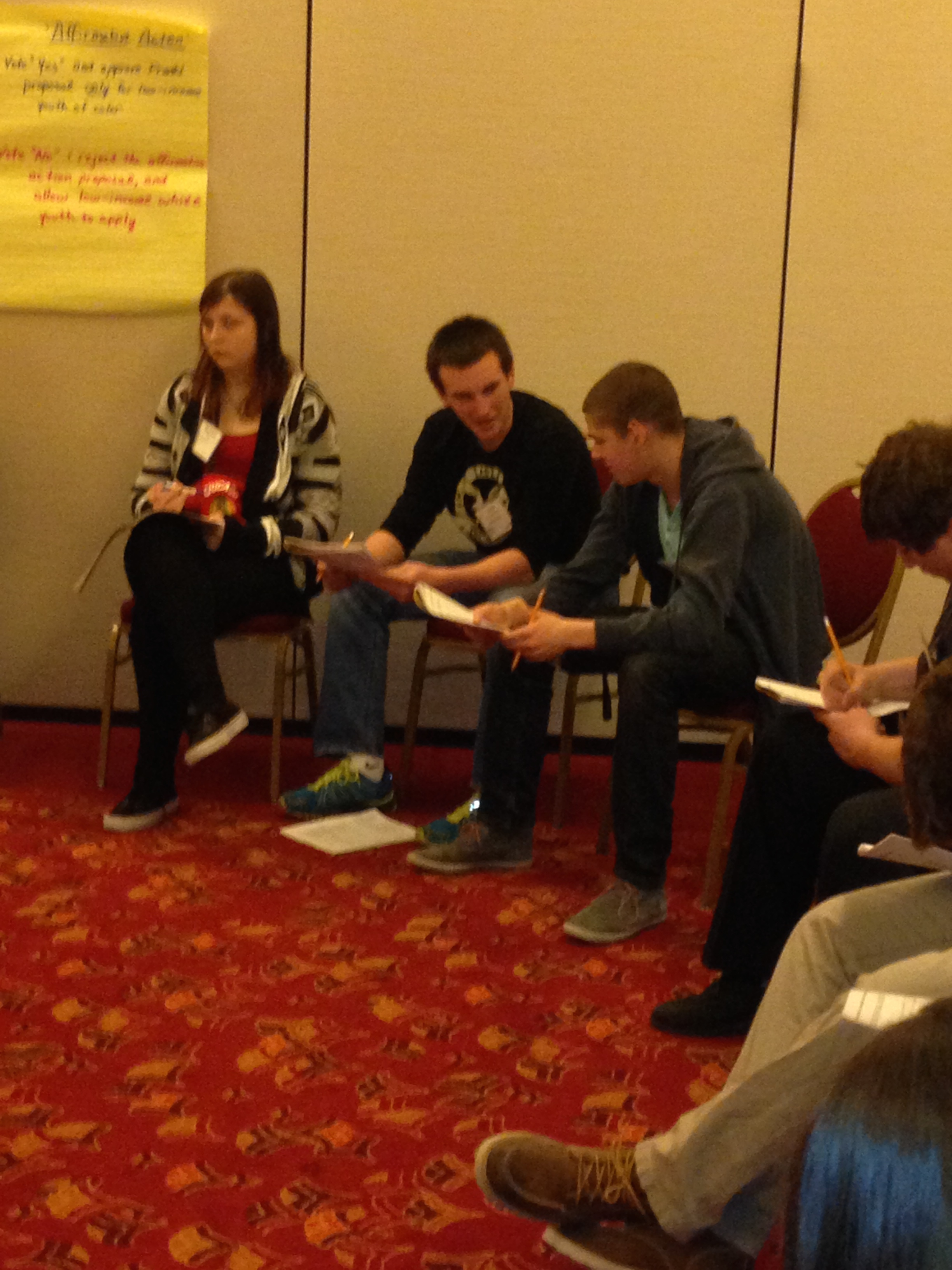
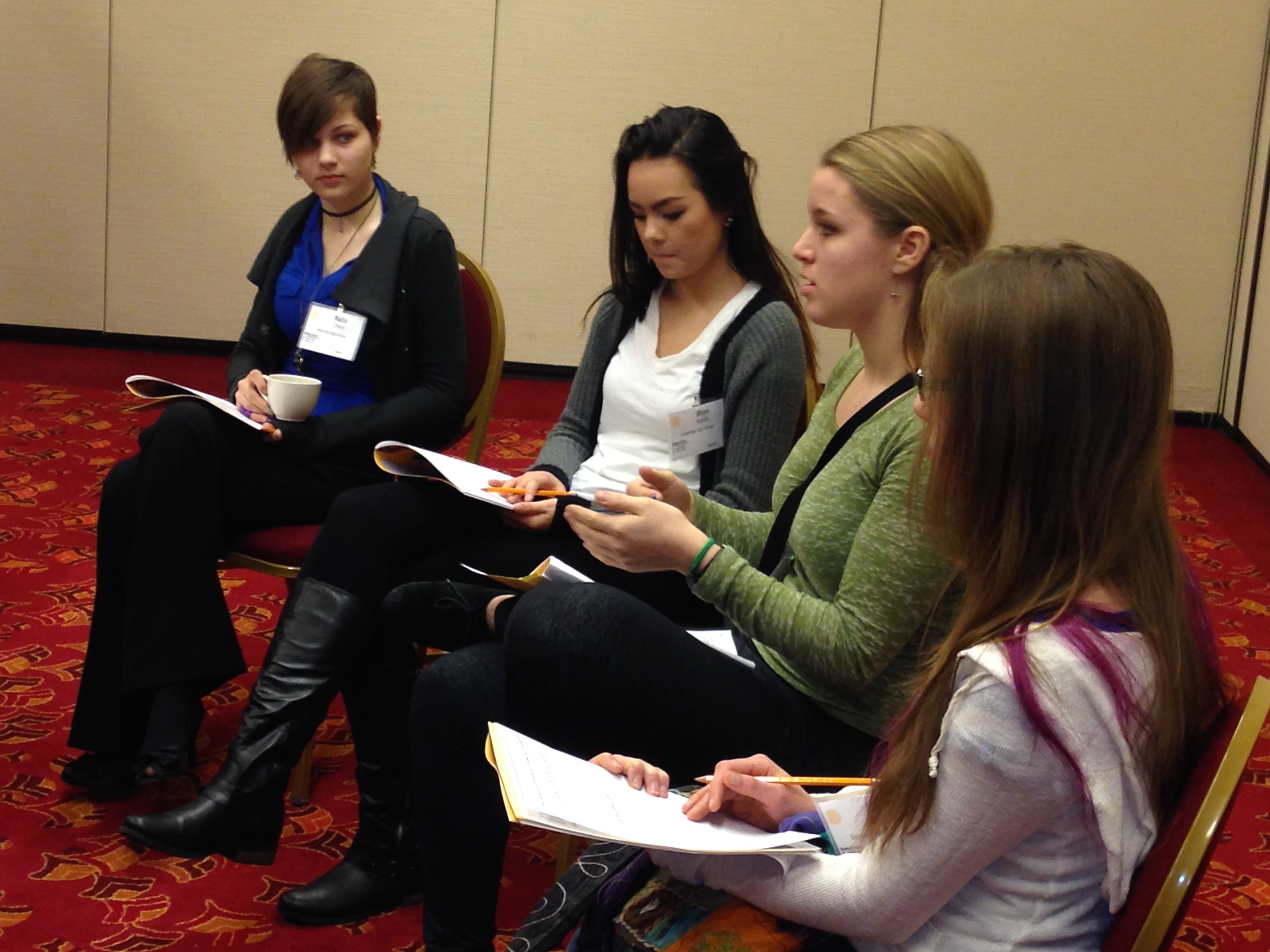
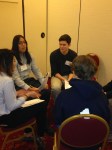
Students dispersed into workshops to learn the practical application of the Rotary Framework. The sessions were designed to group together students from a variety of high schools.
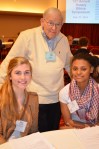
Photo2  DSC_0048     Photo3   DSC_0065

“Once students were in the smaller groups, they were willing to delve into the issues,” said Sophie Chadli, 17, a senior at Madison’s Shabazz High School.

At first, many participants felt isolated. They later discovered a new-found freedom as they listened to each other and even gained the confidence to rethink their stand.

“When we were doing the panel on affirmative action, others’ opinions changed mine about certain things,” said Dominique Taylor, 16, a junior at Middleton’s Clark Street Community School. “Me and some other students want to inform our teachers about the process so we can start training and recommend (the Ethics Symposium) to other students.”
IMG_9530  IMG_9514   IMG_9506

It was a new learning experience, most students agreed.

“I really enjoyed today,” said a student from Madison’s East High School. “It’s something that will stick with me. It’s a tradition that will keep on giving. I met lots of new people.”

The students’ willingness and enthusiasm to embrace a new experience impressed Rotary leaders.

Photo12   IMG_9517   IMG_9516

Sarah Gempeler, 20, a junior at Edgewood College and a Rotaract member, grew up in Monroe, a south-central Wisconsin city of about 45,000 residents.

“It’s great to see how passionate these kids are about (relevant) issues,” Gempler said. “I grew up in a town where there wasn’t much diversity in our high school.”

A first-time volunteer for the symposium, Janet Piraino, a Rotary member and district director for a Wisconsin representative, praised the next generation of Wisconsin voters.

“This is my first time and I’m blown away by their ability to stand their ground,” she said. “There were students of color on both sides of an issue that spoke very passionately for their position. One African American girl spoke in opposition to affirmative action because she felt it didn’t honor equality.”

Discussions on controversial topics showed that students are listening and collecting information as they go about their daily lives, said Steve Johannsen, a Rotary member and Madison business advisor.

“The (affirmative action) statistics were eye-opening for all the students,” Johannsen said. “It gave them a much better feel for real community issues. The conversations were unbelievably insightful and respectful.”

Rotary leaders are willing to assist high schools students and faculty with developing an “Ethics in Action” project at their schools, said Stacy Nemeth, Chair, 2015 Rotary Ethics Symposium.

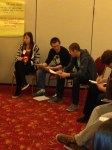
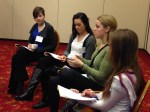
Monona Grove High School Principal Paul Brost led a discussion with judicious students from his 925-student school. Students were enthusiastic about working with trained facilitators – Rotaract students and Rotary leaders – to deliver the project to Monona Grove.
IMG_9507   IMG_9511  DSC_0049

“People need help learning about ethical decisions, but we need someone to help facilitate our conversations,” noted a Monona Grove student who voted in favor of assistance from Rotaract students. “We’re too used to just listening and taking notes. We need a role model to help us get going.”

Throughout the discussion, Brost encouraged students to take a leadership role.

“I’m willing to preload the idea at a staff meeting,” he offered. “If it’s student-led, it’s up to you to take the lead and find a coach or a teacher willing to make it work. It needs to be bite-sized and meaningful.

“Part of our goal in school is to get kids to different leadership opportunities,” added Brost who has attended the conference 13 years. “Students always find this very worthwhile. It has high value for us.”
DSC_0034  DSC_0041  DSC_0033

Rotary member, Donna Beestman, is a veteran participant at the Ethics Symposium. She praises students and school leaders for their dedication and applauds the annual work of the more than 50 Rotaract and Rotary volunteers.

“It’s like students go through a transformation in the course of four hours,” she said.