Category Archives: Rotary Club of Madison

“Service Before Self”

–submitted by Bill Haight; photo by Pete Christianson

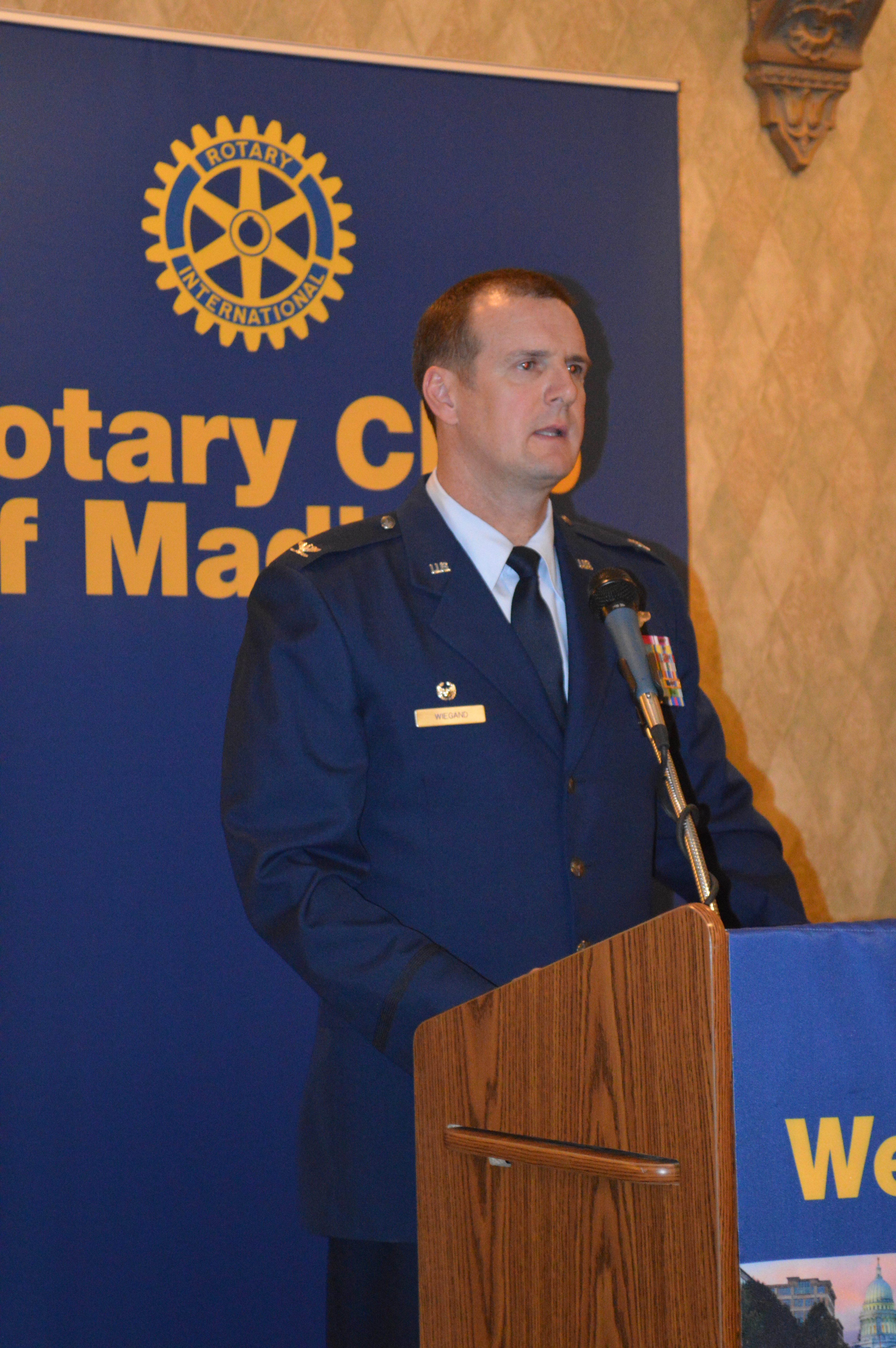
Weigand Jeff“Service Above Self” is the Rotary motto. “Service Before Self” is the motto of the Air National Guard. In noting the similarity, Colonel Jeffrey J. Wiegand, commander of the 115th Fighter Wing, Wisconsin Air National Guard, emphasized the role of his organization within the community.

The unit is composed of over 1,100 men and women, including 445 full-time employees .The rest are “citizen airmen” who live and work within the community 28 days a month, and train for two days. The total payroll is $58.2-million.

The 115th Wing has 35 pilots averaging about 2,000 hours of total flying time each and adding about 150 training hours per pilot annually. Maintaining flying hours is a major measure of a unit’s size and strength. Colonel Wiegand noted that his unit, as a joint state-federal entity, is less susceptible to “sequestration” which calls for the full-time Air Force to cut costs ten percent annually.

Colonel Wiegand said he strives to assure that the unit is a valuable resource to the greater Madison area. In addition to being called for overseas missions, the ANG can provide domestic assistance such as mobile medical facilities, search and rescue, drug surveillance, and bomb disposal.

The 115th  Fighter Wing is a tenant of the Dane County Regional Airport, paying part of its “rent” by providing fire and rescue services for the entire airport. His pilots also work closely with the airport to minimize noise complaints.

Colonel Wiegand sounded as much like a business leader as a military commander when he talked about his desire to maintain strong relationships within the community and provide a good place to work so highly skilled personnel can be retained after their minimum six-year reserve duty is finished. That retention rate currently stands at an admirable 60 percent.


The Face of Edgewood College is…

–submitted by Linda Baldwin; photo by John Bonsett-Veal

photo

From left: President-Elect Ellsworth Brown with Scott Flanagan

Everyone!

Scott Flanagan is the 7th President of Edgewood College, after spending 16 years at the college as a teacher and administrator.  Today he gave us an overview of the college.  Begun in 1949 under the leadership of the Dominican sisters, Edgewood College has grown to more than 3000 students in many undergraduate, graduate and non-traditional programs.

President Flanagan recalled that in 1970 the college went co ed and announced this change through a road sign “Now Co ed.”  He surmised this change was not met with enthusiasm as the sign was quickly stolen.

Today the sisters’ legacy is carried out through the good work of all associated with Edgewood; students, faculty and staff, the board of trustees and even the presidents, past and present.

Edgewood College was one of the first in the country to offer the “yellow ribbon” program, an opportunity for veterans to attend college on scholarships.  Today more than 150 vets are attending Edgewood.

Edgewood primarily educates students from the greater Madison area, and they stay in the area after graduation.  Flanagan proudly pointed to the fact that only 3% of 2013 grads were still looking for work; 97% were working, in the military or doing graduate work.

He also talked about the programs for returning students seeking professional advancement through Edgewood programs, serving traditional and non-traditional students and invited everyone to the “Stream,” Edgewood’s new arts complex.

It’s Wisconsin, so Flanagan mentioned the 15 sports programs at the college, the robust study abroad program, the community internships which take students out into the community for service and civic engagement, offering more than 200,000 hours in service.

In closing, he touched on the partnerships with area businesses that provide additional scholarship money for students; the emphasis on inclusivity, noting that 15-20% of Edgewood students are minorities with retention rates almost as high as the student body in general and affordability, noting that 94% of Edgewood students receive some sort of financial aid.

President Flanagan closed by asking Rotarians to get involved with Edgewood to help meet our society needs for qualified workers, engaged citizens, servant leaders and scholarly problem solvers.


Does Nixon Really Matter Today?

–submitted by Roger Phelps; photo credit to Pete Christianson

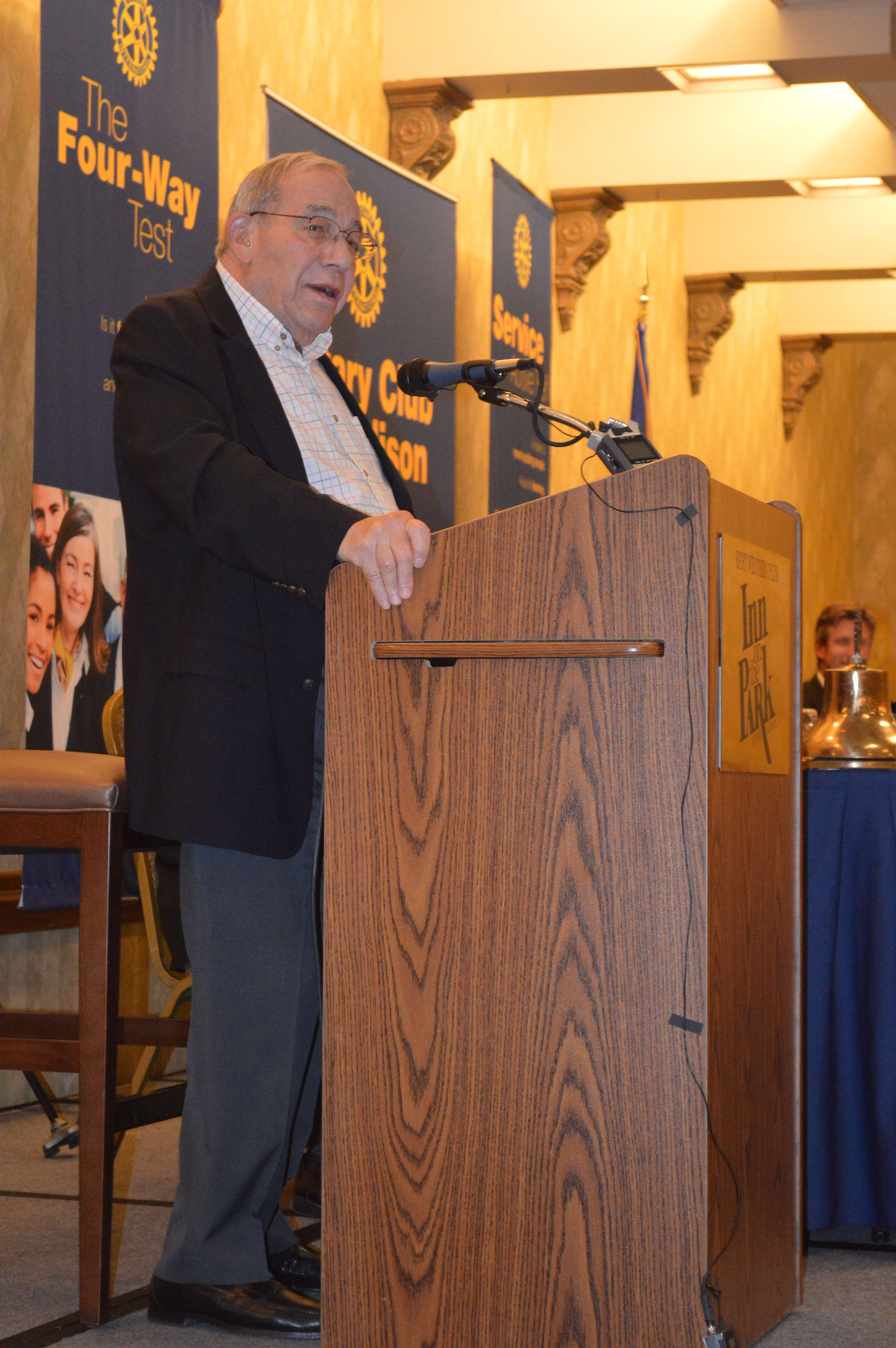
DSC_0025Professor Stanley Kutler provided a coherent and passionate explanation of why Richard Nixon still matters.  Although it has been 40 years since his resignation, the Nixon legacy endures.  And, it’s largely not what people focus on when they think of Nixon.

President Nixon was the first and only U.S. President to resign office.  The Watergate scandal and the unprecedented Presidential abuse of power was his undoing.  The outcome of his certain impeachment was beyond question, but Nixon avoided it by resigning office.

Aside from this significant event in American history, why does Nixon matter?  What lasting impact still felt today had its roots in his administration?

One of the legacies is the Southern Strategy pursued in the 1968 election of Nixon.  He actively and directly courted support among Southern democrats and got enough of them to vote Republican to put him in office.  The replacement of Democratic Party voters with Republican voters cemented Nixon’s position and affected every election since then.  It is one of the major political realignments in American history.

Another lasting impact of President Nixon is the significant influence he had on the Supreme Court.  In a period of less than 3 years, Nixon appointed (and got confirmation) of 4 Supreme Court judges.  More importantly, all assumed the mantel of “strict constructionism” and forever changed the way appointees are questioned in their confirmation hearings.  The concept of questioning “judicial activism” was spawned in that era.

Professor Kutler adroitly and with appropriate humor addressed a number of questions from Rotarians.  His presentation at our Rotary Club was an upbeat event we’ll not soon forget.

DSC_0010


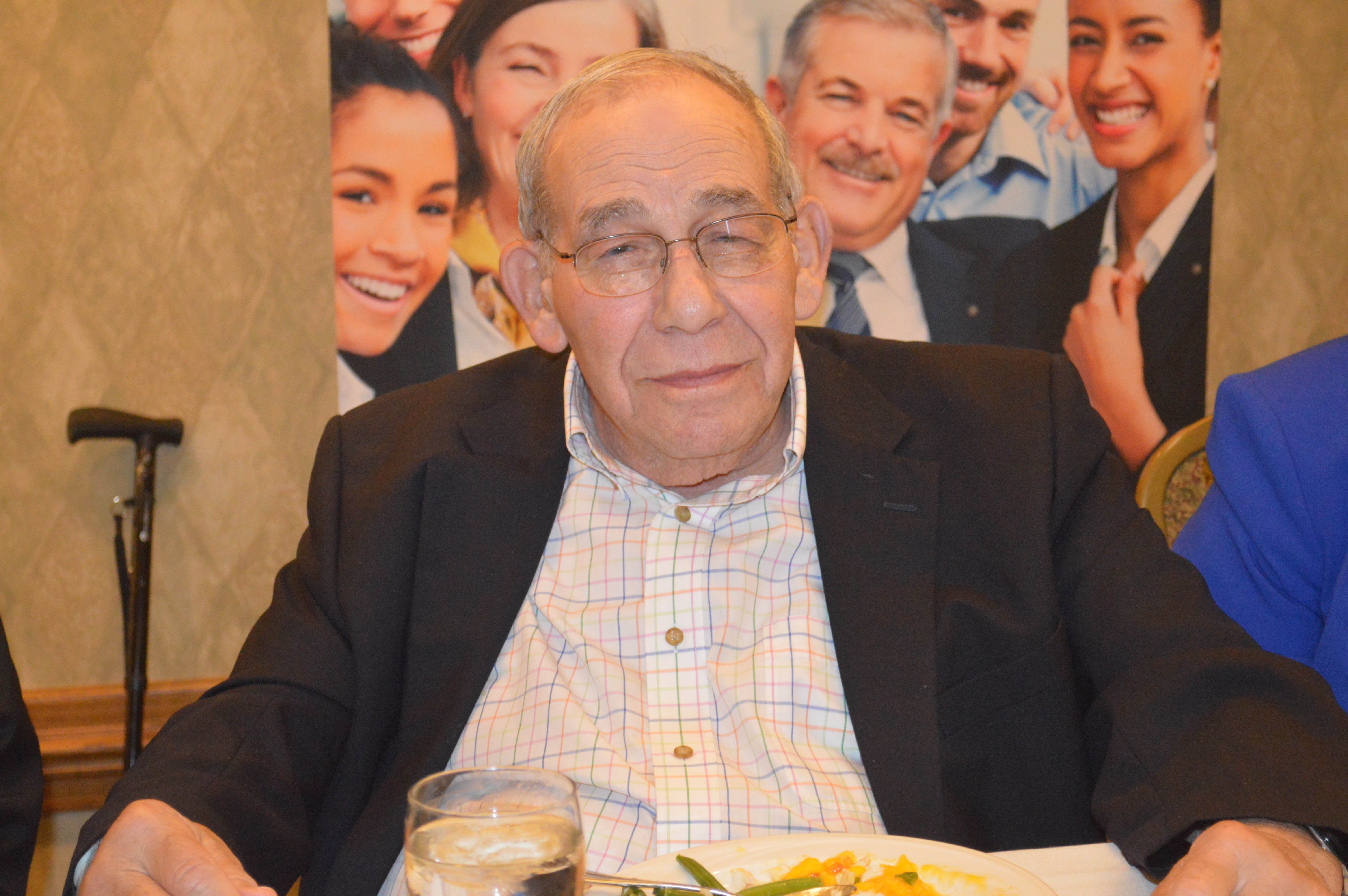
And, by the way, Happy Birthday to Stanley Kutler, who is celebrating his 80th birthday this week.


Our thanks to Professor Kutler for his presentation and to Roger Phelps for this review article.  We also thank WisconsinEye for videotaping our program this week.  CLICK to watch the video.

Dean Soyeon Shim on Fiscal Responsibility

–submitted by Stan Inhorn

Soyeon ShimOn June 18, Soyeon Shim, new Dean of the School of Human Ecology at UW-Madison, told Downtown Rotarians about her research on influences in creating financial responsibility in young adults. This study was started around the time of the 2008 financial crisis, when Professor Shim was at the University of Arizona. The study is called APLUS (Arizona Pathway to Life Success.)

Shim recognized that many parents worry that their children lack financial literacy, especially when they send them off to college. In a report to a President’s Advisory Panel in 2013, the study found that many students already had large credit card debts. Messages to students to save for the future or for retirement have little impact, whereas emphasis on creating a modest plan for saving has better outcomes.

Her studies found that there are three categories of students in relation to managing personal finances. “Pathfinders” are those who are taught to carry out financial transactions responsibly. “Followers” are those tend to adapt their parents’ style, whereas “Drifters” have no systematic approach to good financial management. Much depends on whether parents and other adults have had meaningful conversations and interactions with their children regarding fiscal management.

In 2013, the study found that in two years after college, only half of college students have permanent jobs.  32% are self-supporting, 51% are still helped by their parents, and 17% are borrowing elsewhere. Dr. Shim’s advice to parents is to be intentional in their interactions with their children and to use adult dialogue. Parents should themselves establish positive financial behavior in order to help students become “Pathfinders”, which in turn results in overall happiness and in becoming successful adults.

(CLICK for a copy of Dean Shim’s powerpoint presentation on June 18.)

Melanie Ramey Receives Joseph G. Werner Meritorious Service Award

–presented by Carol Toussaint, June 4, 2014


Club President Renee Moe (left) pictured here with Melanie Ramey

Club President Renee Moe (left) pictured here with Melanie Ramey

The 2014 Joseph G. Werner Meritorious Service Award is presented to Melanie Ramey for her extensive service to Rotary.

Joining the club in 1991, Melanie immediately signed on for committees, especially those that called for a tireless volunteer.   She brought humor and hard work to every task and seemed always ready for the next assignment.  She became a Rotary News reporter, managed the Sergeant at Arms position and was elected to the board of directors, then vice-president, president in 1998-99, followed by more service on the board of the Madison Rotary Foundation.  Her Rotary reach extended to leading the Ethics Symposium Committee and helping organize the first Ethics Symposium for high school students.  She is a mentor for Rotary scholars, an advocate for UW and Edgewood College students in Rotaract, helped secure funding from Rotary International Foundation to launch CECADE, the club’s signature international project, is active on the Orientation, Visitor Hospitality, Member Development Committees, and on and on.

There is also something special about Melanie and money.  There was a club auction held in 1994 to raise funds for community grants and youth awards.  President Alan Orenberg used words such as brash, forceful, persuasive to describe her auctioneering style, but he also praised Melanie for the $8000 added to the fund.  In 1998 at the start of her term as president, she inaugurated the system to pay forward on your birthday with the suggestion that each celebrant make a gift of one dollar for each year of age, rounded up to 100.  Succeeding presidents have not wanted to tamper with a sound money scheme and to date Melanie’s presidential year idea has averaged over $26,000 a year for a 15-year total of $402,021 to the Foundation from the birthday “tax”.

The Werner Award Committee also takes into consideration an individual’s work for community causes whether as a volunteer or professional.  In 2010, Melanie was nominated by our club and was selected by the Madison Area Service Club Council to receive the Ruth Gordon Service Award.  This award is given to honor an individual who, over time, has exemplified the concept of volunteer service for the betterment of the community.

In 2012, the club honored Melanie with the Manfred Swarsensky Humanitarian Service Award and detailed many of her selfless acts in support of others.  Individuals and organizations needing an advocate seem to find Melanie or perhaps she finds them.  Those living in poverty, those in prison or any who are denied rights as citizens have seen that same forceful, persuasive, might I add, brash and effective style, put to work on their behalf.

In November 1974, nearly 40 years ago, club president Ted Long presented the first Werner award.  He told the club that the intention is not to provide a reward or incentive for Club efforts, but rather to maintain examples of the Rotary tradition of “Service above Self”.  It was a special moment for Ted.  Joe Werner had been his mentor at the law firm and his sponsor for Rotary membership.

Congratulations Melanie!

Congratulations Melanie!

It is also a special moment for me to congratulate a friend who becomes the 29th member of this club to receive the Joseph Werner award.  Melanie Ramey.

History of Joseph G. Werner Meritorious Service Award: In 1974, our club established the Joseph G. Werner Meritorious Service award as the club’s highest recognition for club service.  This award is granted by our Rotary Club in recognition of outstanding club service in the Rotary tradition of “Service Above Self.”  Joseph Werner was a committed Rotarian.  He chaired many significant committees, both before and after serving as club president in 1953-54.  He served as a district governor in 1958-59 and became the second member of this club to serve as director of Rotary International in 1969-71.  He later served Rotary International in many other positions, and two different RI Directors indicated that Joe was in line for president of Rotary International at the time of his death from cancer in 1973.  Joe was a truly committed Rotarian whose example of “Service Above Self” is memorialized in this award.