Category Archives: Rotary Weekly Guest Speaker

Listening to Latino Stories in Wisconsin

–submitted by Linn Roth; photo by Mike Engelberger

Armando Ibarra 12 6 2017

Professor Ibarra (center) pictured here with his wife, Veronica and Rotarian Pete Christianson

In his presentation “Listening to Their Stories: How Latinos Survive and Thrive in Rural and Urban Wisconsin,” Professor Armando Ibarra of UW Extension summarized data from his recent studies to illustrate how the state’s demographics have significantly changed over the last three decades and how they will continue to change in the future.  For example, Latinos are much more widely dispersed throughout Wisconsin today, and locally. Latinos now constitute 6.6% of Madison’s population and 20% of Fitchburg’s populace.

Over the last 25 years, Dane County’s Latino population has exploded from 5,000 to about 32,000, although that number is probably a substantial undercount due to the immigration status of many people.  More importantly, this growth will continue to occur, regardless of changes to immigration law or border control.

Yet, even with a strong work and family ethic, the Latino community has not enjoyed full integration into our economic, social and political culture.  However, given that the Latino community is now an integral part of the Wisconsin economy, e.g. 80% of our dairy products are handled by Latinos, that cultural integration will inexorably move forward.  As Professor Ibarra stressed, Latinos are essential to the economic and cultural prosperity of the US, and we should welcome all individuals, regardless of race or nationality, to contribute to and participate in the promise of our democracy.

If you missed our meeting this week, you can watch the video online.

The New South Campus of Madison College

–submitted by Stan Inhorn; photo by Pete Christianson

Jack Daniels 10 4 17

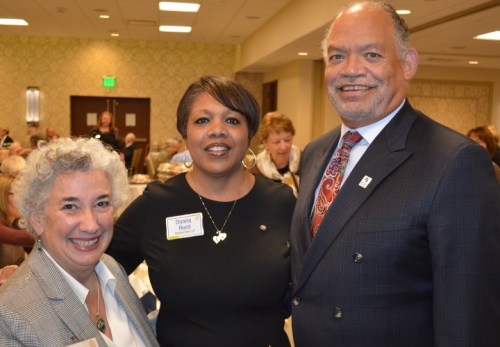
From left: Lucia Nunez, Club President Donna Hurd and Jack Daniels

With great enthusiasm, Jack Daniels, President, described the new Madison College’s South Campus Initiative. Starting in 2013, the college has been working to develop a full-service campus. By partnering with 11 community organizations and agencies, the Initiative has made great strides in the creation of a center for life-long learning for an under-served population.   The foundation of the campus follows the Rotary Four-Way Test.

  1. Is it the Truth? While Madison is considered to have one of the most educated populations in the country, 57.8% of south-side residents have no post-high school education. It is an area of poverty and social isolation.
  2. Is it fair to all concerned? Most residents have barriers to education, including low wages, need for affordable child-care, extreme poverty.
  3. Will it build goodwill and better friendships? The campus will provide social vitality along with partners such as the Madison Metropolitan School District. A pilot program will allow junior and senior high-school students to earn up to 48 college-transferable credits.
  4. Will it be beneficial to all concerned? The Goodman Foundation has pledged $10 million and American Family Insurance has pledged $1.3 million for the first phase in building the campus. Once completed, people in the area will gain the opportunity to pursue jobs that pay a living wage.

Phase 1 contemplates a 38,000-square foot center that will provide learning spaces, support services, STEM-related activities. With additional funding, the campus could expand to 45,000 square feet.

Phase 2 would enlarge the campus to a 75,000 sq. ft. wrap-around, 7-day-a-week full-service academic center. Health professions, IT, business, language, technical trades would be included. Graduates would help meet the present worker shortages in these fields. The building would include 4 science labs, 3 IT labs, with transportation to the Truax campus for certain training. To allow students to pursue their education, financial aid scholarships will be available as will internships.

If you missed our meeting this week, you can watch the video here.

Gill v Whitford

–submitted by Kevin Hoffman; photo by Mike Engelberger

David Canon 9 27 2017

From left: Sarah Canon, Club President Donna Hurd & Guest Speaker Prof. David Canon

UW Professor David Canon presented a historical context and current review of Gill v. Whitford, the Wisconsin case before the US Supreme Court that challenges the most recent redistricting completed in 2011.  The issue is whether the plan used excessive partisan gerrymandering to create an unconstitutional redistricting that discriminated in favor of one political party over another.  Oral arguments are scheduled this Tuesday, October 3.

Professor Canon explained that redistricting happens every ten years following the census to adjust districts for changes in population.  Generally, districts must be of equal population, must conform to voting rights acts (cannot violate racial or ethnic considerations), be compact and contiguous, and respect traditional and natural boundaries.  However, the practice of achieving partisan districts, called gerrymandering (drawing boundaries to enhance political advantage), has been part of our nation’s history for over 200 years.  The party in power wants to maintain an advantage whether it is Democrat or Republican.

Methods used to do this are called “cracking” and “packing”.  Cracking is the practice of drawing the district boundaries to reduce a given party’s voters so that they are too small to have an impact on the election outcome.  The sweet spot for cracking is to obtain a 55-60% election advantage.  Higher than that becomes overkill.  Packing is the practice of drawing the boundaries so that a given party’s voters are concentrated into a few districts.  The objective of these methods is to maximize the number of legislative seats for a given party.

The issue of partisan gerrymandering has come before the US Supreme Court in prior cases but the court has been reluctant to rule it unconstitutional since an objective and neutral measure of partisan balance has not been available.  Gill v Whitford uses an Efficiency Gap calculation to attempt to quantify the competitiveness of a given district.  The gap is the difference in the two party’s losing votes divided by the total votes.  Gaps closest to zero indicate a competitive district.  Anything over 7% is considered uncompetitive.  Wisconsin’s was in the 10-13% range.

The Federal District court has ruled the Wisconsin redistricting unconstitutional but did not force redistricting pending review by the Supreme Court.  The US Supreme Court is expected to come down along ideological lines with Justice Kennedy the swing vote.

If you missed our meeting this week, you can watch the video here.

Preventing Workplace Violence

–submitted by Ben Hebebrand; photo by Jeff Burkhart

Longley Mahoney 9 13 17

Dane County Sheriff Dave Mahoney and Deputy Josalyn Longley

Speaking at the September 13 meeting of the Rotary Club of Madison, Dane County Sheriff Dave Mahoney along with Deputies Josalyn Longley and Cindy Holmes urged business and civic leaders to take a more active stance in preventing violence in area businesses, civic and religious institutions, schools and medical facilities. In the case of many shootings, the majority of which play themselves out in less than five minutes, “we are not there quick enough,” according to Deputy Longley, adding that “we are not the first responders – you are.”

Promoting a more action-oriented approach, the Sheriff’s Department is promoting an approach known as A.L.I.C.E. – and acronym for “Alert, Lockdown, Inform, Counter the attack, and Evacuate or Escape.” Citing broad support from the FBI or the Department of Homeland Security, the action-oriented approach stands in contrast to a more passive response such as hiding underneath a desk. “Passiveness is deadly,” said Longley.

In explaining A.L.I.C.E., the presenters started with the concept of “Alert”, posing the question whether businesses or buildings have a way to alert everyone to a crisis situation. Alerting everyone in a building in plain language as opposed to a code is the preferred method of communication. As regards to the “Lockdown” component, Longley encouraged that everyone within a building know and determine how you can get behind a locked door or as an alternative how one could barricade oneself. Having the option to lock a door from within a room rather than having to go into corridors is much preferred. The “Inform” function is to call 911 or also text 911 – an option available in Dane County.  Longley urged callers to be as precise as possible with describing one’s location, citing that numbered exit doors may serve as an excellent guide to responding law enforcement. The “Counter” approach is to be employed in cases of last resort – an approach where one should feel empowered to combat the assailant by throwing chairs or other objects. Lastly, the “Evacuate/Escape” function requires that potential victims know the quickest and easiest way to escape. “Do all your people know all the exits?” asked Longley, adding that most of us are creatures of habit, and thus escape the way we usually enter the building.

Ultimately, the best defense is to plan and practice. Just like fire drills have become second nature in schools, planning and practicing drills to prepare for attacks are the key to preventing tragedies. “The body cannot go where the mind has not been,” said Mahoney.

The action-oriented approach, however, has one significant exception. Citizens who are armed under “Conceal and Carry” rights are not trained to take matters into their own hands, said Mahoney, affirming his opposition to “conceal and carry” approaches. Other than the lack of training, armed citizens may also be mistaken as the shooter when law enforcement arrives.

Under the auspices of the Dane County Sheriff’s Department, more than 6,000 individuals in the county have received in the past 18 months specific training programs and educational materials on “Active Shooter and Workplace Violence” scenarios.

Please contact Dane County Emergency Preparedness Coordinator Deputy Josalyn Longley for scheduling and/or additional information.  (Longley@danesheriff.com or 608-977-1300).

If you missed our meeting this week, you can watch the video here.

Will Madison Win the Nation’s F-35 Competition?

–submitted by Dave Mollenhoff; photo by John Bonsett-Veal

Col Erik Peterson 8 2 2017

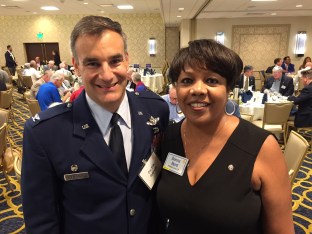
Col. Erik Peterson with Club President Donna Hurd

Will Madison be selected as one of two Air National Guard bases where the nation’s newest and most expensive fighter jet, the F-35, will be stationed?  That was the question that Colonel Erik Peterson, the Commander of the 115th  Fighter Wing at Truax Field, addressed in his talk to Rotarians.  Already Madison made the first cut from 18 Air Guard bases to today’s five.

Peterson argued that Madison meets and exceeds all Air Force criteria for this major strategic decision.  We have the capacity to handle F-35s with today’s F-16 hangers and support facilities.  We have cost advantages over other sites because just four minutes away—at F-36 speeds!—are 30,000 square miles of practice air space and a target range.  Four minutes may not seem important, but for an aircraft that costs $40,000 an hour to fly, having everything nearby will be a strong cost argument for locating the squadron here. Another cost advantage is that we already own the necessary hangers and support facilities.  We will not adversely affect air quality and the F-35’s will be no noisier than today’s F-16s.  Finally, Madison has always given the 115th Fighter Wing strong community support.  That’s a strong resume, said Peterson.

Zach Brandon, the President of the Greater Madison Chamber of Commerce and a project supporter who attended the meeting, reminded everyone that Madison has been an Air Force town since Truax was founded during World War II.  Remember, Brandon continued, when 9-11 happened, it was F-16s from Truax that scrambled to protect O’Hare Airport.  This is the proud job of the National Guard.

Peterson said that if the F-35 wing is stationed at Truax, its economic impact based on payrolls and purchased services will be $100 million per year.  Another benefit that few realize is that the Air Force pays for the fire-rescue program at Dane County Regional Airport.

Carson Gulley’s Legacy

–submitted by Moses Altsech

5130078da3521-imageWhat happens when you live in a society where the government and the majority of the people show a complete disregard for social and civil rights? Well, if you’re Carson Gulley you defiantly march on in the face of adversity and accomplish greatness against all odds.
The son of a former slave from Arkansas, Carson Gulley came to Madison in 1926 at a time when Jews and people of color were not allowed to join fraternities or sororities, hotels and restaurants banned African Americans, and there were even restrictions on trying on clothes at a department store if you were a person of color.

Thirty years later Carson Gulley had become one of the first instructors of c
olor at the University of Wisconsin, had written cookbooks, and had become a celebrity chef with his very own radio and television programs co-hosted with his wife Beatrice. He traveled across Wisconsin and to neighboring states for speaking engagements, having to drive home right away because usually the town would not have a hotel that allowed people of color to stay there.

seyforth-scott-2-1-2017As Scott Seyforth noted, in 1954, Gulley was a speaker at our [then all-white] Rotary Club. It’s natural to think of Carson Gulley’s odyssey with admiration for his courage, yet one can’t help but think of the torment that he endured during a lifetime of discrimination.
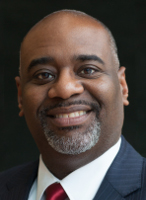
Although he retired from the University after 27 years of service and after having been routinely passed over for promotion, he became the first African American to have a building named after him at the University in 1965, three years after his death.

If Carson Gulley’s life story is inspirational, let it also be a call to action to stand up against all forms of discrimination and make our country better tomorrow than it was yesterday–just as he did. That’s Carson Gulley’s legacy and that should be ours as well.

You can watch the YouTube video, “The Life and Times of Carson Gulley,” here.