
Category Archives: Uncategorized

Human Genome Editing

submitted by Ben Hebebrand; photo by Mike Engelberger
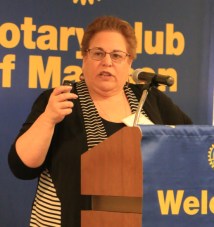
Alta Charo 12 5 2018The recent claim by Chinese scientist  He Jianjui that he successfully altered the DNA of twin girls to build up the twins’ HIV resistance served as a backdrop of the Rotary Club of Madison’s weekly meeting, whose guest speaker Dr. Alta Charo, a UW-Madison professor of law and bioethics, offered as a broad outline of ethical considerations concerning Human Genome Editing.

Jianjui’s actions have drawn wide condemnation by the medical, ethical, and research community as there are allegations that his work lacked an ethical compass that according to Charo at this point in time should be guided by the thought that “other than prevention or treatment” human genome editing “should not proceed.”

Genome editing, according to Dr. Charo, is best explained by “adding, deleting, inactivating, or making targeted alterations” of DNA. Genome editing is acceptable practice in research laboratories. Somatic gene therapy, in which therapeutic DNA is integrated in the genome, is a process used to treat disease that is highly regulated. “Somatic gene therapy should only be employed for treatment and prevention but not for enhancement,” said Dr. Charo. Gene therapy cancer vaccines are being developed , but among the most common uses today of somatic gene therapy are to treat cystic fibrosis, heart disease, hemophilia and AIDS.

If human genome editing is pursued for purposes of enhancement, there are obviously significant risks. Among the medical concerns rising to the very top is the potential of newly introduced genes not interacting with the existing gene structure. Dr. Charo characterized the ethical concerns revolving around the idea that human mankind may be closer to “making a step toward designer babies.” Other ethical concerns in Jianjui’s work is “the lack of consent by the affected person” and circumventing the traditional medical peer review process, instead publicizing his work directly with popular media sources. In summarizing Jianjui’s work, Dr. Charo said “two edited baby girls have been born.”

If you missed our meeting this week, you can watch the video here.
Let’s Embrace Inclusivity!

submitted by Andrea Kaminski; photo by Neil Fauerbach

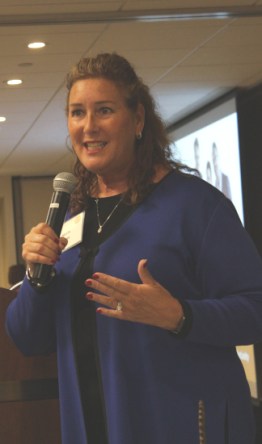
Maria White 11 28 18.Our Rotary speaker on November 28 opened by introducing herself with her full Latina name, including her given name, her Confirmation name, her father’s last name and her mother’s last name. Then she mentioned that she married a guy named Bill White and became Maria White. Born in Havana, Cuba, White is a new member of the Toledo, Ohio, Rotary Club. She is so new, in fact, that she hasn’t even attended one of their meetings yet. It was our luck to have her speak to our club. That’s certainly worthy of a make-up in Toledo!
White is the founder and CEO of a consulting firm called Inclusity, and she has worked with more than a dozen Fortune 500 CEOs and a myriad of senior leaders, managers and supervisors throughout North America and Europe to help them successfully increase diversity in their organizations. She congratulated our Rotary club for embracing a business model to increase inclusivity in our membership.

White walked us through an evolution of inclusivity work over the decades, beginning with the seemingly homogeneous society in the 1950s. Common themes were those of the “company man” and employment for life. Women were more likely to go into specific professions that did not create the kind of leadership that was recognized and rewarded. In largely white male-dominated workplaces the mantra was, “Work hard and you’ll get ahead.” Some of the intended outcomes of this culture were realized, including outstanding productivity. However there was also the unintended consequence that women, people of color and LGBT people were excluded and their potential to contribute to society was not realized.

Homogeneity gave way in the 1970s to a period focused on assimilation. Common themes were affirmative action and increased representation of women and people of color in organizations. The intention was to increase visible diversity without changing the culture. It was the time of “dress for success” in which women were encouraged to wear suits similar to men’s suits – except certainly not with pants! The success formula was, “Be like us. Work hard and you’ll get ahead.”

“That kind of assimilation causes you to give up on yourself and breeds resentment,” White said. “They wanted me to be like them.” This was very frustrating for White, and she didn’t realize until much later that the intentions of her superiors were to help her to “fit in” and be successful. The unintended consequence was that many workers decided they couldn’t or wouldn’t, and they left. The result is a brain drain.

This eventually led to an emphasis on diversity, with themes of celebrating differences (as opposed to assimilation) and creating opportunities. Employers offered what White referred to as “Fun, Food and Flags” events. The intention was to achieve numerical diversity targets. The unintended consequence of this approach is that some majority workers feel discriminated against, while women and minority workers feel exhausted from having to work harder to attain the same recognition.

In the long run, what we need is not just diversity but inclusivity, said White. That requires that we all – whether we are in the majority or not – understand that we are part of diversity. The guiding themes of inclusivity are a focus on maximum productivity, an acceptance of intentional inclusion and an awareness of unintentional exclusion.

Under the inclusivity model, all you need is decision-making that is based on shared values along with behavioral standards which define the organizational culture, she said. As an example of a shared set of guiding principles, she pointed no further than to Rotary’s own four-way test.

If you missed our meeting this week, you can watch the video here.

“How Are You Going to See Our Children?”

submitted by Ellsworth Brown; photo by Neil Fauerbach

IMG_4116

Judge Everett Mitchell pictured here with his mentor, Ms. Milele Chikasa Anana, who received our club’s Manfred E. Swarsensky Humanitarian Service Award at this week’s Rotary meeting.

Imagine the combined power of a preacher and the authority of a judge, connected by an unrelenting mission to lift up children who stand alone.  Now imagine the twenty-minute Rotary program this produced in reflection of and response to the career challenge that Judge Everett Mitchell was given via the question above, by the day’s Manfred E. Swarsensky award winner Ms. Milele Chikasa Anana, on the occasion of his installation as Circuit Court Judge in 2016.

But we didn’t have to imagine this.  It came to life with driven speed, intensity and the best desperation to help us understand how incapable the child welfare system, often following inevitably into the juvenile justice system and ultimately the criminal justice system, are to the task of repairing damaged lives, providing help and hope to those who enter these systems with no experience, no point of reference, no one to hear, no hand to hold, no ability to move beyond a closed loop.

Using poignant examples, Judge Mitchell spoke movingly of the power of restorative justice.  His source of language and guidance in court is Trauma and Healing Guide Resource, which speaks directly to the need for courts and the public to speak to a child’s future more than the past.  The absence of and critical need for mental health treatment was a frequent theme, as was the need to keep dreams alive as a replacement for the damages done to children, giving them voices.

The Judge spoke of the Court in partnership with the Madison Metropolitan School District, to open an Office of Youth Engagement.  He spoke of the need to raise the bar of the justice system’s practices, which are not yet equal to the focus on trauma.

The best expression of Judge Mitchell’s commitment to the power of his vision and the role of the Court was his closing word:  “I am not just their judge, I am their reflection.”  His life, once his nightmare, turned into his dream:  power of a preacher and the authority of a judge, bent to a consuming mission.

Lessons from Business Empress Martha Matilda Harper

submitted by Valerie Renk; photo by Pete Christianson

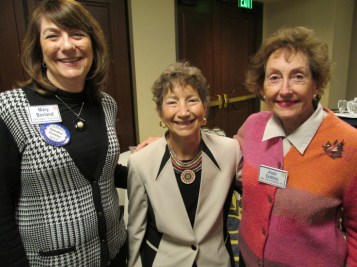
Jane Plitt 10 17 2018

From left: Rotarian Mary Borland, Guest Speaker Jane Plitt & Rotarian Joan Collins

Rotary and Martha Matilda Harper both want to make the world a better place, said October 17 Rotary speaker Jane Plitt.  Plitt highlighted how Harper, a poor Canadian servant for 25 years, became the American pioneer of modern retail franchising with 500 Harper Method Hair shops around the world catering to world royalty, US presidents, along with suffragettes.

Harper was born in Canada and put into servitude at age 7.  As she grew, she learned several business lessons.

Dream. She dreamed of success and marrying, although marriage would not release her from being a servant.

Stick to your Goals.  Her last employer was kind. He taught her about a product he designed to make hair stronger.  On his death bed, he bequeathed her the hair tonic formula.  With that formula, she believed she has the passport to change her life.  She moves to Rochester, New York, home to suffragists, entrepreneurs, and Quakers, a hot bed of activists. With about $300 in savings, she’s denied a building lease, until hiring a lawyer.

Capitalize on Your Assets. Her floor length hair, pictured on the door, drew in mothers of piano students from next door.  She offered them chairs, then drew them into to hear about her hair tonic.

 Understand and Delight the Customer.  Harper created the first reclining barber chair; this meant no soap in customers’ eyes and clothes were protected.

Create Buzz.  Famous customers such as Grace Coolidge and Bertha Palmer kicked off her fame.  Bertha drew her to open a second store in Chicago.

Commit the Customer.  Harper asked Palmer to come back with a list of 25 friends on a petition for her to come to Chicago.

Thinking Outside the Box.  Today we call this franchising, from the French “free yourself from servitude.”  After success franchising, she rethinks her anti-male beliefs and marries at 63 to a 39-year-old. She ends up with 500+ shops, two in Madison, five training schools, one also in Madison, and two manufacturing centers.

Treat Your Staff Well.  She advised franchisees to start staff meetings listening.  She believed it important to celebrate achievements.

In 1935, when Fortune Magazine was saying “a woman’s place is not in the executive chair,” Harper was proving she could make real money and success for her organization and her franchisees.

If you missed our meeting this week, you can watch the video here.

Rotary’s General Secretary: “We Are All Peacemakers”

submitted by Dave Mollenhoff; photo by Pete Christianson

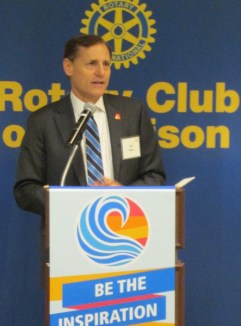
John Hewko 10 3 2018Rotarians were privileged to hear John Hewko, Rotary International’s General Secretary, talk about three global issues facing Rotary in the 21st century.
First, we must finish PolioPlus, even though we have been supporting this cause for 30 years.  Today, with the help of international partners including UNICEF, WHO, and Gates Foundation, the end is in sight.  Yes, Hewko admitted, we are experiencing donor fatigue, but we cannot move on to the next big project until we are successful with this one.  PolioPlus, he continued, has really put Rotary on the international map.  The remarkable infrastructure that we developed to deliver PolioPlus can be used for the next big campaign, he noted, but admitted that no decision had been made on what this would be.

Second, Rotary’s international membership has been stagnant at 1.2 million members for the last 20 years.  This is because membership in the U.S. has been declining, but membership in Asia and Africa has been increasing.  Faced with stagnant growth, Rotary must develop new products for today’s changing marketplace including experimenting with formats that depart from the club model.  Hewko also urged Rotarians to find ways to increase our impact on the world.   For example, our club could join forces with other Wisconsin clubs to do larger scale projects.

Third, Hewko urged us to recognize that “peace is at the center of everything we do.”  We do this by providing potable water, teaching better health practices, and eradicating disease.  Rotary International has recently joined forces with the Institute for Economics and Peace to focus grant programs on those that create the most enduring peace.

Hewko directs a staff of 800 employees at the RI headquarters in Evanston, Illinois and seven other international offices, and has served as general secretary since 2010.

Members from many Rotary Clubs in Southern Wisconsin also attended the talk.

If you missed our meeting this week, you can watch the video here.

“Bring Back Civics Education!”

submitted by Rich Leffler; photo by Pete Christianson

Luke Fuszard 7 18 2018

From left: Paul Ranola, Luke Fuszard and Rick Kiley

Luke Fuszard spoke to us this week on the decline of civics education, which he says places democracy at risk. Luke is a software engineer and has an MBA.  No civics background. But he does have two children, and he is concerned about the decline in civics education.

In 1954 Kentucky required three years of history and civics, and students had to pass a very tough statewide exam. Only nine states today require any such education, and Wisconsin is not one of them. The result is a predictable widespread ignorance. Ninety-seven percent of immigrants taking the [relatively easy] citizenship exam pass it. Thirty-three percent of native citizens who take the same test fail it. For most of American history, it was generally believed that solid civics and history knowledge was needed for people to be good citizens. That seems no longer to be the case.

Two occasions seem to have sped this decline in interest: (1) Sputnik in 1957; (2) the 1983 report, “A Nation at Risk.” Both incentivized the teaching of math and science, and as these expanded, history and civics courses were reduced. Middleton and Wausau still have robust civics programs. Wisconsin has recently adopted a statewide civics exam, but it is online and can be taken multiple times. And in 2012, all federal funds were shifted away from civics or history to math and science.

Why are civics and history important? Many math majors will never be mathematicians. Many science majors will never be scientists. But everyone will eventually be a member of the body politic. Since 1776, hundreds of thousands of people have given their lives in defense of our freedom and our democracy. The least we can do is to lobby our legislators to support civics education. Much civic behavior is learned in childhood: We should pass on to our children our belief in the importance of being an educated citizen, able to make informed political decisions.

Our thanks to Wisconsin Eye for videotaping our meeting this week.  You can watch the video here.