
submitted by Carol Toussaint; photo by Pete Christianson
 What will it take for Wisconsin to win the battle for economic growth fueled by entrepreneurship? Rotarians and their many guests left the Wednesday lunch with some specific ideas presented by Kevin Conroy, Chairman and CEO of Exact Science.
According to Conroy, Wisconsin is not inspiring start-ups. Our demographics are currently against inspiring start-ups and our demographics are holding us back. Our workforce is rapidly aging and shrinking. Median family income is flat. We are near the bottom in terms of net migration of college workers and we’re not building a promising young workforce. We need exciting companies to keep and draw exciting companies.
According to studies conducted by the Kaufman Foundation, Wisconsin is ranked last in the U.S. for start-up activity and Conroy stressed that start-ups create most new net jobs and are the key to success in the battle for economic growth. Venture Capital needs to be more readily available in Wisconsin if there is to be a change in status among the states. Currently three states–California, New York and Massachusetts–manage 83% of the nation’s venture.
What Conroy termed a “silver lining” is that experience from the last 3 years has been better for investment in new companies. Angel investors are providing significant help but there is a “funding gap” after angels. Without growth in next stage funding Wisconsin will continue to lag behind other states. Models to look at include a private sponsored venture capital model in Michigan and a Public-Private Partnership.
In speaking of the Company he heads, Conroy shared that Exact Science relentlessly pursued a solution to the big problem of colon cancer, partnered with the Mayo Clinic, focused on great science, raised nearly $2 billion, and had a direct lineage to the UW-Madison via Third Wave Technologies.
The company is expanding to a new campus which includes lab, manufacturing, and customer care services in the former Rayovac building and is expanding into new headquarters in University Research Park. To make the point that “start-ups matter”, Conroy summarized that the impact on Wisconsin from the start-up he heads provides $2 billion in capital and $29 million in taxes.

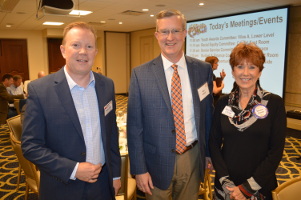


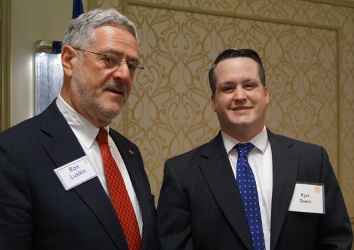 Professor Ryan Owens, a member of the UW Department of Political Science and an Affiliate Faculty of the Law School (and who is developing the Tommy Thompson Center on Public Leadership) spoke to the Club about “The Past, Present, and Future of the U.S. Supreme Court.” He began with an interesting “Thought Experiment.” With the addition of Neil Gorsuch to the Court, Justice Anthony Kennedy continues to be the middle or the median justice, often called the swing vote. But what happens if he retires, and if President Trump appoints a solid conservative such as Paul Clement, who is perhaps more conservative than Samuel Alito? In that case, the new median justice becomes Chief Justice John Roberts, who would then become the most powerful [influential?] Chief Justice since John Marshall. [Though he would be a very distant second.] If Ruth Bader Ginsburg were then to retire, Justice Alito would become the median justice. On the other hand, if Hillary Clinton had been elected, Justice Stephen Breyer might be the swing vote, etc. Very easily, a 6-3 conservative court under Trump might have been a 6-3 liberal court under Clinton. The presidential election of 2016 was, then, a very consequential election.
 Rotary Club of Madison, Wisconsin